July 17, 2026
The Trade Everyone Ignored All Year
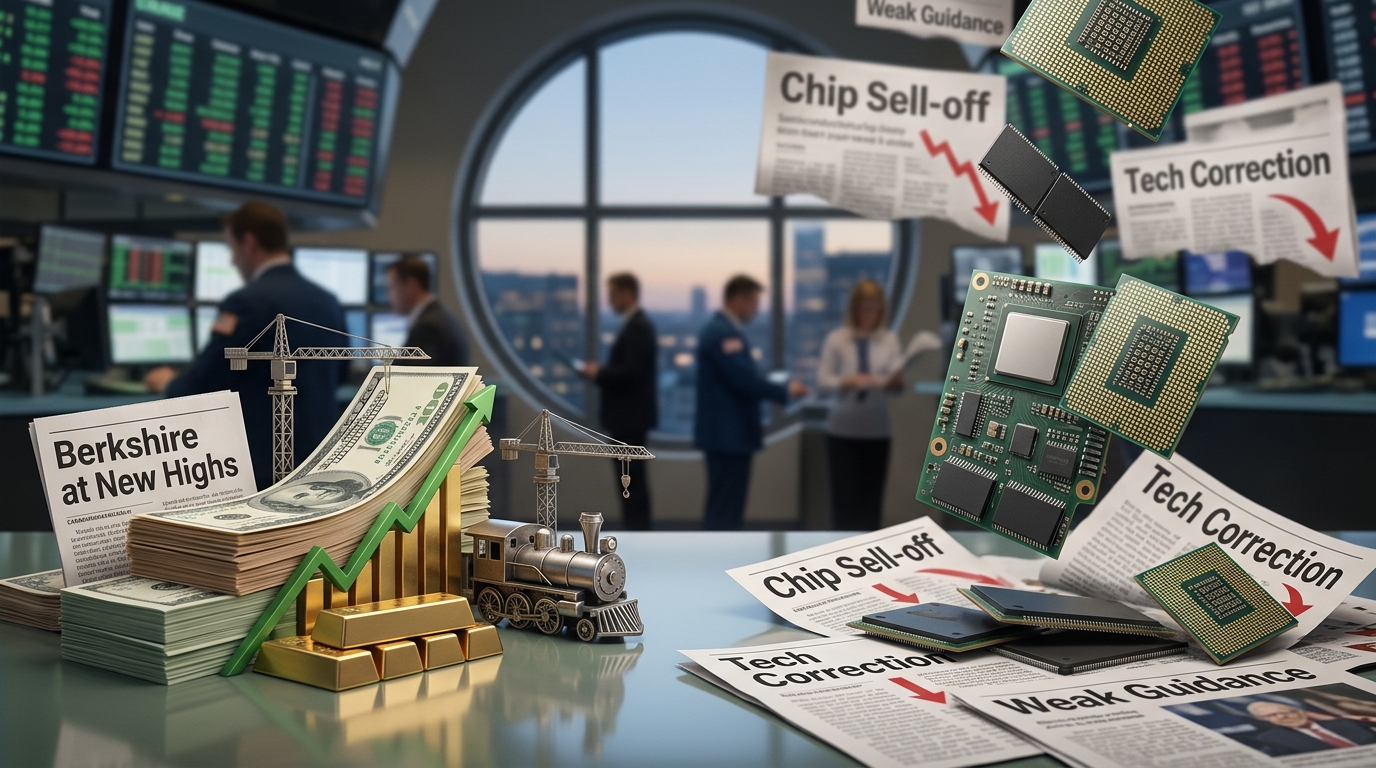
Berkshire Hathaway is rising while chips fall hard.
Analyst Targets (BRK.B)
- UBS: Buy | Target $540
- Barclays: Overweight | Target $530
- TD Cowen: Buy | Target $525
- Raymond James: Outperform | Target $520
- Financhill 12-month historical model: $559.89
There is a rotation happening in real time, and most investors are looking at the wrong end of it.
The chip selloff is dominating every headline. Since June 22, Yahoo Finance’s nearly 60-stock semiconductor basket has lost roughly $2.1 trillion in market value, with a median decline of 21%. The Philadelphia SE Semiconductor Index is down 11% this week alone — on pace for its largest weekly fall since March 2025 — and has dropped nearly 24% from its late-June all-time high, putting it on the verge of confirming a bear market. The selling is indiscriminate. Memory, GPU designers, equipment makers, foundries. All of it.
Louis Navellier: Don’t buy OR sell another AI stock…
Until you’ve heard this urgent AI warning from the man who called Nvidia before its 44,000% rise…
According to Louis, a massive reset is coming in an obscure corner of the AI market.
This $100 trillion disruption could send some of the world’s biggest AI stocks to zero… and one off-the-radar stock soaring… starting now.
And right in the middle of all that damage, one stock went up on Friday.
Berkshire Hathaway climbed more than 1% on Friday, outperforming the broader market as investors rotated into defensive stocks amid a technology-led selloff. The move higher contrasted with steep declines across semiconductor and artificial intelligence stocks, as investors sought the relative safety of Berkshire’s diversified portfolio of insurance, energy, railroad and industrial businesses.
This is not just a one-day bounce. It is the beginning of a broader story that has been building since January 1, 2026 — the day a new era at Berkshire quietly began.
The Market Opportunity
Capital rotation at this scale does not happen quietly. While the VanEck Semiconductor ETF plunged 5.1% in a single session, the Dow Jones Industrial Average paradoxically reached record territory above 53,000 — a divergence that signals a fundamental shift as capital rotates aggressively out of high-valuation technology stocks and into industrials, financials, and defensive sectors.
Investors are locking in massive AI-driven profits and seeking better-priced opportunities in value stocks that offer robust dividend yields and stable earnings growth. First-half AI winners are losing momentum because their valuations became stretched far beyond near-term earnings potential.
The part that matters: when money leaves a crowded trade at this speed, it has to go somewhere. And right now, a meaningful slice is going exactly where you’d expect it to go when uncertainty spikes — into a company sitting on almost $400 billion in cash, run by a disciplined capital allocator, and trading at a reasonable multiple to book value.
AI euphoria has subsided, and the once high-flying chip and memory stocks appear to have gotten ahead of fundamentals. As investors look beyond AI stocks, names like Berkshire are beginning to see renewed buying interest.
Why Berkshire Hathaway
For the first time in six decades, Berkshire Hathaway is run by someone other than Warren Buffett. Greg Abel took over as CEO at the start of 2026, and his first months have given investors plenty to think about — most notably a record cash pile of approximately $397 billion at the end of the first quarter, up from $373 billion at year-end 2025. That war chest is equal to more than a third of the company’s $1.1 trillion market value.
That cash is not sitting idle.
In his first big deal, Abel agreed to buy homebuilder Taylor Morrison for $6.8 billion at a 24% premium, and steered Berkshire into an unusual place for a firm that long avoided technology: a $10 billion private placement in Alphabet, taken at a discount, pushing its stake in the Google parent past $26 billion. Abel also resumed share buybacks in March 2026 at roughly $234 million, the first repurchase activity in 21 months.
What’s interesting here is the combination. Abel is deploying capital after 21 months of patience, at a moment when asset prices in his preferred categories — quality businesses at fair prices — are becoming available again as the AI froth clears. That is not a coincidence. That is the Buffett playbook being executed by a successor who clearly absorbed it.
Friday’s gains were also fueled by growing optimism that Berkshire stepped up share repurchases in the second quarter. Barron’s estimated the company may have bought back between $5 billion and $11 billion of its own stock during the period. If confirmed, that would represent a significant acceleration from the $234 million repurchased in Q1 — and a strong signal that Abel sees the current valuation as compelling.
Competitive Advantage
Berkshire’s moat is structural. The insurance float alone — hundreds of billions in low-cost capital generated by GEICO, General Re, and its other insurance operations — gives Berkshire an investment engine that no other conglomerate can replicate. That float funds the equity portfolio. The equity portfolio compounds. The operating businesses generate free cash. It is a self-reinforcing machine built over 60 years.
The operating portfolio spans BNSF Railway, Berkshire Hathaway Energy, GEICO, See’s Candies, Dairy Queen, and dozens of industrial and consumer brands. Berkshire screens as undervalued on most checks, with the broader toolkit indicating the stock looks cheap against fundamentals in 5 of 6 valuation tests. Berkshire’s price-to-book value multiple sits at approximately 1.51 times — having peaked around 1.8 times last year, the valuation has compressed as the share price has come down while book value has grown.
Slight tangent, but it matters. One of the most overlooked components of the Berkshire story right now is the Alphabet stake. Abel steered Berkshire into a $10 billion private placement in Alphabet at a discount, pushing the stake past $26 billion. For a company that spent decades explicitly avoiding tech, this is a meaningful signal about how Abel views the next chapter.
“A Dangerous Financial Plan Unfolding in D.C. Could Cost You 40% of Your Wealth”
Former Goldman Sachs executive who traded through Black Monday warns this plan is all written down in black and white, spearheaded by a financial insider who infiltrated the Federal Reserve… It’s gone “viral” in the hedge fund circles… and yet practically nobody on Main Street understands this financial shock playing out across America. He lays out all the evidence… plus a detailed roadmap for exactly what to do. (And it doesn’t require shorting… options… or perfectly “timing the market.”)
The Alphabet position is particularly well-timed. While the market dumps semiconductor stocks over AI spending concerns, Alphabet is a hyperscaler — a beneficiary of AI adoption, not a hardware supplier exposed to the capex overcapacity fears now weighing on chip stocks. Abel bought access to the AI cycle from the demand side, at a discount. That is a smarter entry point than most.
The Numbers
- Cash and equivalents (Q1 2026): approximately $397 billion — a new all-time high
- Market capitalization: approximately $1.1 trillion
- Price-to-book value: approximately 1.51x (below recent historical range of 1.6–1.8x)
- Q1 2026 share buybacks: $234 million (first in 21 months)
- Estimated Q2 2026 buybacks: $5 billion to $11 billion (per Barron’s estimates)
- Taylor Morrison acquisition: $6.8 billion at a 24% premium
- Alphabet private placement stake: more than $26 billion
- BRK.B 52-week range: $455.19 to $516.85
As of early July, Berkshire’s B shares are down approximately 1.8% year-to-date — trailing the S&P 500’s 10.7% gain. That underperformance is actually the opportunity. The stock sat out the AI rally entirely, which means it did not participate in the AI selloff either. It is one of the few large-cap names in the U.S. market that is essentially unchanged on the year while the most crowded trade of the cycle corrects 20% to 25%.
Why the Stock Is Moving Now
The chip selloff is the ignition, but the fuel was already in place.
The July 2026 selloff represents more than a temporary correction — it signals a potential regime change in how investors value AI infrastructure stocks. For two years, the market applied a scarcity premium to any company involved in AI chip production, pricing stocks based on the assumption that GPU supply would remain perpetually constrained while demand exploded.
That scarcity story started cracking when reports emerged that Meta Platforms plans to launch a cloud business unit to sell surplus AI training and inference capacity. If hyperscalers have excess capacity to sell, the AI hardware supply/demand story looks very different. And when that story changes, the multiples on chip stocks contract fast.
Berkshire does not own chip stocks. It does not have AI hardware exposure. Markets’ obsession with artificial intelligence is actually the reason behind Berkshire’s underperformance earlier this year, as investors moved funds away from names like Berkshire and toward AI names. That same dynamic is now running in reverse.
Macro Context
The sharp semiconductor selloff and concurrent rotation into industrials, financials, and defensive sectors signals a fundamental shift in investor preferences that may persist for an extended period. While the long-term prospects for AI and digital transformation remain compelling, the near-term outlook for technology stocks has become considerably more challenging as valuations normalize and growth expectations recalibrate.
Rate policy adds another dimension. Softer employment data has reinforced expectations that the Federal Reserve will remain on hold, supporting the broader market while reducing the relative appeal of high-duration growth stocks. That environment favors Berkshire’s earnings model — the company earns enormous interest on its $397 billion cash pile, and its operating businesses generate consistent free cash flow that does not depend on multiple expansion to deliver returns.
Geopolitics matter too. Berkshire’s largest operating business, BNSF Railway, moves freight across the country. That business is not exposed to export controls, chip licensing restrictions, or Taiwan Strait tensions. It moves grain, coal, automotive parts, and consumer goods. It is not a geopolitical bet. It is the infrastructure of the American economy.
Bull / Base / Bear Scenarios
Bull Case
Abel deploys a significant portion of the $397 billion cash pile into one or more large acquisitions at attractive valuations during the AI-driven market dislocation. Buybacks in Q2 come in at the high end of estimates ($8 billion to $11 billion range), compressing the share count. The rotation into quality and value persists through year-end, compressing the gap between Berkshire’s price-to-book and its historical average. Target: $540 to $560.
Base Case
Buybacks continue at a measured pace. Abel makes one additional mid-sized acquisition. Berkshire’s insurance operations remain profitable. The company reports solid Q2 operating earnings when results arrive in early August. The stock closes the year-to-date gap with the S&P 500, settling in the $510 to $525 range as the rotation trade extends through the summer.
Man Who Called 2025 Crash Warns of October 27th
An imminent turning point in the stock market could double your money on a move greater than any we’ve seen yet this year. This move has occurred 100% of the time over the last 15 years, according to the fintech CEO who called the 2025 crash and rally – 3 months before it unfolded.
Click here for his full warning (and a free recommendation).
Bear Case
A major catastrophic loss event hits Berkshire’s insurance operations, pressuring book value. Abel’s large acquisitions (Taylor Morrison, Alphabet) underperform expectations. If the market reverses and the AI trade resumes strongly, Berkshire’s relative underperformance reasserts itself. Price-to-book remains compressed near 1.3 to 1.4 times. Stock stalls in the $460 to $475 range.
Technical Overlay
BRK.B’s 52-week high is $516.85 — approximately 5.8% above the current price — while the 52-week low is $455.19, roughly 6.8% below current levels. The stock is effectively range-bound between those levels, which gives it an unusually tight risk/reward profile relative to most of what is trading in this market right now.
The stock is holding above its 50-day and 200-day moving averages even as the Nasdaq rolls over. That relative strength is not noise. When a stock holds its moving averages during a broad technology selloff, institutional money is defending a position, not exiting one. The Q2 buyback data, expected when second-quarter results arrive in early August, will be the next meaningful price catalyst.
What Investors Should Watch
- Q2 2026 earnings (expected early August): the magnitude of share repurchases will be the key data point
- Any additional acquisition announcements from Abel — the $397 billion cash pile creates optionality that few companies on earth can match
- 13F filings: watch for new equity additions or position increases that signal where Abel is directing capital
- Berkshire Hathaway Energy regulatory developments: ongoing utility rate case outcomes could affect book value
- Continued capital rotation out of tech: every dollar that leaves semiconductor ETFs needs a home, and quality/value names are the logical destination
- Taylor Morrison integration: housing-related earnings will begin flowing through in the back half of 2026
The Risks
This is worth taking seriously. Berkshire’s return trails that of the S&P 500 Index by more than 20 percentage points over the last three years — broadly the timeframe in which AI has been the dominant investing theme. If the AI trade reasserts itself after this pullback, Berkshire’s underperformance could persist. The stock does not have a growth catalyst. It has a capital allocation catalyst — which is different, and slower.
There is also an Abel execution risk. While Abel’s recent capital moves — including the Taylor Morrison acquisition and resumed share buybacks — support the investment case, execution risk around large housing and AI-related investments may limit how much of that value the market is willing to pay for in the near term.
And the Buffett discount is real. There was always a “Warren Buffett premium” built into Berkshire shares, and after the nonagenarian announced that he would step down as CEO, that premium began to wither. Abel has made smart moves, but he has not yet earned the same unconditional trust from the market that Buffett commanded. That takes time.
Bottom Line
The debate around Berkshire is not whether the business is good. It clearly is. The real question is whether the Greg Abel era produces a meaningful rerating of the stock over the next 12 to 18 months.
Here is the case for yes. Abel inherited a record cash pile. He is deploying it selectively and intelligently — a housing bet, an AI-adjacent tech stake, buybacks resuming at a moment of valuation discipline. He is doing it at the exact moment when the most crowded trade in the market is unwinding, which means the capital rotating out of chip stocks needs somewhere to go. And Berkshire, sitting at roughly 1.5 times book value with a $397 billion cash position and a diversified earnings engine that does not depend on AI capex, is one of the most logical destinations in the market right now.
The thesis does not require a macro call. It does not require AI to fail. It only requires investors to ask the question they have been avoiding since early 2023: what do I own if the crowded trade stops working?
Berkshire Hathaway is the answer a lot of portfolios are arriving at this week.
The Death of the Nasdaq?
Wall Street legend Marc Chaikin’s award-winning system turned bearish on software stocks two months before they crashed this year. Now, he’s warning that one AI lab’s breakthrough could CRASH the Nasdaq while igniting a $500 trillion wealth transfer. He’s found a little-known $40 “pre-IPO backdoor” into the private startup behind this economic sea change.
For informational purposes only.