August 1, 2026
The $2.4 Trillion AI Bet Is Splitting in Two
Featured: The $2.4 Trillion AI Bet Is Splitting in Two
Dear Reader,
Have you ever wished you could see what the price of Nvidia would be a week from now?
Wall Street spends millions trying to figure out the answer.
They calculate prices with super computers…
They fly teams around the world for boots on the ground research…
And hire massive teams of analysts.
A Main Street investor just couldn’t keep up.
That’s because a new kind of AI is levelling the playing field.
A new way to use AI is letting main street forecast the price of over 2,334 stocks…
Up to 21 days in the future.
And it’s unlocked a new style of investing that beats out “buy-and-hold” five to one.
Best of all, you don’t need to be a hedge fund or a millionaire to do it.
It operates on the same principle that lets storm watchers track hurricanes from their personal computers.
With more accurate results than the most advanced government models in the world.
Only instead of predicting hurricanes… these folks are turning AI’s predictive power to the stock market.
I want to give you the top five stocks this AI is recommending today for free.
But I also want you to understand exactly how you can use AI to inform all of your own trades moving forward.
That’s why I put together this brief demo showing exactly how this AI works…
How a bizarre MIT discovered phenomenon makes it VASTLY different from Chat-GPT and more uniquely suited to looking at stocks…
How it forecasts prices to the penny up to 21-days in the future…
And exactly how it could help you grow your account.
Click here to watch the Predictive AI demo now.
Keith Kaplan
CEO, TradeSmith
The $2.4 Trillion AI Bet Is Splitting in Two
The number that defined earnings season this week was not a revenue figure. It was not an EPS beat or a guidance raise. It was $2.4 trillion: the combined purchase commitments, contractual obligations, and long-term leases that Alphabet, Amazon, Meta, and Microsoft have locked in for AI infrastructure, a figure Bloomberg reported in late July.
But the more important story is what happened after the checks were written. This week’s results exposed a split inside that spending wave that the headline number obscures entirely. Some of this capital is already converting into margin-expanding, backlog-building, cash-generative revenue. Some of it is burning through free cash flow with no near-term answer for when the math turns.
That gap is where the investment opportunity lives.
The Commitments Are Real. The Returns Are Uneven.
Start with the scale. Alphabet leads the group with $811 billion in contracted future spending commitments as of the end of June, a figure Bloomberg reported surged sharply over the prior quarter. Meta follows with hundreds of billions in future obligations tied to its AI buildout. Amazon now expects 2026 capital spending to total $220 billion. Microsoft’s capital spending is also rising sharply as it adds AI data center capacity.
Citigroup has raised its long-range forecast to more than $2.8 trillion through 2029, up from a prior estimate of $2.3 trillion, citing aggressive early investments and growing enterprise demand. Citi now sees AI capex across hyperscalers reaching $490 billion by year-end 2026. Every number in this cycle keeps getting revised upward.
But here is what the aggregate disguises. The spending is producing radically different financial outcomes depending on which company you examine.
Two Companies Are Cashing the Check
Amazon reported Q2 2026 results Thursday that reframed the debate. AWS revenue surged 37% and marked its fastest growth in 18 quarters. In a statement, CEO Andy Jassy said Amazon’s AI and chips businesses each crossed an annual revenue run rate of more than $25 billion. Jassy also said demand for 2028 capacity is already striking. Amazon now expects 2026 capital spending to total $220 billion.
Microsoft told a similar story a day earlier. Azure and other cloud services revenue increased 43% in its latest quarter. Commercial remaining performance obligations stand at $627 billion, according to Microsoft’s filings and earnings materials.
Alphabet’s Google Cloud grew 82% in Q2, reaching $24.8 billion, with its cloud backlog jumping by more than $50 billion in a single quarter to $514 billion. Google Cloud’s operating margin expanded to 35.6% from 20.7% a year earlier. That margin expansion matters: it means the infrastructure spending is producing not just revenue growth, but accelerating profitability.
These are the returns the bull case was built around. They are showing up in real numbers.
One Company Has a Different Problem
Meta’s Q2 told a harder story. Advertising revenue was about $59 billion, and strong by any traditional measure. But free cash flow fell to $784 million for the quarter, a 91% collapse year over year. Shares fell in after-hours trading.
The market’s reaction was not about the ad business. It was about the financing question. Meta has guided full-year 2026 capex to $130 billion to $145 billion. Mark Zuckerberg framed this as funding for superintelligence. Investors, watching operating cash increasingly disappear into data center construction, want to see the same proof that AWS and Azure have already delivered: that the capacity will be monetized faster than it is built.
Meta does not yet have a cloud business that provides that visibility. Its AI spending is defensive and strategic, but the revenue pathway back to investors is longer and less direct than it is for Amazon or Microsoft.
The Constraint Nobody Is Pricing Correctly
The spending commitments are locked in. The accounting smooths the cost over years through depreciation. But the physical constraint sitting underneath all of this is not in a financial statement. It is in the ground.
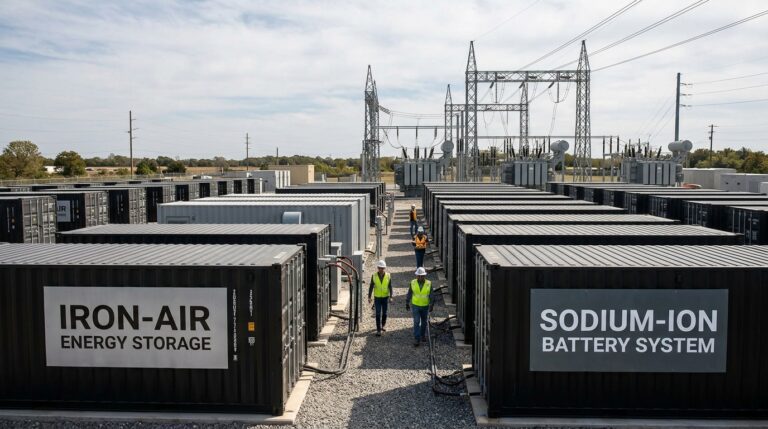
AI-optimized racks now require roughly 50 to 100 kilowatts of power, compared to 5 to 10 kilowatts for traditional racks. High-voltage substation lead times can run years. Morgan Stanley forecasts a shortfall of roughly 49 gigawatts in available U.S. power access by 2028, against projected data center demand of 74 gigawatts. Interconnection delays in some regions can extend for years.
This is the binding constraint on the commitment. The capital is committed. The chips are on order. The land is being acquired. But the electrons to run the facilities are not guaranteed to arrive on schedule. That dynamic is driving hyperscalers toward behind-the-meter power, nuclear offtake agreements, and direct investment in grid infrastructure. On March 4, 2026, hyperscalers signed a White House “Ratepayer Protection Pledge” to bear the costs of electricity generation and delivery infrastructure upgrades for their data centers, acknowledging they can no longer be passive consumers of public infrastructure. It is an unusual posture for software companies.
Investors pricing only the semiconductor supply chain are missing half the bottleneck.
The Investment Framework
The commitment does not represent uniform risk. It represents a spectrum.
At one end: companies whose AI spending is already producing measurable, margin-expanding, backlog-supported returns. AWS is accelerating. Google Cloud’s margin expanded nearly 15 percentage points. These businesses are past the question of whether the investment pays off. The debate has shifted to how fast and for how long.
At the other end: companies whose free cash flow is under severe near-term pressure with a less direct revenue feedback loop. The risk is not that the AI opportunity fails to materialize. The risk is the timeline, and whether the balance sheet can absorb the wait.
Citi’s analysts noted that hyperscalers are “no longer relying only on profits to fund AI infrastructure,” with some borrowing to keep pace. The cost of this buildout is large enough that the financing structure underneath these commitments is changing as fast as the infrastructure itself.
What to Watch
Three developments will determine whether the next leg of this cycle rewards patience or punishes it. First, whether AWS and Azure can sustain the revenue-versus-capex ratio that justified this week’s stock moves. Jassy’s framing was precise: once revenue growth outpaces incremental capex growth, the resulting cash flow becomes compelling. Both companies showed that crossover is happening now. Second, whether Meta’s AI investment surfaces a direct monetization pathway, or whether it remains stranded capital in pursuit of a model that has not yet been proven at scale. Third, whether the power grid can keep pace with the commitments already on paper. The capital is deployed. The electrons are the variable.
Final Verdict
The $2.4 trillion headline is the wrong frame for investors. The right frame is the split inside it. Amazon and Microsoft have answered the most important question in this cycle: the spending produces returns. Alphabet is answering it in real time, with margin expansion at Google Cloud that was not visible a year ago. Meta is still writing the question.
The AI infrastructure buildout is not a bubble argument or a bull argument. It is a return-on-capital argument, and this week’s earnings gave investors the clearest data yet on which side of the ledger each hyperscaler actually occupies. The companies whose cloud backlogs are growing faster than their capex commitments deserve a different conversation than those still asking their investors to wait.
That distinction is where the highest-conviction ideas in this cycle are hiding.