
September 6, 2026
Bonus Content: GM and Ford Pitch New Customers: Defense and Grid Storage
Editor’s Note: What is the final phase of Elon Musk’s master plan – and why could it mean a massive payday for anyone taking advantage of this ONE ticker? Our friend Larry Benedict, a hedge fund legend who made over $274 million for his clients, says he has the answer. Click here to see the details.
Dear Reader,
After PayPal. After Tesla. After SpaceX.
Elon Musk is now preparing to execute the final phase of one of the most ambitious plans in history.
Click here to discover exactly what he’s planning – and the ONE ticker that could benefit the most.
According to Larry Benedict – the man who delivered a 279% return on cash in 2025 while the S&P returned just 15% – when the “Final Phase of Elon’s Master Plan” is triggered, it could move more money than anything Elon has ever done before.
We’re talking billions – potentially trillions – of dollars flowing into a single ticker.
It’s not Tesla. It’s not SpaceX. It’s not crypto, or AI, or anything Wall Street is currently talking about.
But when the “Final Phase” kicks in, Larry believes it’s positioned to capture the surge.
He’s revealing the name and ticker today – completely free.
Regards,
Lauren Wingfield
Managing Editor, The Opportunistic Trader
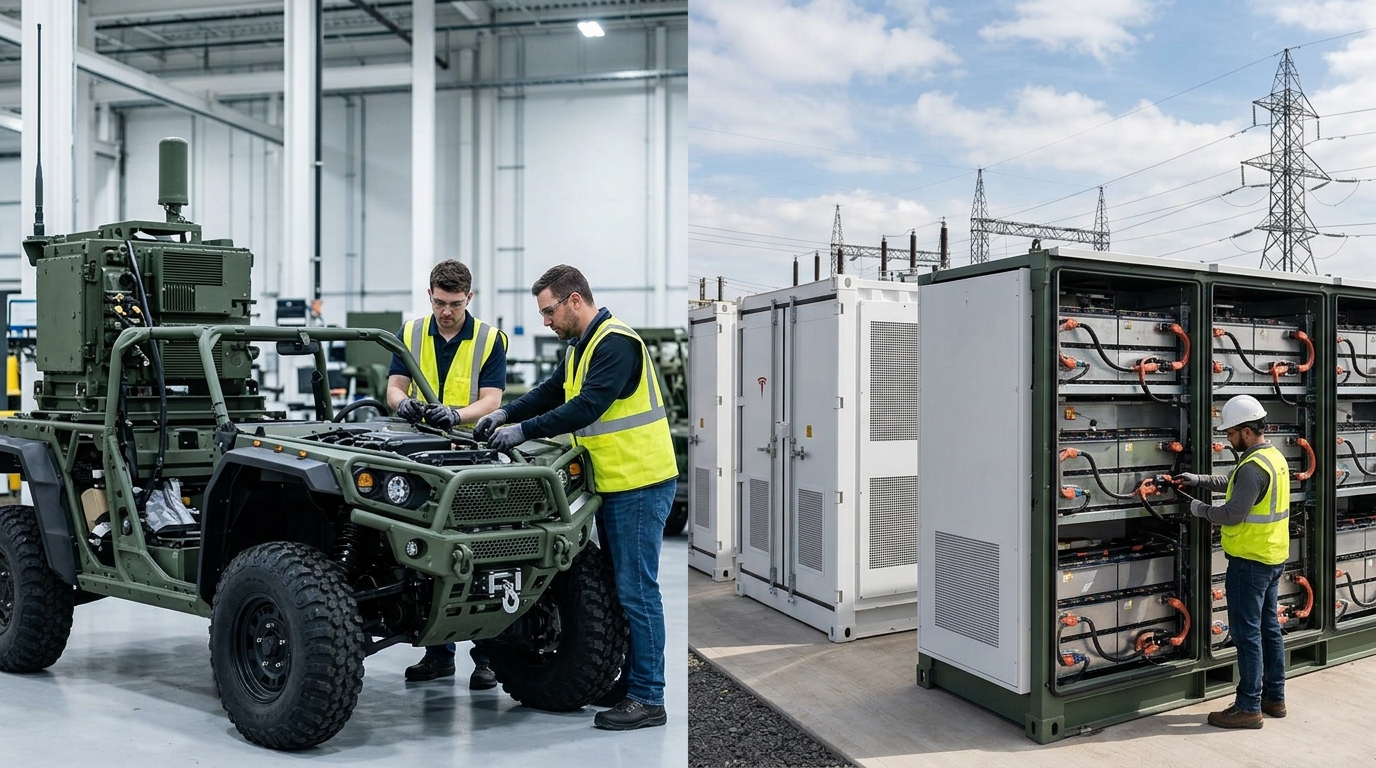
GM and Ford Pitch New Customers: Defense and Grid Storage
The core auto business is under pressure. J.D. Power and GlobalData’s August outlook pointed to total U.S. new-vehicle sales down about 4.8% year over year, with retail sales off 6.9% on a selling-day-adjusted basis. Battery-EV share also appears to have cooled versus last year, with industry trackers putting August EV mix in the mid-single digits to high-single digits as the federal EV purchase credit has rolled off for many buyers and models. Against that backdrop, General Motors and Ford each moved this week to frame diversification as something more than a pivot story. They want it reflected in the consensus.
The question worth answering here is specific: what are GM’s defense line and Ford’s energy storage effort actually worth against the financial hole each company is carrying?
GM Defense: Real Revenue, Real EBIT, Still Small
On its 2026 guidance and commentary, GM has said it expects GM Defense 2026 revenue to grow to almost $700 million and is targeting positive results on an EBIT basis this year, while also building a backlog of future business. That is not a rounding error, but it needs context: GM reported $48.0 billion in revenue in the second quarter of 2026. On that math, a $700 million annual defense run-rate is still small next to the core business, and it is closer to 1.5% of a single $48 billion quarter than it is to anything that moves consolidated revenue by itself.
The more consequential development is the Lockheed Martin partnership. Lockheed Martin and GM Defense announced a collaboration on June 16, 2026 to strengthen America’s manufacturing and defense industrial base under a memorandum of understanding, with the stated intent to explore opportunities that combine Lockheed’s defense production expertise with GM’s high-rate commercial manufacturing and engineering capabilities. The key detail for investors is also the limiting one: at the time of the announcement, the companies did not disclose specific programs or contract awards tied to the MOU.
Understanding what it actually takes to win and execute on defense contracts adds important context here. The defense industrial base is facing hard supply-chain constraints that will shape which partnerships translate into awarded programs and which remain on paper — a closer look at the Pentagon’s manufacturing deadlines and which suppliers can realistically meet them helps frame how much runway GM Defense actually has to convert MOU language into contracted revenue.
That last point is the one that belongs in the model. The MOU creates optionality, not cash flow. If GM Defense can scale toward $1 billion and sustain EBIT-positive results, it deserves a standalone multiple. At defense sector comps in the 15x-18x EBIT range, even $50 million of defense EBIT is worth $750 million to $900 million in enterprise value, roughly 2% of GM’s current market cap. Meaningful, not transformational, not yet.
Ford Energy: The $4 Billion Hole and the 2027 Hope
Ford’s situation is structurally different and harder to frame positively in the near term. Ford has guided to a roughly $4.0 billion to $4.5 billion loss in its Model e segment for 2026, and it has said it is targeting a path to breakeven for Model e in 2029. Any stationary storage upside lives under that umbrella for now, which means any value the market assigns to storage tends to be discounted against a segment that is still losing money.
Ford has described stationary battery storage as a higher-return growth opportunity and has signaled meaningful investment tied to that effort. The company has also reshuffled its Kentucky battery-plant ownership and related obligations in 2026, and has pointed to battery energy storage as part of the strategy mix going forward. What is hard to underwrite today is the near-term revenue contribution: absent confirmed shipment volumes and contracted pricing, stationary storage remains more of a 2027 and 2028 execution question than a 2026 earnings lever.
That is why the market is right to be skeptical. Competitors including Tesla’s Megapack line and Fluence Energy (FLNC) already have installed bases, service networks, and proven delivery track records. Intense competition from established energy storage leaders like Tesla and Fluence is a direct risk. GE Vernova (GEV) is expanding grid infrastructure exposure from the transmission side. Ford is entering a crowded field, and the bar is not a concept slide deck. It is deliveries, uptime, and service economics.
The scale of infrastructure spending flowing into AI data centers is one reason grid storage demand is growing fast enough to attract new entrants like Ford in the first place. Dell’s $95 billion AI backlog and what it signals about infrastructure capital spending illustrates just how large the power and storage opportunity has become — and why incumbents with installed service networks hold a structural advantage over late arrivals still building their first delivery track record.
What Each Is Worth in Today’s Consensus
GM Defense at roughly $700 million in 2026 revenue, turning EBIT-positive, deserves to be carried at a 1x revenue multiple as a floor given its early-stage government contract profile. Call it about $700 million of value sitting outside the core auto valuation. The Lockheed MOU extends that option, but the timeline to contract wins and scaled production is still likely measured in quarters, not weeks.
Ford’s stationary storage effort is worth close to zero in the 2026 model because it contributes little to no recognized revenue today and the surrounding segment is absorbing roughly $4.0 billion to $4.5 billion of losses. By 2028, if Ford ships at utility scale with credible service economics, the standalone valuation argument becomes legitimate. Today it is not.
Bottom Line
Both markets are likely to be small portions of each company’s revenue for the foreseeable future, but they can diversify exposure as new-vehicle demand slows. GM’s defense unit is the more mature asset: it has revenue, it is aiming for EBIT-positive performance, and the Lockheed partnership gives it a credible path to scale. It is worth a modest positive revision to GM’s through-cycle valuation.
Ford’s storage bet is strategically coherent, but the financials do not support a rerating today. The Model e loss outlook is the number that governs Ford’s stock in 2026. Stationary storage is a 2027 to 2028 execution story. Investors who treat it as a 2026 catalyst are pricing in shipments and economics that have not been proven yet.