Frontline posted the best quarterly profit in its history last week. War-risk insurance is moving again to remind investors why that number has an expiration date stamped on it.
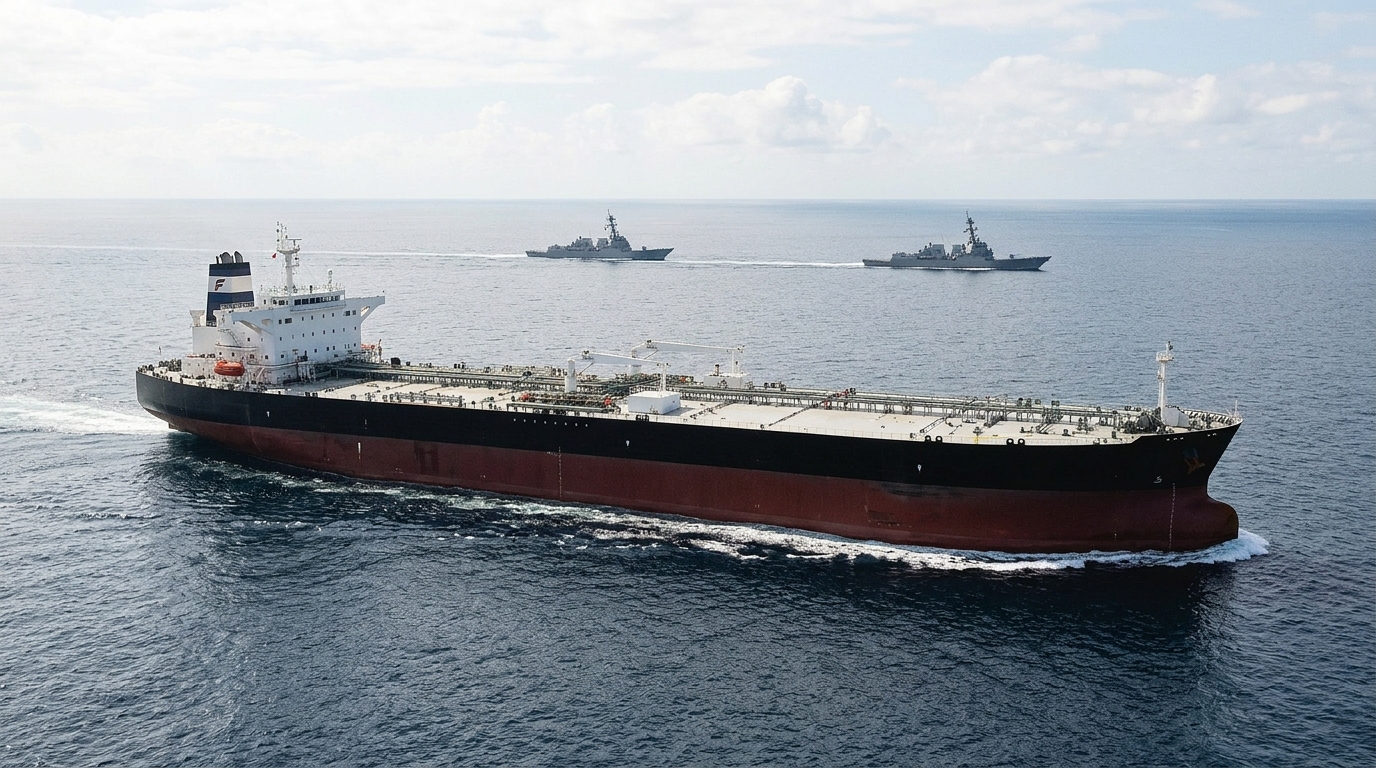
The United States and Iran escalated tit-for-tat attacks over the past 24 hours, with Washington targeting three Iranian oil tankers and Tehran firing ballistic missiles toward US Navy warships operating near the Strait of Hormuz. US Central Command said US forces “permanently disabled” two Iranian crude oil carriers and “completely destroyed” a third unladen tanker after Iran’s Islamic Revolutionary Guard Corps launched ballistic missiles toward a US aircraft carrier and a guided-missile destroyer. Iran, for its part, said it struck vessels it described as using an “unauthorised route.” Both navies are now shooting at the same waterway that Frontline depends on.
Frontline reported its best quarterly profit ever of $659.2 million for the second quarter of 2026, and the best adjusted profit ever of $580.2 million, on revenues of $943.3 million. Revenue rose 96.5% year over year, beating the roughly $759 million consensus estimate by a wide margin. Average daily spot time charter equivalent rates reached $152,700 for VLCCs, $111,500 for Suezmax tankers, and $92,400 for LR2/Aframax vessels. Those are not normal numbers. They exist because the strait’s disruption rewired global crude flows, forcing oil onto longer routes and driving ton-mile demand sharply higher.
Frontline estimated crude exports from inside the Strait of Hormuz had fallen 82%, while idling days per VLCC increased 23% because of trade-related delays and logistical inefficiencies. That is the paradox at the center of this trade: the crisis that cratered Hormuz throughput simultaneously inflated the rates that operators charge for every barrel that does move. Ship-to-ship transfers, longer-haul routes, and vessel delays have reduced effective tanker supply and increased ton-mile demand, helping sustain elevated rates despite lower crude-export volumes.
The insurance layer is where weekend events hit the income statement most directly. War-risk shipping insurance premiums have surged as high as 10% of hull value per transit, up from roughly 0.10% to 0.25% before the war. A $100 million tanker can face war-risk premiums of $3 million to $10 million per transit, compared with roughly $100,000 to $250,000 prior to hostilities. Marcus Baker, global head of marine, cargo, and logistics at Marsh, told S&P Global in July that additional war-risk premiums in the region had jumped from 1%-3% of hull value weeks earlier to 7.5%-10% at the peak. With Saturday’s exchange of fire, that range is being tested again.
The bull case is still intact, barely. For Q3 2026, Frontline had already booked 86% of VLCC days at $156,900 per day, 79% of Suezmax days at $117,400, and 70% of LR2 days at $81,000. Based on the current fleet, contracted rates, and average spot rates as of August 28, the company estimated annual cash generation potential of $2.3 billion, or $10.35 per share. The company ended June with $1.2 billion of liquidity and no meaningful debt maturities until 2030. The balance sheet is not the concern.
The bear case is also concrete. Within 48 hours of the February 28 strikes, major marine insurers terminated existing coverage and offered replacements at roughly 60 times pre-crisis rates, and Lloyd’s Joint War Committee redesignated the entire Arabian Gulf as a conflict zone. If underwriters reach a similar conclusion in the coming days, operators face a binary outcome: pay premiums that consume the rate advantage entirely, or park ships and collect nothing. The sharp increase in war-risk insurance costs threatens to further disrupt crude flows from the Persian Gulf, where strikes on multiple tankers have prompted some shipping companies to halt or limit operations through the strait.
FRO shares last closed at $46.13, with the company carrying a market cap of about $10.27 billion and a P/E ratio of 6.91. The stock is up roughly 111% year to date. At a P/E below 7, the market is already discounting duration. What investors need to watch is whether this weekend’s exchange marks an acceleration toward full strait closure or a continuation of the managed chaos that has, so far, kept rates high and Frontline’s ships sailing. The answer will not show up in the oil price first. It will show up in the Lloyd’s underwriting room.