The question for investors is not whether Amazon loses a plane. It is whether this crash forces a reckoning with the structure of the entire Amazon Air network, and what that costs.
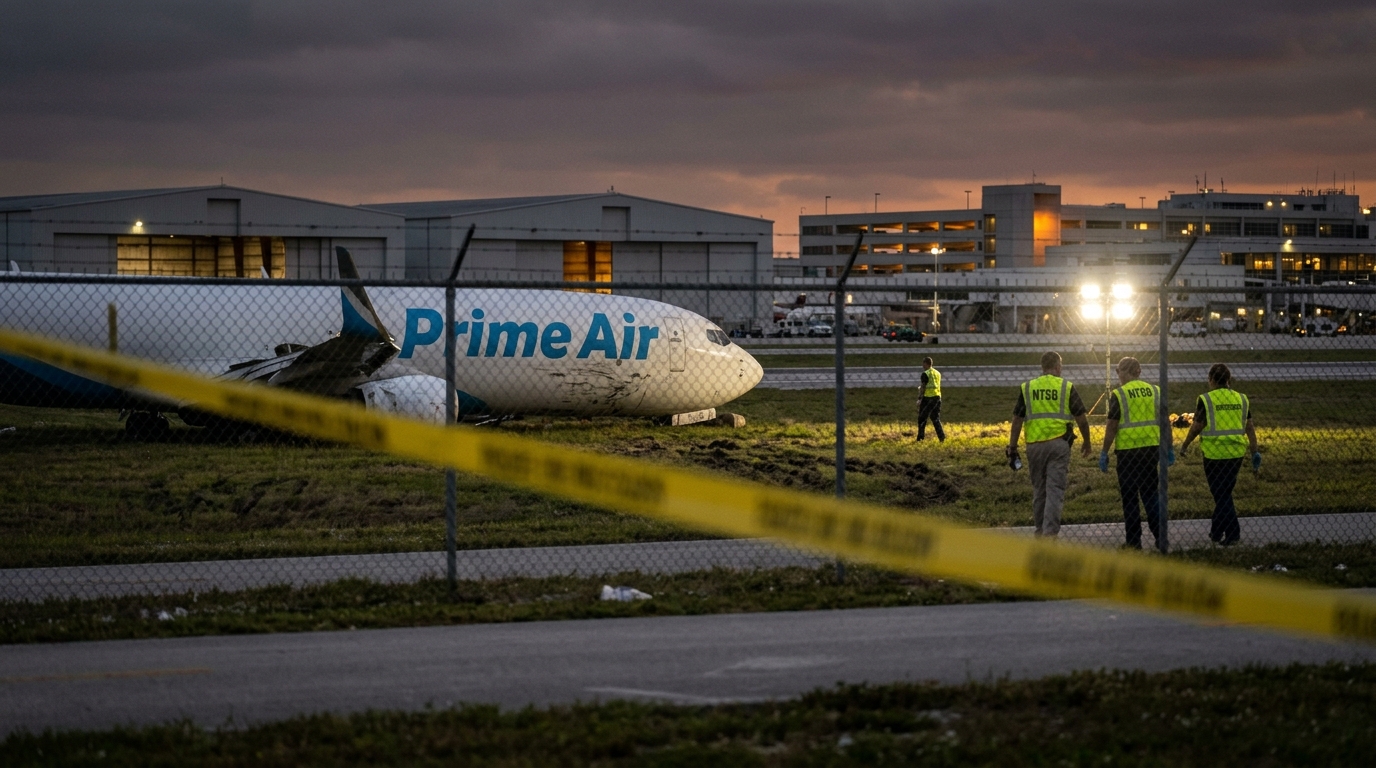
At about 2 p.m. Sunday, Sept. 6, 2026, Amazon Air Flight 7598, a Boeing 767-33A operated by 21 Air LLC, overran Runway 30 at Miami International Airport. The plane traveled roughly 1,300 feet past the runway, crashed through a perimeter fence, crossed Northwest 67th Avenue, and struck multiple vehicles. The five people killed were in a van carrying a seven-person aircraft cleaning crew and in an SUV outside airport property. Five more were injured.
The flight had been arriving from San Juan, Puerto Rico, with two crew members onboard, and it was on its third trip of the day, having gone from Cincinnati to Miami, then Miami to San Juan, and back to Miami. Thunderstorms and gusting winds were recorded in the area at the time. Investigators have said the pilots did not report problems to air traffic control before landing.
The Business
Amazon does not operate these cargo flights under its own air carrier certificate. The Amazon Air network is flown by contracted operators, of which 21 Air is one. That structure insulates Amazon from certain operator responsibilities, but it also creates a chain of accountability that investigators are now pulling hard.
Investigators say they will examine the contractual relationship between Amazon and 21 Air. NTSB Chair Jennifer Homendy said investigators will want to understand what the relationship is, who does what, and what safety provisions exist in contracts or policies.
Why Wall Street Is Paying Attention
During Monday’s trading session, Amazon shares ranged from a daily high of $261.12 to a low of $255.29, a muted reaction for a headline this large. That relative calm reflects the arithmetic: Amazon says its air network provides capacity across a fleet of more than 100 aircraft supporting over 250 daily flights, so the company has substantial capacity to absorb the temporary loss of a single plane. On that math, one aircraft is less than 0.4% of a 250-flight daily schedule.
But the real exposure here is not operational, it is regulatory. If investigators uncover weaknesses in contractor oversight, maintenance, or operating controls, Amazon could face tighter requirements across a logistics system carrying its merchandise and reputation. That is a harder thing to model.
This is the second fatal crash involving an aircraft operating for Amazon Air. In February 2019, an Atlas Air Boeing 767 freighter operating an Amazon flight from Miami crashed into Trinity Bay near Houston, killing all three people on board. Two Miami-originated tragedies in seven years, both involving 767 freighters, both operated by contractors, will make scrutiny of Amazon’s oversight standards considerably more pointed this time.
What Could Go Wrong
The investigation is at its earliest stage. Investigators have said they will examine speed and braking, weather and wind conditions, the aircraft’s mechanical condition, and other factors. The 767 is 32 years old and was originally built as a passenger plane before being converted to a cargo plane in 2015. That conversion history, combined with questions about maintenance responsibility shared across Amazon’s contractors and other parties, gives litigators considerable runway of their own.
Miami International Airport does not have an Engineered Materials Arresting System, a safety feature used at more than 70 U.S. airports. The airport says Runway 12/30 maintains the full 1,000-foot Runway Safety Area mandated by the FAA, and that EMAS is generally used where space constraints prevent a full safety area. The airport has also said no U.S. airport has EMAS at a runway end that also maintains the full, unobstructed 1,000-foot safety area, describing EMAS as an alternative rather than an additional layer. Still, the absence will generate political pressure, and political pressure eventually becomes regulatory cost.
The Bottom Line
Amazon’s stock held up. Its contractor model may not. The crash does not change Amazon’s fundamental investment case, anchored in AWS margins and advertising growth, but it opens a serious question about the liability and compliance costs of running a 250-flight daily logistics operation through a web of contracted carriers who bear the certificate while Amazon provides the brand and the customer promise. The NTSB said it has 32 people on the ground. Until investigators identify a cause, the uncertainty sits primarily with 21 Air and, to a lesser degree, Boeing. The moment the findings point toward systemic contractor oversight failures, the calculus shifts toward Amazon. That is the variable worth monitoring, not today’s share price.