What a Gold Story Looks Like Before Most Notice
The biggest gains in mining rarely come after a discovery is obvious.
They come earlier.
Before the market has clean answers. Before the analysts have polished models. Before the headlines make it feel safe.
That is the stage this company may be entering now.
The early clues are already on the table:
- Neighboring a producer with a roughly $4.5B market cap
- Surface grades reported up to 73 g/t gold and 21% copper
- A second drill now turning on the project
None of this proves what sits underground.
But it does explain why this moment and this company are worth watching.
Because in mining, the wave usually starts before the crowd can see it.
Nvidia’s China Revenue Bet Just Got Harder to Make
NVDA opened Monday at roughly $218, sitting about 10% below its all-time closing high of $235.20 set on May 14, 2026. The stock is not in freefall. But a story that broke over the weekend is quietly changing the probability that China revenue ever returns to the level Wall Street once modeled, and investors holding the summit as a catalyst should understand exactly why.
The Aivres Problem
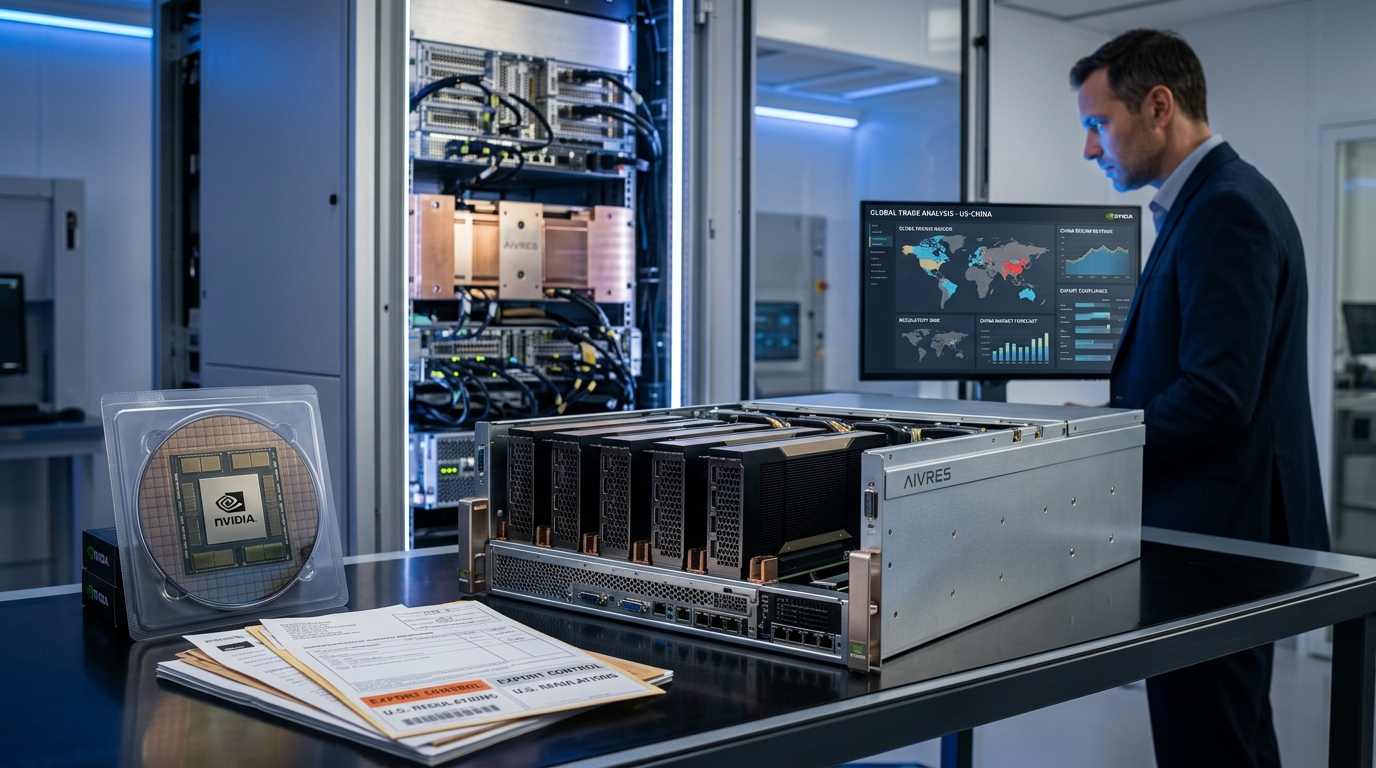
A New York Times investigation published September 6, 2026 traced how Inspur Group, the Shandong-based server maker placed on the Commerce Department Entity List on March 2, 2023, continued acquiring advanced Nvidia chips through a California subsidiary renamed Aivres. Between April 2024 and February 2026, Aivres exported at least $5.6 billion in advanced technology to Southeast Asia, including more than $3 billion in servers built with Nvidia’s Blackwell chips. Those servers ultimately reached Chinese customers including ByteDance and Alibaba.
The mechanism matters for Nvidia specifically. Aivres sits in a legal gray zone. When BIS added six Inspur subsidiaries to the Entity List in March 2025, Aivres was not among them. When BIS introduced its Affiliates Rule in late September 2025, automatically extending Entity List export restrictions to any company at least 50% owned by one or more listed entities, Inspur’s reported one-third stake in Aivres kept it below the threshold. Federal officials have begun looking into Aivres’s business, but the inquiry’s status remains unclear.
That regulatory sequence is now a live enforcement dispute, nine days before Xi arrives at the White House.
What Consensus Still Assumes
Nvidia’s most recent quarter, Q2 fiscal 2027, posted $96.2 billion in revenue. Gross margin was 75.0%, and net income was $59.7 billion, a 62% net margin. China data-center compute revenue was effectively negligible: Nvidia disclosed that shipments of its Data Center Hopper products to China during the quarter were less than 1% of Data Center revenue. H200 shipments to approved Chinese buyers were described to Congress in July as “very few.” Bernstein estimates Nvidia’s China AI-chip market share has fallen from roughly 40% in 2025 to about 8% in 2026, with Huawei rising to around 50%.
Yet a portion of analyst targets still embed a China recovery option. Piper Sandler initiated coverage on September 10 with an overweight rating and a $300 target, while the Street-wide consensus average sits near $328. Any target above roughly $260 implicitly requires some version of China upside materializing. The Aivres case makes that harder to price.
What September 24 Could Change
Managing frontier AI risk and protecting intellectual property are set to top the September 24 agenda. The summit is the latest of 2026, following the May meeting in Beijing. Congressional export-control legislation targeting chip-smuggling loopholes is actively moving in parallel. The combination of an open enforcement case, a live loophole dispute, and a geopolitically charged summit is not a background condition. It is the condition under which any deal on chip access would have to be struck.
The May summit produced almost nothing on semiconductors. The U.S. Trade Representative stated explicitly there were no discussions of chip export controls at that meeting.
Bull / Base / Bear
- Bull: Trump and Xi reach a framework on September 24 that expands licensed H200 and China-specific Blackwell sales beyond the current approved list. Enforcement action against Aivres is resolved quietly. Nvidia’s China revenue recovers toward $10 billion annually. Street upgrades follow.
- Base: The summit produces no actionable chip agreement. The Aivres investigation continues without a formal enforcement action before year-end. China data-center revenue remains near zero. NVDA trades on non-China hyperscaler demand alone, which is strong enough to hold current levels but not enough to push through $236.
- Bear: BIS formally adds Aivres to the Entity List or tightens the Affiliates Rule to capture minority-stake structures. Congressional legislation passes. Any residual H200 licensing framework collapses. AMD faces the same constraint on its China exposure. NVDA revisits the $195-$200 range, which served as support during April’s export-control shock.
Technical Overlay
NVDA’s 52-week range is $164.27 to $236.54. The stock closed Friday, September 11, 2026 at $218.29. The $207-$209 zone is the first meaningful level to watch. Below that, $195 represented the post-export-control floor from the spring. On the upside, $236 is the ceiling that has held since May. A summit with a concrete chip agreement would be the only near-term catalyst large enough to break it.
Bottom Line
Nvidia’s China revenue story was already largely written off by the company’s own disclosures. The Aivres case does not change that math directly. What it does is raise the diplomatic cost of any deal Trump might want to offer Xi on chip access. A president trying to show enforcement credibility cannot simultaneously loosen the rules for the exact product category at the center of an active federal inquiry. The September 24 summit matters for Nvidia, but not as a catalyst. It matters as the event that will confirm, once more, whether China upside is a real option or a number analysts carry because removing it is uncomfortable. Position accordingly.