
September 26, 2026
Friday’s 4.0% bounce tells only half the story
Analyst Targets
- Baird (Tristan Gerra): Buy, thesis: wireless IP remains foundational to smartphones and gains leverage as agentic AI moves to the edge
- StoneX: Buy, $270 target, expanding data-center exposure
- Bernstein (Stacy Rasgon): Market Perform, $165, renewal terms undisclosed, duration unknown, details “minimal”
- Wolfe Research: Hold, views renewal as neutral; doubts Qualcomm secured better terms than the prior agreement
What Happened This Week
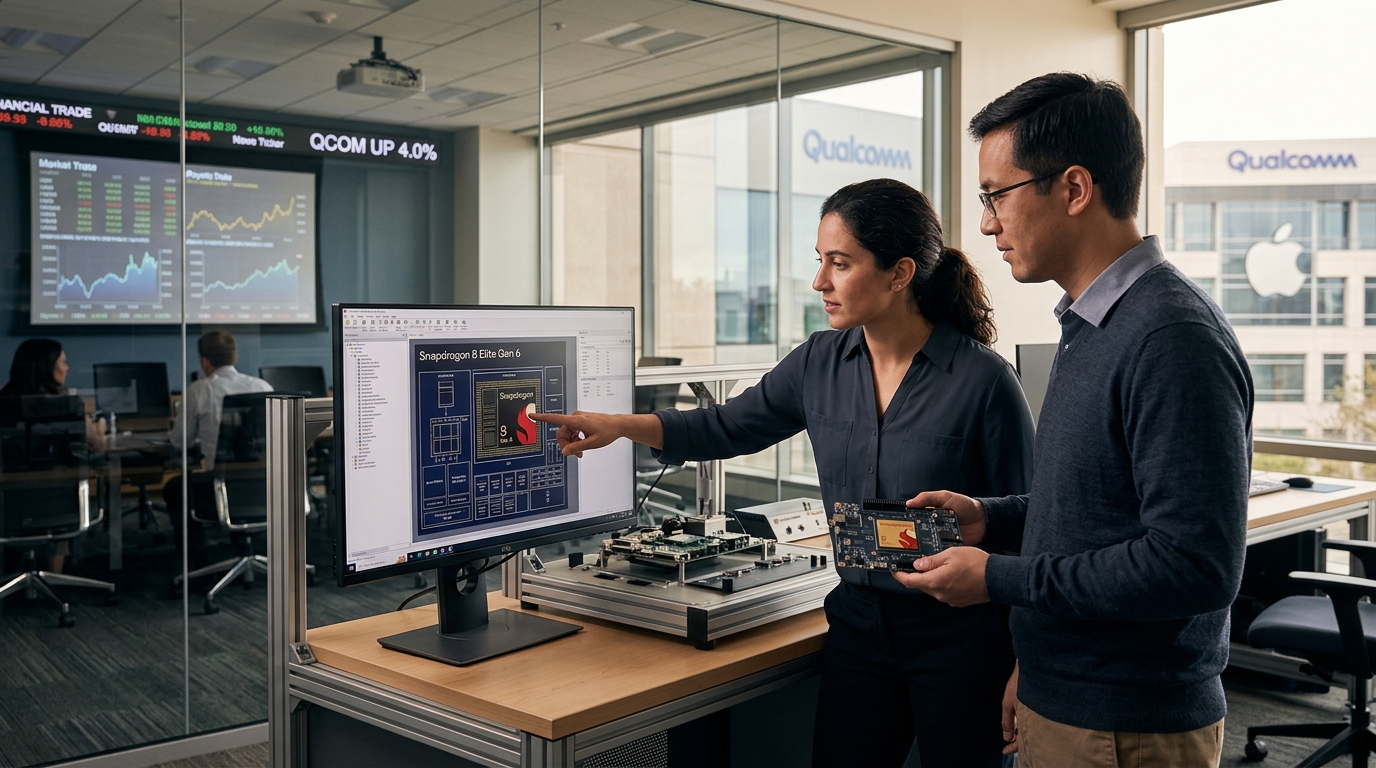
Qualcomm closed Friday at $201.97, up roughly 4.0% from Thursday’s close of $194.26, capping a week that whipsawed investors in both directions. The stock initially fell 1.5% on Thursday as the market processed Qualcomm’s Apple patent license renewal. By Friday, buyers had reversed the entire move and then some.
Your Download Link Will Expire
If you still haven’t downloaded my free “Safe Trade Options Formula” guide…
…please take a few seconds and download it right now before your new temporary download link expires.
I eventually plan to charge money for this training, so do yourself a favor and download it now…
That way, no matter what it costs in the future, you’ll have a free copy on your computer.
Make sense?
The week also included Snapdragon Summit in Maui, where Qualcomm broke a long-running single-flagship cadence by unveiling two top-tier processors simultaneously. The combination of events forced investors to answer a sharper question than usual: what is QCOM actually worth if the Apple relationship is now purely about patents?
Company Profile
Qualcomm operates two distinct businesses. The chip segment (QCT) designs and sells Snapdragon processors, modems, and RF systems to Android OEMs and, until recently, Apple. The licensing segment (QTL) collects royalties on virtually every 3G, 4G, and 5G handset sold globally, regardless of whose silicon is inside. Qualcomm collects royalty income on the majority of 4G and 5G handsets sold, as it holds many essential patents used in these networks. That structural separation is now the defining feature of the Apple relationship.
The Numbers
In the most recent quarter (fiscal Q3 2026, reported July 29), Qualcomm posted non-GAAP EPS of $2.21, missing the consensus of $2.23 by $0.02, while revenue of $9.95 billion topped the $9.69 billion estimate. Revenue was down 4.0% year over year. Within the licensing segment, QTL revenues fell 3% year over year to $1.28 billion, with earnings before taxes declining 6% to $881 million and the EBT margin compressing to 69% from 71%. For fiscal Q4, the company guided QTL revenues of $1.2 to $1.4 billion with an EBT margin of 68% to 72%.
The License: What It Is and What It Is Not
Qualcomm announced that the companies have renewed the agreement once again, with the new deal taking effect on April 1, 2027. No duration, no royalty rate, no term structure. Bernstein’s Stacy Rasgon noted that when Qualcomm announced the 2019 agreement, it explicitly disclosed the six-year term and extension provisions, whereas this statement was notably lacking in detail.
Critically, this renewal covers only the global patent license agreement, with no mention of extending chip supply arrangements. The chipset supply deal, signed in 2023 to cover Apple smartphones through 2026, has expired on its own terms. The patent agreement is separate from Qualcomm’s agreement to supply Apple with modems for smartphone launches through 2026; among the latest iPhone models, only the U.S. version of the iPhone 18 Pro Max still has a Qualcomm modem, according to MacRumors.
Qualcomm is not the only semiconductor supplier navigating a shifting Apple relationship. The broader iPhone component ecosystem has been reshaping itself, and the regulatory path for the Skyworks-Qorvo combination is one of the clearest signals of where consolidation pressure is heading. how the Skyworks-Qorvo merger is playing out as Apple’s supply chain consolidates offers useful context for understanding which RF and connectivity suppliers are positioning themselves to fill the gaps Qualcomm is leaving behind.
The Playbook Every Options Trader Should Have!
Do you dream of retirement but it seems like an impossibility? Wish you knew the best moves to get you there sooner?
It’s closer than you think and you won’t have to work overtime to get it!
Hi! I’m Dave Aquino, expert options trader and my e-book, “How To Master the Retirement Trade” has helped thousands reach their goals!
Follow the link to get your copy and see what you’ve been missing!
Bernstein estimates the Apple agreement generates approximately $1.5 to $1.7 billion in revenue for Qualcomm at roughly $7.50 per phone, contributing between $1.25 and $1.50 in earnings per share. That stream is now confirmed to continue. The chip revenue from Apple, however, is effectively finished as a meaningful line item. At the fiscal Q3 2026 earnings call, management said that due to supply constraints, the decline in product revenue from Apple would accelerate starting in the fiscal fourth quarter.
Snapdragon 8 Elite Gen 6: The Replacement Strategy
Qualcomm unveiled both new chips at its Snapdragon Summit in Maui, the industry’s first mass-market mobile chips built on TSMC’s 2nm process node and the first to push a smartphone CPU clock to 5 GHz, according to Qualcomm. Snapdragon 8 Elite Extreme Gen 6 is positioned as the higher-tier part, and Qualcomm says the family can run 30 billion-plus parameter Mixture-of-Experts models directly on-device.
Baird’s Tristan Gerra believes the Snapdragon platform will give Qualcomm leverage once AI-powered software agents start running directly on devices. That is the bullish read: the Gen 6 cycle is not just a spec refresh but a structural shift toward on-device AI that could expand the addressable market beyond smartphones into PCs, earbuds, and automotive.
Macro and Industry Context
QTL royalty revenues are closely linked to the smartphone market, and weakness in the handset market continues to pressure the business. China remains an exposure point: China (including Hong Kong) accounted for 46% of Qualcomm’s revenues in fiscal 2025, at a time of sustained U.S.-China trade tension. Qualcomm’s pivot toward data centers adds diversification but is not yet scaled enough to offset a handset slowdown. In September, Qualcomm announced a multi-generational collaboration with Amazon to supply customized silicon for AI data centers, with a stated focus on inference workloads.
Understanding what that Amazon relationship could eventually be worth requires a clear picture of how AWS is spending and where its economics are tightest. The cloud unit’s operating margin has become the central variable in every custom silicon conversation, because it determines how aggressively Amazon will invest in proprietary chips versus third-party alternatives. what AWS’s 39% operating margin signals about its AI infrastructure priorities frames the demand side of the deal Qualcomm is trying to scale.
Bull, Base, and Bear Scenarios
Bull: The Gen 6 cycle drives a strong Android upgrade wave in H1 2027. Agentic AI pulls forward enterprise and PC chipset orders. The Apple patent deal, even at undisclosed terms, holds near prior rates, and the Amazon data-center relationship compounds into a credible third revenue leg. QCOM trades toward $240+.
Musk Signs MASSIVE Six-Year Deal with Tiny Company
Musk is buying 75,000 metric tons of one “magical” element from a completely unknown company.
Base: Gen 6 sustains QCT market share in premium Android, the patent stream continues near Bernstein’s estimate, and data-center revenue begins contributing in fiscal 2027. The stock holds the $195 to $215 range as earnings estimates stabilize. The company’s Q4 guidance midpoint of $2.15 in EPS supports this range at current multiples.
Bear: The undisclosed Apple license terms turn out to be materially worse than the prior deal. Handset demand softens into 2027. MediaTek gains ground in the premium Android segment on its own 2nm platform. QCOM gives back the week’s gains and retests the $175 area.
Technical Overlay
QCOM closed Friday at $201.97 after trading as high as $205.85 intraday. The stock is testing the $201.40 Fibonacci resistance level, with key moving average support at $175.93 and $171.62, and upside targets at $215.28 and $235.05 if the breakout holds. A resistance zone running from $220.82 to $223.43 is formed by a combination of trend lines and moving averages on the daily timeframe. Holding above $200 into next week would be technically constructive; a close back below $194 reopens the Thursday selloff gap.
What Investors Should Watch
- Qualcomm’s fiscal Q4 earnings call (scheduled November 3): first opportunity to learn the Apple patent deal’s duration and any rate changes
- QTL revenue trajectory in Q4 relative to the guided $1.2 to $1.4 billion range
- First Gen 6 device launches in Q4 and sell-through data heading into the holiday quarter
- Any further disclosure on the Amazon AWS silicon engagement and timeline to material revenue
- Analyst target revisions following this week’s events
Bottom Line
The market initially sold the Apple announcement because it confirmed the obvious: the chipset relationship is over. It then bought it back because the more durable point is that moving away from Qualcomm hardware does not eliminate Apple’s need to license patented cellular technologies, meaning Qualcomm can continue receiving licensing revenue from Apple even as its role as a modem supplier declines. That is a real floor. What the market does not yet know is the ceiling: the duration and rate of the new license are undisclosed, the Gen 6 cycle has not yet shipped at volume, and the data-center business is still early. QCOM at $202 is pricing in a competent execution of a transition that has not been completed. The November earnings call will do more to set the stock’s direction over the next six months than anything that happened in Maui.
That execution risk does not exist in isolation — it sits inside a broader semiconductor landscape where the definition of the essential AI chip is actively being contested. AMD, Arm, and Intel have each made moves in recent weeks that complicate the assumption that any single architecture holds a durable lead. how AMD, Arm, and Intel are challenging the AI chip hierarchy heading into late 2026 is the competitive backdrop against which Qualcomm’s data-center ambitions will ultimately be measured.