Analyst Targets
- Wolfe Research — Outperform, $250 (reiterated Sept. 23, 2026)
- Bank of America Securities — Buy, $268 (raised from $250, Sept. 14, 2026)
- J.P. Morgan — Overweight, $245 (initiated Sept. 9, 2026)
- Barclays — Buy, $300 (maintained Aug. 20, 2026)
- Consensus (15 analysts, S&P Global) — Buy, avg. $252.21; SKHY closed Oct. 2 at $195.13
The Opening Position
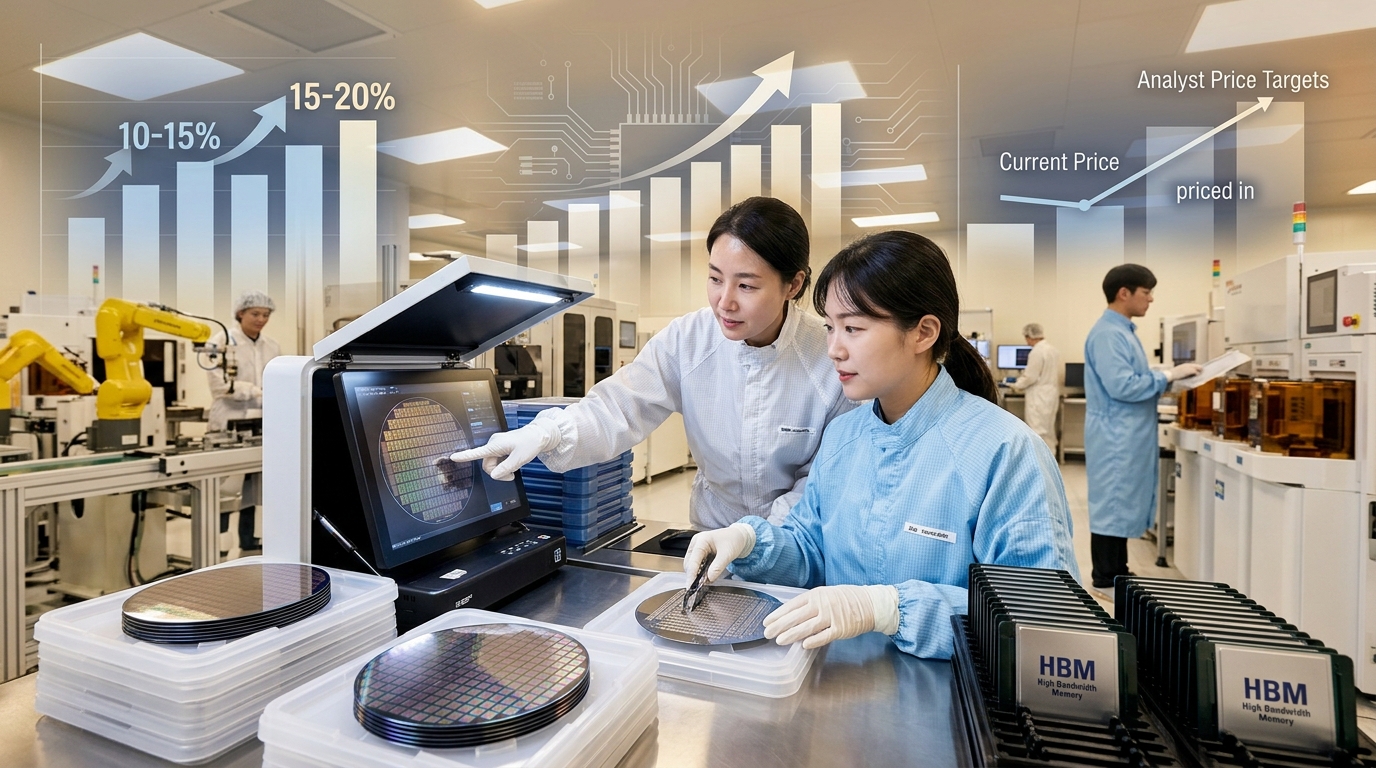
TrendForce’s Q4 2026 memory forecast projects conventional DRAM contract prices rising 10–15% quarter over quarter, with NAND flash climbing 15–20%. That is not a rumor. It is a forecast published September 30, and the market moved on it immediately.
SK Hynix rose 3.2% in the Korea market on October 1, 2026, as optimism over tight AI-memory supply supported the rally. The question worth asking now is not whether the price increases are real. They are. The question is how much of the resulting gross profit transfer has already been priced into SK Hynix and Samsung shares, and what happens if either company misses Q3 earnings expectations on October 27.
Company Profile
SK Hynix offers DRAM across server, graphics, mobile, and PC memory segments, plus NAND flash and SSD products. Gross margin in the most recently reported quarter was about 83%. Samsung’s semiconductor division mirrors that profile but at greater scale, with its DS division generating the bulk of consolidated profit.
The Numbers Behind the Move
SK Hynix’s Q2 2026 operating profit of KRW 60.54 trillion marked an all-time high, up 557% year over year, with operating margin reaching 76%, driven by strong DRAM and NAND pricing and cost improvement.
Samsung’s Q2 2026 revenue reached a record KRW 171.5 trillion; its DS division posted revenue of KRW 127.5 trillion won and operating profit of KRW 89.2 trillion won, with operating profit accounting for nearly all of the company’s total operating profit.
Those are margins that semiconductor companies have never sustained across a full cycle. The question for Q3 is whether they hold.
Why Prices Are Moving — and Who Gets the Benefit
TrendForce attributes continued pressure primarily to cloud service providers expanding procurement for AI infrastructure, with memory manufacturers prioritizing HBM, server DRAM, and enterprise storage, leaving conventional desktop and notebook memory with a smaller share of available capacity.
TrendForce’s September 30 note centers the demand impulse on AI server buildouts and procurement patterns. The key takeaway for investors is that the price tailwind is being driven by AI-related demand and product mix, rather than a broad-based consumer recovery.
The consumer side is under growing strain. Higher memory costs are already weighing on notebook sales and smartphone production, and PC brands are reducing SSD capacities in mainstream models to lower bill-of-materials costs. That dynamic limits the demand recovery that would otherwise absorb incremental supply, keeping prices elevated for suppliers while compressing margins downstream at Dell, HP, Lenovo, and Apple.
Forward Scenarios
Bull
SK Hynix continues entering multi-year contracts with customers, with long-term agreement negotiations concluded with 10 customers and discussions underway to expand scope. If Q3 earnings on October 27 clear the consensus revenue estimate of roughly KRW 101 trillion and operating margins hold above 70%, analyst price target upgrades follow. SKHY trades toward the $268–$300 range.
Base
The pace of price increases moderates, partly because substantial increases were already priced in during previous quarters. SK Hynix meets but does not beat Q3 estimates, shares consolidate around current levels, and Samsung’s consumer electronics drag remains a partial offset to memory strength.
Bear
The shares are about 49% above the $130.53 GF Value estimate, leaving little room for execution mistakes. A miss on Q3 revenue, combined with weakening consumer electronics demand could push SKHY back toward the $165–$175 range.
Technical Overlay
SKHY has traded between $161.50 (September 1 open) and the current $195 level, a 21% move in a single month. The October 1 close at $182.82 followed by a recovery to $195 by October 2 suggests the gap from the TrendForce catalyst held as support. Key resistance sits at the $200 level; a break above $200 on volume ahead of the October 27 earnings call would be a constructive signal.
What Investors Should Watch
- October 27 earnings: SK Hynix Q3 results. Consensus revenue of ~KRW 101 trillion. Operating margin trajectory versus the Q2 record of 76%.
- LTA disclosures: Whether any new long-term agreements beyond the current 10 customers are confirmed, and at what pricing.
- PC OEM guidance: Dell, HP, and Lenovo quarterly outlooks will reveal how much of the DRAM and NAND cost increase is flowing to system prices versus being absorbed in margin.
- CSP capex signals: Any softening in hyperscaler AI infrastructure spending would compress the demand side of the equation faster than supply could respond.
Bottom Line
The gross profit transfer from a 10–15% DRAM contract price increase is enormous at SK Hynix’s and Samsung’s scale. Both companies have already demonstrated the ability to sustain 70%-plus operating margins in a rising-price environment. The harder debate is valuation: with SKHY trading at a P/E around 11.6 and an analyst consensus pointing to $252, the market is not paying a heroic multiple, but it is pricing continued execution at record margins. The October 27 earnings call is the first real test of whether Q4’s contract price increases are landing in the income statement the way the TrendForce forecast implies they should.