October 19, 2026
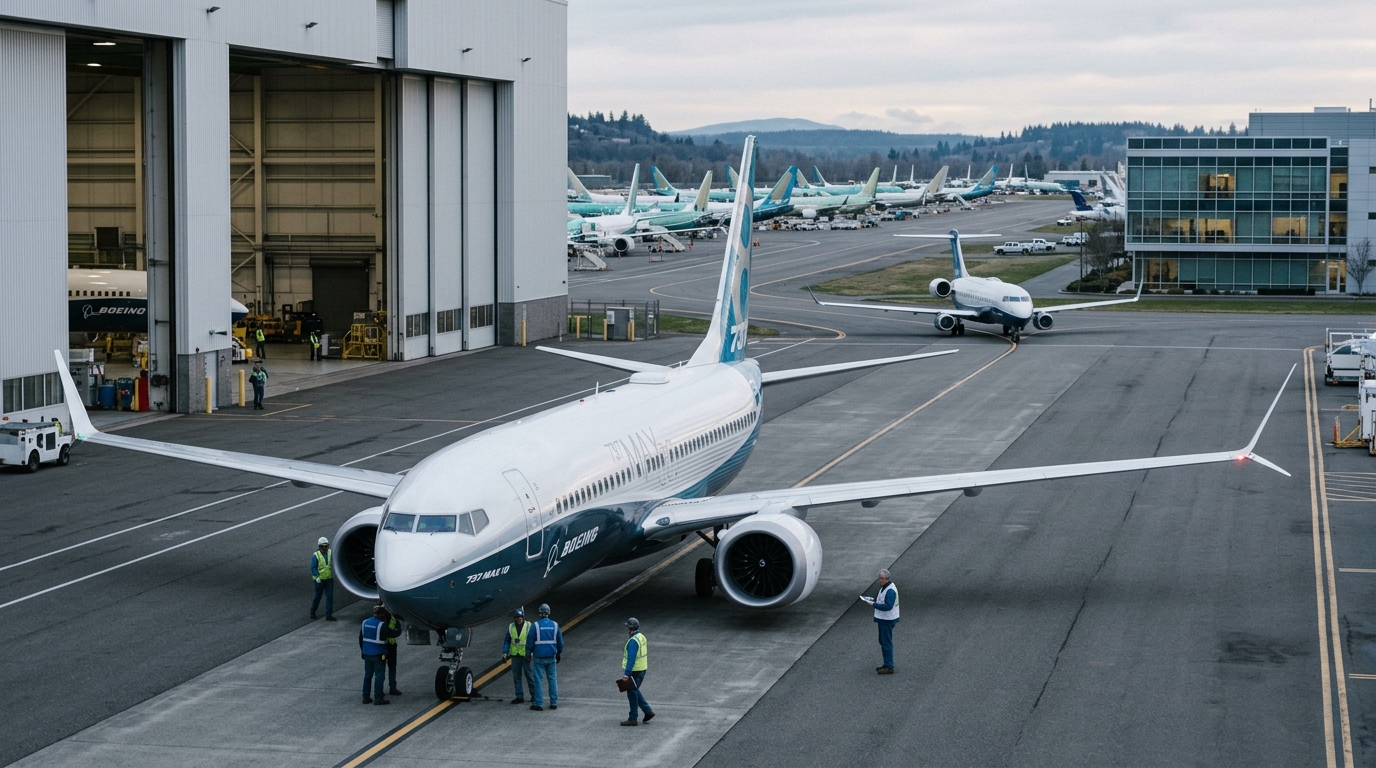
Bonus Content: Boeing’s 737 MAX 10 Is Days From FAA Approval. What It Unlocks.
Dear Reader,
November 1910. Jekyll Island, Georgia.
Seven of America’s most powerful bankers met in secret to design the Federal Reserve.
Their goal wasn’t to protect your wealth…
It was to create a system where they control the money supply and you pay for it through inflation.
Since 1913, the evidence is clear… the dollar has lost 98% of its purchasing power.
Your savings are worth less every single year.
And now they’re preparing the final move to lock you in forever:
Central Bank Digital Currencies.
Once they force everyone onto CBDCs, there will be no escape.
Every transaction tracked. Every account programmable. Every dollar subject to government control.
But here’s what they didn’t count on…
Decentralized Finance has created a backdoor out of their system.
And right now, that door is still open.
If you have $100k+ in assets, I’ve put together a free presentation that walks you through the exact three-phase process to become your own bank.
You’ll learn how to hold wealth they can’t inflate, generate income they can’t track, and position yourself before they close this exit.
Discover the legal loophole before it’s too late →
To your freedom,
Tan Gera, CFA
Decentralized Masters
P.S. This is your last chance to legally opt out before CBDCs trap everyone in their system. Watch the presentation now →
Boeing’s 737 MAX 10 Is Days From FAA Approval. What It Unlocks.
Analyst Targets
- Barclays: Overweight, $300
- JPMorgan: Buy, $290
- Bernstein: $298
- Morgan Stanley: Equal Weight, $225 (lowered from $250 on October 16)
- RBC Capital: $235 (lowered from $265)
- Consensus: Moderate Buy, ~$268 average target
The Moment
Seven years after Boeing rolled the first 737 MAX 10 out of its Renton factory, the jet may finally get a type certificate in the coming days. On Friday, October 16, 2026, the FAA’s Type Certification Board held its review of the aircraft. Multiple aviation outlets have reported, citing people familiar with the matter, that formal certification could follow shortly after that review, pending final FAA sign-off.
BA closed at $190.21 on October 16, 2026, about 12% below its December 31, 2025 close of $217.12 and below both its 50-day and 200-day moving averages. The MAX 10 certificate is a catalyst the bull case has been waiting on.
What the MAX 10 Actually Is
The 737 MAX 10 is the largest and final variant of the MAX family, a stretch of the MAX 9 built to compete directly with the Airbus A321neo in the 190-plus-seat single-aisle segment. Boeing originally targeted commercial service in 2020. An engine anti-ice redesign, the MAX crisis aftermath, and repeated FAA scrutiny pushed that out by more than six years. The smaller MAX 7 received its certificate on August 3, 2026, leaving the MAX 10 as the sole uncertified variant.
Boeing has said certification flight testing has been completed on both the 737-7 and 737-10 as of July 2026. Specific totals like “976 flights,” “2,060 flight hours,” and “1,040 hours of ground testing” were not confirmable from primary Boeing or FAA disclosures as of October 19, 2026, so they are removed here. Reporting in early October said an FAA review board determined a flight-management issue was not a safety concern and the agency would not require a fix before certifying the MAX 10.
The Backlog Unlock
Airlines have hundreds of MAX 10s on order, but “nearly 1,500” could not be verified from Boeing’s filings or other primary sources as of October 19, 2026. Boeing’s commercial backlog stood at $596.7 billion as of June 30, 2026, with over 6,200 aircraft valued there. The MAX 10 is one of the largest undelivered components within that figure. Major customers include United Airlines, Ryanair, Alaska Airlines, Delta, and American, with Lufthansa adding 20 orders in September 2026.
Boeing has already built a handful of MAX 10s sitting on the ground awaiting the certificate. First customer deliveries are targeted for 2027, not 2026. United has said it expects its first MAX 10 deliveries in mid-to-late 2027, with up to 20 aircraft that year, and plans to retire at least 80 aircraft in 2027. The delivery unlock is real but staggered: the revenue and cash flow impact concentrates in 2027 and beyond, not this quarter.
The Free Cash Flow Bridge
This is the number that matters most to BA shareholders. Boeing guided full-year 2026 free cash flow of $1 billion to $3 billion. First-half free cash flow came in at negative $823 million, leaving the back half to carry the full guidance range. Q2 free cash flow of $631 million was the first meaningful positive quarter since Boeing’s post-2018 MAX-era downturn began. Management has repeatedly described its long-term $10 billion annual free cash flow target as “very attainable,” tied explicitly to higher deliveries.
Analysts estimate 2026 full-year free cash flow will land near the upper end of guidance, rising materially in 2027 as MAX 10 deliveries begin and overall commercial output improves. A MAX 10 certificate in the coming days does not change 2026 cash flow in any material way. It does validate the 2027 ramp. If deliveries slip deep into the second half of 2027, those 2027 estimates become exposed. The Boeing October 27 earnings call will tell investors whether the Q3 free cash flow bridge held, including the impact of the expected DOJ payment the company has flagged for the second half of 2026 (the “$700 million” figure was not confirmable from Boeing’s disclosures as of October 19, 2026, so it is removed).
Free cash flow has been the governing metric for BA’s re-rating all year. A Q2 delivery beat and Fitch outlook upgrade earlier in 2026 showed how quickly sentiment can shift when Boeing’s production numbers clear consensus.
The balance sheet context: $45.9 billion in debt against $20.0 billion in cash and marketable securities as of June 30, 2026.
Forward Scenarios
Bull
Certificate arrives in the coming days. First MAX 10 deliveries begin in mid-to-late 2027 on schedule. 737 production holds near 47 per month. 2027 free cash flow reaches $6 billion or above, validating the path to $10 billion. Stock rerates toward the $290-$300 target range as delivery execution replaces certification risk as the debate.
Base
Certificate arrives in late October or later in 2026, first deliveries begin mid-to-late 2027. 2027 free cash flow comes in near $5 to $6 billion. Stock recovers gradually toward the $250-$270 range but the production ramp remains the binding constraint, not the certificate.
Bear
Certificate is signed but early deliveries slip to late 2027 due to supply chain or interior fit-out bottlenecks. United absorbs more delays. 2027 free cash flow misses consensus. BA retests the $176.77 52-week low.
Technical Overlay
BA closed at $190.21 on October 16, 2026. The 52-week range spans $176.77 to $254.35. The stock trades below both its 50-day and 200-day moving averages, a technically weak posture. The $195-$200 zone is the first meaningful resistance. A confirmed certificate in the coming days could push a test of that zone. Failure to certify would likely revisit the $183-$184 support.
Bottom Line
The MAX 10 certificate, when it arrives, closes one of the longest certification sagas in modern narrowbody history. It is necessary, but not sufficient, to move Boeing’s stock materially higher. The real question is execution: can Boeing convert a record commercial backlog into deliveries fast enough to reach roughly $6 billion in free cash flow next year, on a production system still stabilizing, against $45.9 billion in debt? Certification removes one risk. The October 27 earnings call will show whether the others are narrowing.