Verizon reports third-quarter 2026 earnings before the open Monday, October 26. Consensus sits at about $34.25 billion in revenue and $1.27 to $1.28 in adjusted EPS. That is the easy part. The harder question is whether Dan Schulman’s subscriber turnaround held through a competitive quarter, and what management says about reports that SpaceX is seeking to lease roughly 80,000 U.S. cell sites, a story that helped push VZ shares lower Friday.
Analyst Targets
- TD Cowen: Buy, $56 (raised July 27)
- Scotiabank: Sector Outperform, $50 (cut from $52 on October 9)
- Morgan Stanley: Equal-Weight, $52 (raised July 27)
- Bank of America: Hold, $48 (reiterated October 14)
- Wells Fargo: Equal-Weight, $47 (raised July 27)
- RBC Capital: Sector Perform, $47 (raised July 27)
Average analyst target across roughly 25 firms: $51.24. VZ closed Friday at about $44.66, a 52-week range of $38.54 to $51.68.
What Verizon Is, Right Now
Schulman took the CEO chair in October 2025 after Hans Vestberg stepped down. The turnaround playbook: axe 13,000 jobs, commit to $5 billion in operating cost reductions, simplify consumer plans, and lean into convergence bundles pairing wireless with Frontier fiber, whose acquisition closed January 20, 2026.
It worked. Q4 2025 delivered more than one million total net additions across mobility and broadband, the highest quarterly figure since 2019, with 616,000 postpaid phone net adds beating estimates of 420,500. Q1 2026 added 55,000 postpaid phone net adds, the first positive first-quarter result in that category since 2013. Q2 beat EPS expectations again, posting $1.30 against a $1.27 estimate. Management has raised full-year EPS guidance twice in 2026, now targeting 6% to 7% adjusted EPS growth and 9% to 10% free cash flow growth. The $25 billion buyback authorization, announced January 30, is well underway: $3.5 billion repurchased in the first half.
The Numbers to Watch
- Revenue: Consensus about $34.25 billion vs. $33.82 billion in Q3 2025 (+1.3% YoY)
- Adjusted EPS: $1.27 consensus vs. $1.21 a year ago (+5.0%)
- EBITDA: Second-quarter adjusted EBITDA was $13.7 billion; watch the Q3 margin trajectory after Q2’s record 40.1% adjusted EBITDA margin
- Postpaid phone net adds: Full-year guidance is the upper half of 750,000 to 1 million; Q3 is the critical data point
- Churn: Q2 came in at 84 basis points, down 6 bps YoY, watch for continued improvement
- Broadband net adds: Q2 delivered 348,000; management has said it remains on track to end 2026 with more than 32 million fiber passings
The EPS estimate has drifted down 1.6% over the past 90 days, from $1.29 to $1.27. Analysts cite promotional activity and equipment revenue softness. Verizon has beaten estimates in each of the last four quarters; the question is margin quality, not just the headline beat.
The SpaceX Variable
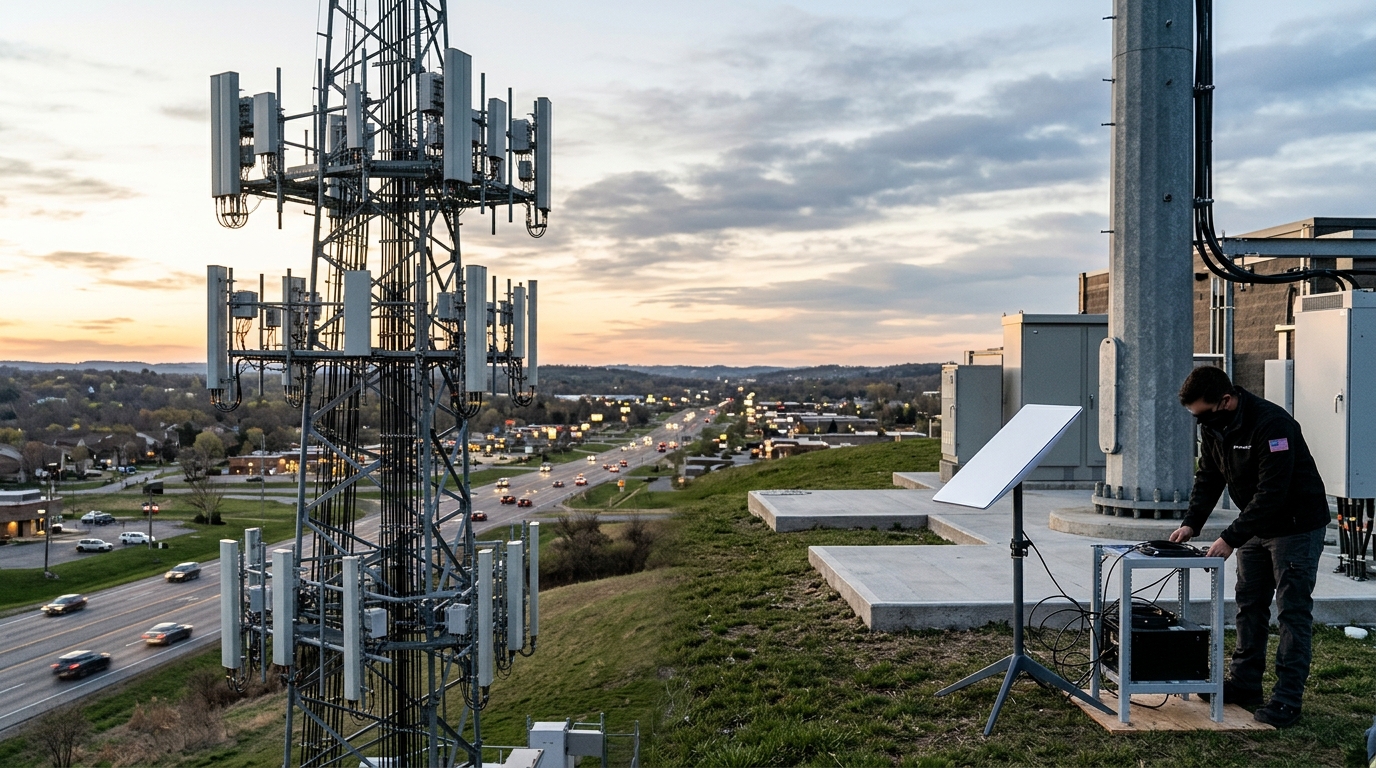
Bloomberg reported Thursday evening that SpaceX is negotiating to lease space at a minimum of 80,000 U.S. cell sites as it builds out a terrestrial network for Starlink Mobile. Crown Castle’s CEO, when asked directly whether it was discussing leases with satellite operators, said: “You can assume that we’re talking to all parties.” No lease has been signed. SpaceX has not commented publicly.
The market reaction was swift and asymmetric. Crown Castle surged about 9% Friday; American Tower rose about 4% Friday. VZ, AT&T, and T-Mobile each fell. SpaceX also struck a deal this month to acquire Grain Management’s nationwide 800 MHz low-band spectrum portfolio for about $8 billion, a move Reuters reported on October 8. Bernstein analyst Laurent Yoon called an 80,000-site commitment “a point of no return” for any carrier aiming at national terrestrial coverage.
Crucially, Schulman said as recently as September at the Goldman Sachs Communacopia conference that SpaceX had shown no meaningful impact on Verizon’s growth. That statement is now the first thing management will be pressed to update on Monday’s call.
Forward Scenarios
Bull
Q3 postpaid phone net adds stay on track for the upper half of annual guidance. EBITDA margin holds near the record 40.1% set in Q2. Management characterizes SpaceX’s terrestrial build as years away from competitive scale and reiterates guidance. VZ reclaims the $47 to $48 resistance zone and analysts begin lifting targets toward $54 to $56.
Base
Revenue lands near consensus; EPS beats by a few cents as cost discipline offsets modest revenue softness. Subscriber adds are solid but not spectacular. Management acknowledges the SpaceX reports, provides limited detail, and reaffirms full-year guidance. Stock recovers modestly toward $47, but SpaceX uncertainty caps the re-rating.
Bear
Postpaid phone net adds disappoint, suggesting promotional spending is not translating into durable share gains. Revenue misses. Management’s SpaceX answer is vague or cautious. Stock retests the October 9 low near $41.65.
Technical Overlay
VZ entered earnings week in a technical downtrend, sitting below its 20-day ($45.37) and 50-day ($47.78) moving averages after a bearish moving-average crossover in early October. The stock shed roughly 7.4% in October before the SpaceX headlines added more pressure. Near-term support is clustered between $41.65 and $42.49; resistance on any earnings-driven recovery sits at $47.32, then the more meaningful $48 to $49 zone. An EPS beat paired with credible SpaceX commentary could push a gap fill toward the 50-day; a miss or a vague answer on Starlink Mobile likely revisits the October low.
Bottom Line
The Q3 report is the clearest test yet of whether Schulman’s turnaround is self-sustaining or still dependent on promotional tailwinds. Beat the subscriber number cleanly, hold the margin, and the stock has a case. But Monday’s call carries a second, harder question that no earnings beat fully answers: what does a fourth nationwide wireless carrier, backed by SpaceX’s capital and spectrum, mean for Verizon’s pricing power over the next three years? That is the variable the market will price long after the quarterly EPS is forgotten.