Analyst Targets
- JPMorgan: Buy, target cut to $640 from $755
- Raymond James: Outperform, target cut to $475 from $675
- Morgan Stanley: Hold reaffirmed, target cut to $485 from $640
- RBC Capital: target cut to $615 from $735
- Needham: Buy, target cut to $500 from $750
- Baird: target cut to $600 from $675
- Piper Sandler: Overweight, target cut to $540 from $561
- Craig-Hallum: Downgraded to Hold, new target $390
- Northland: Outperform, target cut to $540 from $800
What Happened
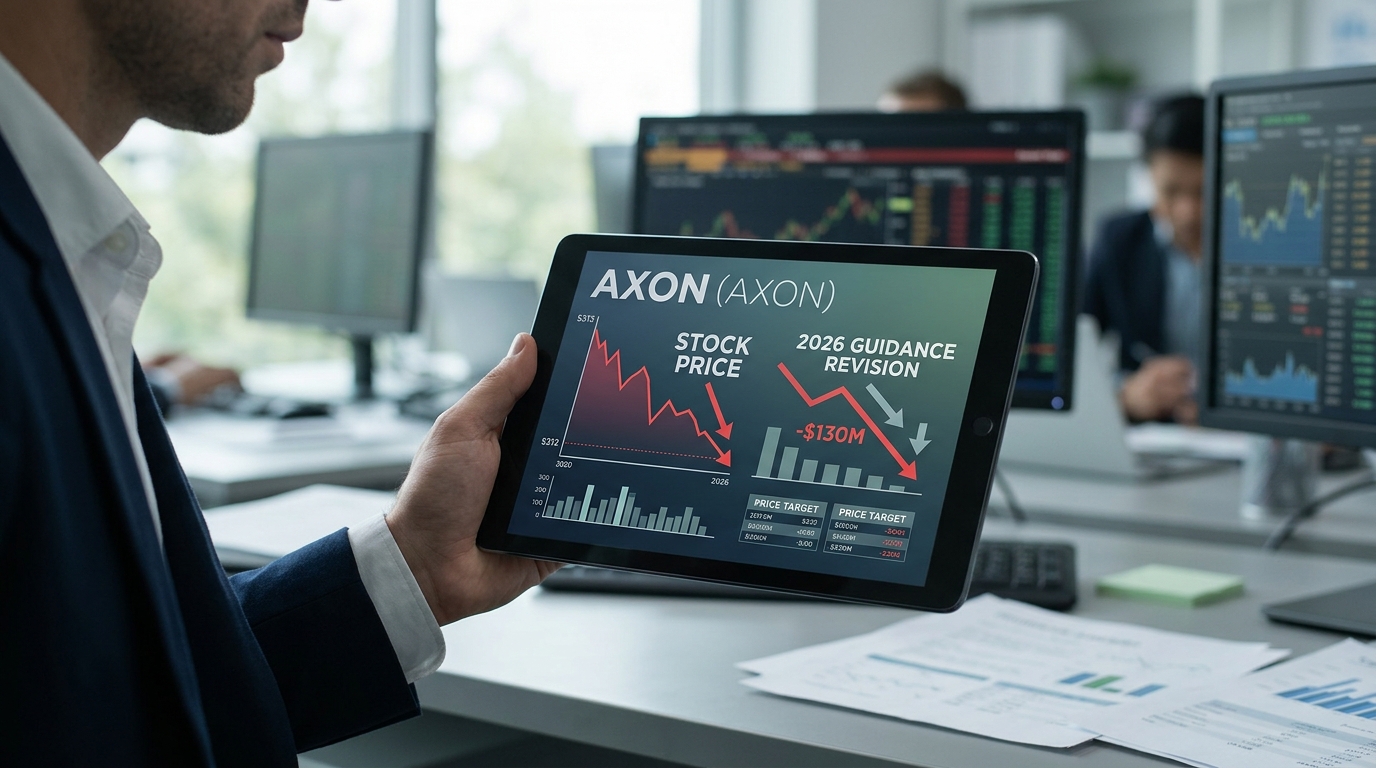
Axon reported Q3 2026 results after Thursday’s close and the market’s answer was blunt. The stock fell 18.18% on Friday to $313.00, a two-year low, on volume nearly five times the daily average. The NASDAQ gained about 1.1% that session. This move is entirely company-specific.
The numbers themselves were not catastrophic. Revenue of $908.6 million rose 28% year over year and set a quarterly record. The problem is what it was measured against and what it implies about the second half.
The Numbers
Every major metric came in below the line:
- Revenue: $908.6M vs. $931.1M expected, miss of roughly $23M
- Adjusted EPS: $1.72 vs. $1.89 consensus, a 9% shortfall
- Gross margin: 56.7%, down from 60.1% in Q3 2025
- Adjusted gross margin: 59.2%, versus 62.7% a year earlier
- Software and Services revenue: $437M, up 43% year over year
- Future contracted bookings: $15.8B, up 39% year over year
The gross margin compression came from three places: a heavier mix of counter-drone hardware, rising memory costs, and new product categories still in their early scaling phase. Software-only gross margin stayed above 80%, which keeps the long-term margin story intact but does not help today’s quarter.
The Guidance Cut Is the Real Story
Axon raised its full-year revenue growth forecast to 32% to 34% on the August Q2 call. It is now guiding to approximately 30% growth, with full-year revenue of $3.61 billion to $3.63 billion, against a prior range of $3.67 billion to $3.73 billion. Analysts had been sitting at $3.71 billion.
The entire reduction traces to three federal Dedrone counter-drone deployments worth approximately $130 million in aggregate. One $30 million order that was expected in Q3 slipped out of the quarter. Two larger deployments totaling roughly $100 million have now been pulled from Q4 as well. Management cited procurement timelines, funding cycles, installation requirements, and regulatory approvals. President Josh Isner said on the earnings call that the company “can’t be sure those come through this year.”
Federal procurement timelines are not the only mechanism that can punish a stock despite strong underlying demand. A guide that only slightly exceeded consensus erased roughly $24 billion in market value even after record revenue and 54% year-over-year growth.
Q4 guidance of $990 million to $1.01 billion also trails the $1.06 billion the Street had modeled, compounding the initial reaction.
Macro and Competitive Context
Federal counter-drone spending is real and growing, but its procurement mechanics are unlike Axon’s core law-enforcement business. Large deployments involve site preparation, export-control compliance, acceptance testing, and agency approvals that can shift revenue by a full quarter or more. Axon acquired Dedrone in 2024 and has announced an additional $1.2 billion minority investment in drone maker Skydio that is expected to take its ownership from about 15% to about 37% on a fully diluted basis. Competitor Motorola Solutions, meanwhile, has pointed to counter-drone as an area of focus. The federal counter-drone market is not shrinking. The question is who captures revenue when, and with what margin profile.
Federal counter-drone procurement has tripped up more than one company this cycle. AeroVironment faced the same gap between a landmark Army counter-drone award and what the income statement could actually show in the near term.
Bull / Base / Bear Scenarios
Bull: The three delayed Dedrone deployments close in early 2027, boosting that year’s growth by roughly 500 basis points. Software accelerates further, memory costs ease as management has suggested could happen later in the decade, and gross margin recovers toward 60%. The $15.8 billion future contracted bookings balance, up 39%, provides durable visibility. Analysts with $600-plus targets are proved right within 12 months.
Base: Federal Dedrone deals arrive with continued lumpiness, keeping hardware-heavy quarters volatile. Software momentum holds, sustaining roughly 30% top-line growth. Gross margin stabilizes in the high 50% range. The stock recovers to the $400 to $450 range over six months as delivery risk is reset but not fully resolved.
Bear: Procurement delays persist through mid-2027, Dedrone margins remain structurally lower than the core business, and the Skydio investment requires further capital. Free cash flow guidance, already cut to $350 million to $400 million for 2026, disappoints again. The stock rerates lower on a compressed multiple.
Technical Overlay
At $313, Axon closed Friday below its 50-day moving average of roughly $447 and its 200-day moving average near $477. The 52-week range now runs from $307 to $665. Friday’s intraday low of $307 represents the nearest support level worth watching. There is no meaningful technical floor established below that level on a two-year chart; the stock has not traded in this range since late 2024. Any recovery attempt will face resistance in the $340 to $390 zone, where previous support has now flipped.
Bottom Line
The core debate here is not whether Axon’s business is broken. The software segment grew 43%, future contracted bookings hit $15.8 billion, and management insists demand for Dedrone is intact. The debate is whether federal hardware deployments will remain structurally unpredictable at this scale, and whether the market is willing to pay a premium multiple while that question is open. At $313 and about 53% below its 52-week high, Axon is cheaper than it has been in two years. It is not cheap by any conventional measure. The next move will be determined by whether those three delayed Dedrone deployments actually close, and when.