
Dear Reader,
My name is Jeff Brown, founder and CEO of Brownstone Research.
And I want you to circle one date on your calendar…
That’s the day a tiny company could announce a huge supply deal with Elon Musk.
It’s a stock trading at under $1…
In an overlooked sector you’d never associate with tech.
But Musk’s robots, microchips and AI satellites all rely on it.

And on page 37 of the SpaceX IPO filing, Musk names this sector directly.
Why does that matter?
Because Musk raised $85.7 billion from the SpaceX IPO…
And a further $25 billion by selling bonds.
That money is about to flow downstream.
And when a Musk supplier in this sector announced a deal before…
The stock soared 395% in a single day.
That’s almost five times your money…
Before the sun goes down.
I recently sat down with an insider in this sector to talk about what could happen on November 11.
A man who once turned $13,140 of his own money…
Into around $1.85 million in under a year.
In our urgent strategy session, we reveal the name and ticker of a crucial Musk supplier…
Entirely for free.
But once November 11 arrives, this opportunity could be gone.
Click here to watch the strategy session before November 11.
We have so much to look forward to,
Jeff Brown
Founder & CEO, Brownstone Research
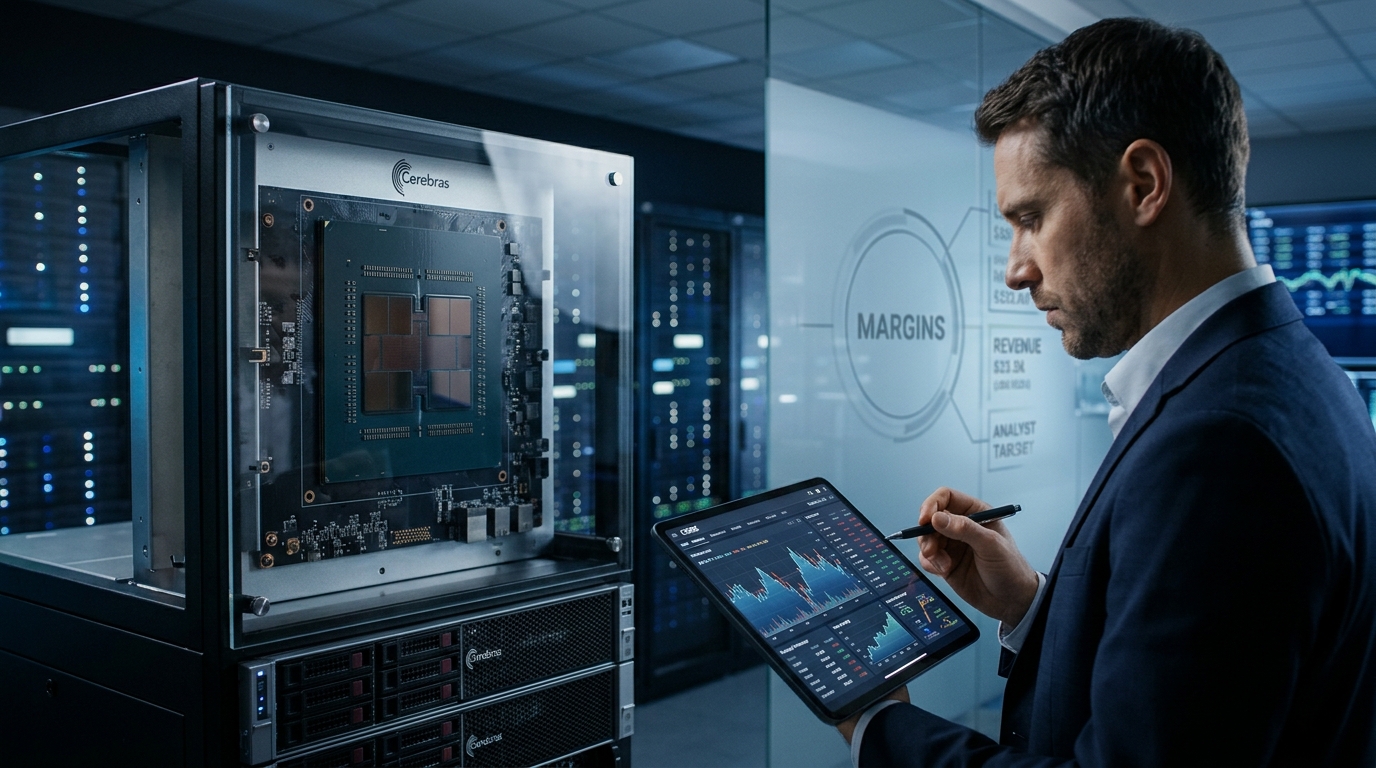
Cerebras Reports Thursday. Margins Decide Everything.
Analyst Targets
- UBS – Buy | Target $250 (lowered from $330, Nov. 2)
- Mizuho Securities – Buy | Target $300
- Barclays – Buy | Target $280
- Rosenblatt Securities – Buy | Target $300
- Craig-Hallum – Buy | Target $325
- TD Cowen – Buy | Target $175
- Consensus – Strong Buy | Average target $275.27 across 11 analysts
What Thursday’s Report Actually Tests
Cerebras Systems (CBRS) reports Q3 2026 results after the close on November 12. The stock last closed at $89.68 on Monday, November 2, sitting about 77% below the $386.34 high it set shortly after its May IPO, and below the $185 IPO price itself. Every bull thesis that surrounded one of 2026’s biggest IPOs now needs a quarter of hard evidence to survive.
The number that matters most is not revenue. It is gross margin.
Company Profile
Cerebras builds AI infrastructure around its wafer-scale engine, a chip that occupies an entire silicon wafer rather than a conventional die. The core proposition is inference speed: the company positions its chips as capable of delivering AI responses faster than GPU clusters, commanding a price premium because, as CEO Andrew Feldman has argued, fast inference is worth more than slow inference.
In December 2025, Cerebras signed a multi-year master relationship agreement with OpenAI under which OpenAI agreed to purchase 750MW of AI inference compute capacity. By Q2 2026, more than 600MW of data center capacity was under contract. The company has also described itself as the launch partner for OpenAI’s frontier model GPT-5.6 Sol, adding a revenue stream that sits alongside its hardware sales.
The Numbers Going In
Q3 consensus stands at $214.7 million in revenue and a $0.14 EPS loss. That aligns almost exactly with the guidance management issued in August: core revenue of $214 to $216 million, core gross margin in the range of 38% to 40%, and core operating margins of negative 25% to negative 23%.
Revenue growth is not in dispute. The trend is clean: Q1 core revenue was $191.3 million, up 92% year over year. Q2 core revenue surged 103% year over year to $209.9 million, with remaining performance obligations reaching $25.4 billion. Management raised its 2026 outlook in August to $880 million to $890 million of core revenue.
The profit line is a different story. In Q2, GAAP EPS came in at negative $2.98 versus a consensus estimate near negative $0.17 to negative $0.18, a miss of roughly $2.80. Most of the loss was tied to stock-based compensation and related charges, with the company disclosing $386.6 million of stock-based compensation expense in its GAAP-to-core reconciliation. On a core (non-GAAP) basis, core net loss was $6.9 million, and the GAAP headline rattled investors regardless.
The GAAP-versus-core gap is not unique to Cerebras. The broader AI infrastructure earnings season exposed how unevenly massive capital commitments are converting into actual margin.
Margin trajectory is the operational watch point. Core gross margin declined sequentially to 40.6% from 46.5% in Q1. Management has said Q3 should be the low point at 38% to 40%, before improving in Q4 as more lower-cost, company-owned systems come online. For the full year, management guided core gross margin of 41% to 43%.
Why the Stock Is Here
Three forces brought CBRS from $386 to under $90. First, the Q2 earnings reaction described above. Second, a short-seller attack: on October 28, Culper Research disclosed a short position and released a report questioning how long Cerebras wafer-scale chips last, claiming they remain functional for just 1.5 to 2.5 years in the field. Culper also alleged that Cerebras runs continuous dummy operations so systems never cool down, attributing that point to remarks it said were made by a Cerebras solutions architect at a June 2026 event in Berlin. Cerebras has not issued a point-by-point public rebuttal to those specific allegations. Third, upcoming lock-up expirations have been highlighted by bears as a technical overhang into the report.
Macro Context
Inference demand is real. The question is who captures it. Nvidia’s installed GPU base processes most inference workloads today; Cerebras is betting that raw speed at the chip level will carve out a premium tier. In its Q2 materials, Cerebras said it expects to bring its disaggregated inference offering to Amazon Bedrock in the first quarter of 2027, which sets the company’s own baseline for when AWS-linked momentum could become more visible. In the meantime, OpenAI remains central to the near-term concentration debate, even as management points to a growing customer list in areas like coding and security as an offset over time.
The OpenAI dependency cuts both ways. A delayed or scrapped OpenAI model release can reprice chip-stock valuations faster than any earnings miss.
Forward Scenarios
Bull
Q3 revenue comes in at or above the high end of the $214 to $216 million guide. Core gross margin holds at 40% or better, disproving the sequential deterioration feared after Q2. Management confirms the Q4 margin recovery path and reaffirms full-year guidance. The Culper wafer-durability claims get addressed on the call with concrete data. Shares recover toward the $150 range as the 2027 triple-revenue target becomes credible again.
Base
Revenue lands in-line around $215 million, gross margin comes in at the low end of guidance near 38%, and operating losses are wide but manageable. The OpenAI contract continues to convert at a steady pace. Management reaffirms 2027 growth without new detail. The stock stabilizes around current levels while the market waits for Q4 margin confirmation.
Bear
Revenue misses, gross margin drops below the 38% floor, and management either softens 2027 language or defers the question. Any acknowledgment of wafer replacement issues, however oblique, reopens the Culper thesis at scale. With lock-up related supply risk still in focus, additional selling pressure compounds any negative reaction. Shares retest the 52-week low of $77.84.
Technical Overlay
CBRS has no meaningful technical floor below $78, its 52-week low. The 50-day and 200-day moving averages are both well above current price, offering resistance rather than support on any rally. The gap from the May IPO open near $311 is unrecovered territory. A close above $110 post-earnings would be the first structural step toward rebuilding a base; below $80, the IPO investors who held through the decline face a decision on cost basis.
What to Watch Thursday
- Core gross margin versus the 38% to 40% guide. Any miss here is the single most important data point.
- OpenAI contribution and remaining performance obligation movement. The company has said it expects to recognize approximately 22% of the $25.4 billion in remaining performance obligations over the initial 24 months ending June 30, 2028.
- Management’s direct response to the Culper wafer-lifespan allegations.
- Q4 guidance and whether the full-year $880 to $890 million core revenue range is maintained.
- Any update on AWS-related commercialization and the timeline for first meaningful cash contribution.
Bottom Line
Cerebras has built a backlog that most semiconductor companies would spend a decade chasing. The challenge arriving Thursday is simpler and harder at once: show that the margin structure can support the business model at scale. Revenue growth at 90%-plus is not being questioned. What the market needs to see is whether gross margins stabilize as promised and whether management will confront the hardware durability question that has hung over the stock since late October. Management has committed to more than tripling revenue in 2027 against a roughly $21 billion market cap and persistent losses. That gap between ambition and profitability is exactly what Thursday’s call must begin to close.