
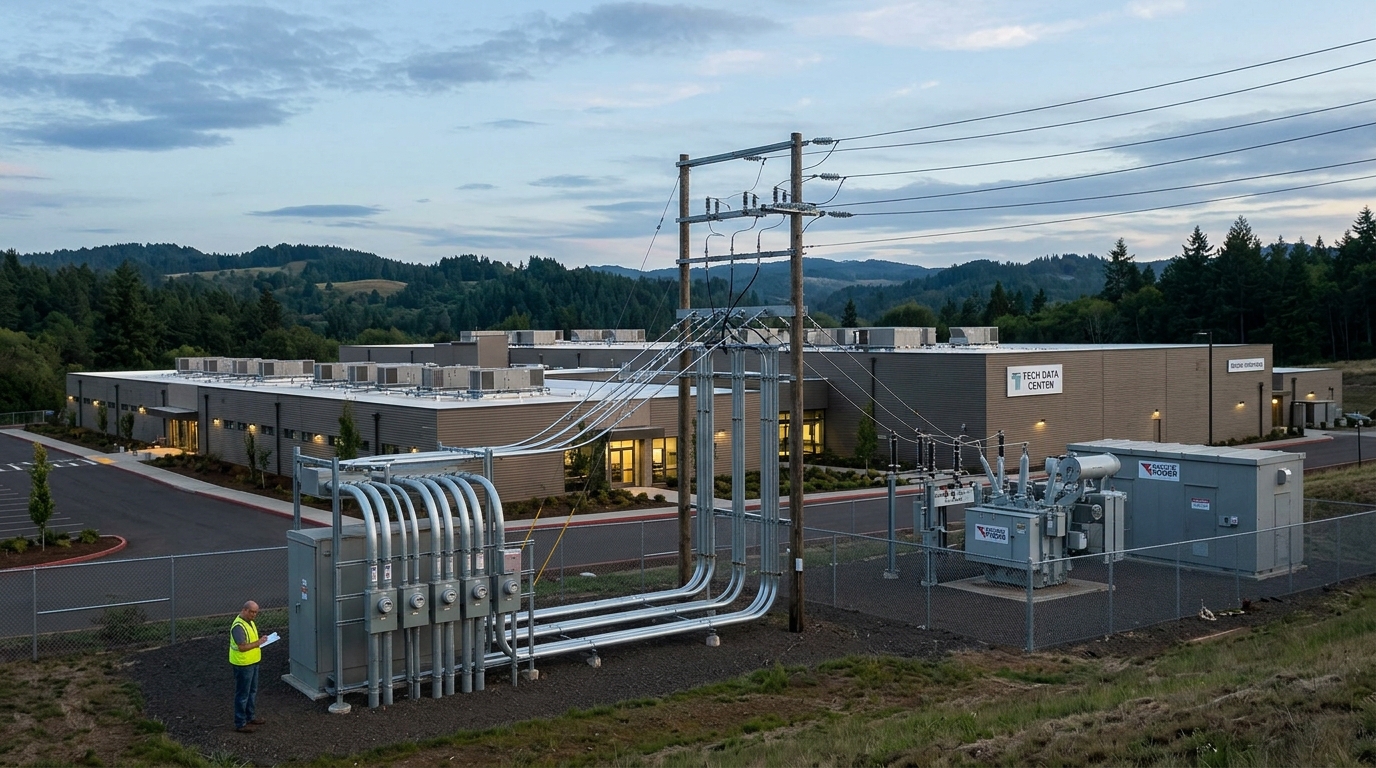
Oregon regulators approved something notable on Friday, November 13, 2026. The Oregon Public Utility Commission approved a new tariff requiring new large data centers in Pacific Power’s Oregon service area to pay the full cost of their electricity service. The newly created customer class applies to facilities that use or can use 20 megawatts or more of electricity for computing infrastructure, data processing, web hosting and related services.
The implications run well beyond Oregon’s borders. Amazon, Meta, and Google operate data centers in Oregon, and the rate rules apply to them, too. Data centers already make up a meaningful share of investor-owned utility load in Oregon, and state projections show that share rising further by 2030. This is not a local story. It is an early map of how governments are going to redistribute the financial burden of AI infrastructure.
The Business
Pacific Power is a subsidiary of PacifiCorp, which is owned by Berkshire Hathaway through Berkshire Hathaway Energy. Under the new plan, data centers using 20 megawatts or more are placed in their own customer class, meaning the cost of serving them gets charged directly to them rather than spread to other customers, and those facilities must sign long-term service agreements and pay for the electric infrastructure and services their operations need.
Data centers are responsible for the cost of electric infrastructure and services needed to support their operations, as well as the costs of energy purchased to serve them. That is a structurally different cost assignment than anything hyperscalers have faced at scale before.
Why Wall Street Is Paying Attention
The standard AI trade has been to buy the chip designers, the cloud platforms, or the hyperscalers themselves. Amazon, Alphabet, Microsoft, and Meta have collectively committed to spending well over $600 billion on AI infrastructure this year alone. Alphabet has said it plans to invest around $180 billion in 2026, and outside estimates have put Amazon’s 2026 spend around $200 billion. Those capital outlays include electricity-related infrastructure, which regulators are increasingly trying to keep from being shifted onto other ratepayers. Now regulators are closing that subsidy.
That changes who keeps the margin. A regulated utility with the legal right to charge data centers directly for dedicated infrastructure does not compete on chips or models. It competes on electrons, and in Oregon, it just won a government mandate to collect the costs its data center customers create.
What’s Driving the Opportunity
The case for BRK.B here is structural rather than headline-driven. PacifiCorp’s new tariff, effective January 1, 2027, locks future data center customers into rates that fully reflect their cost of service. After the state’s Public Utility Commission approved Portland General Electric’s comparable proposal in July 2026, new prices became effective July 8, 2026, with an average rate increase of about 30% for data center customers while residential customers saw an average rate decrease. Pacific Power’s version goes further, with Oregon Citizens’ Utility Board describing it as the strongest proposal from a for-profit electric utility under Oregon’s POWER Act. That is a durable revenue upgrade tied directly to the AI buildout, with regulators doing the enforcement.
Berkshire’s size matters here. PacifiCorp spans six states, and the Oregon model is already spreading. Since the POWER Act passed, Oregon regulators have described ongoing work on implementation and monitoring, and the broader pressure to allocate large-load costs more directly is not unique to one state. Each state that adopts a similar structure is a new cost-recovery mechanism for the utilities that serve those markets.
What Could Go Wrong
PacifiCorp is not a clean story. PacifiCorp’s credit rating sits one notch above non-investment grade after wildfire litigation, and the company suspended upstream dividends and reduced near-term capital expenditures. PacifiCorp recorded cumulative estimated probable losses of approximately $2.85 billion through September 30, 2026, tied to its Oregon wildfires litigation, amid ongoing legal uncertainty surrounding the James class actions and related proceedings. Those are real overhangs.
The Data Center Coalition opposed the PacifiCorp stipulation during the proceeding, and it has signaled objections in prior Oregon filings as well. A court reversal or other regulatory rollback would undercut the revenue logic entirely. And Berkshire Hathaway Energy’s results can swing with large, non-recurring items, so the near-term financials can look pressured even before the new tariff kicks in.
The Bottom Line
Most investors chasing the AI trade are buying the companies building the computers. The harder question is whether the companies selling the electricity, now legally entitled to charge full freight, capture a share of the economics with far less execution risk. Pacific Power’s new rate class is a regulated, government-enforced claim on data center spending. BRK.B is not a momentum trade, but for investors who want exposure to AI’s power appetite without betting on which hyperscaler wins, a utility that cannot legally be undercut on price deserves a closer look than it is getting today.