
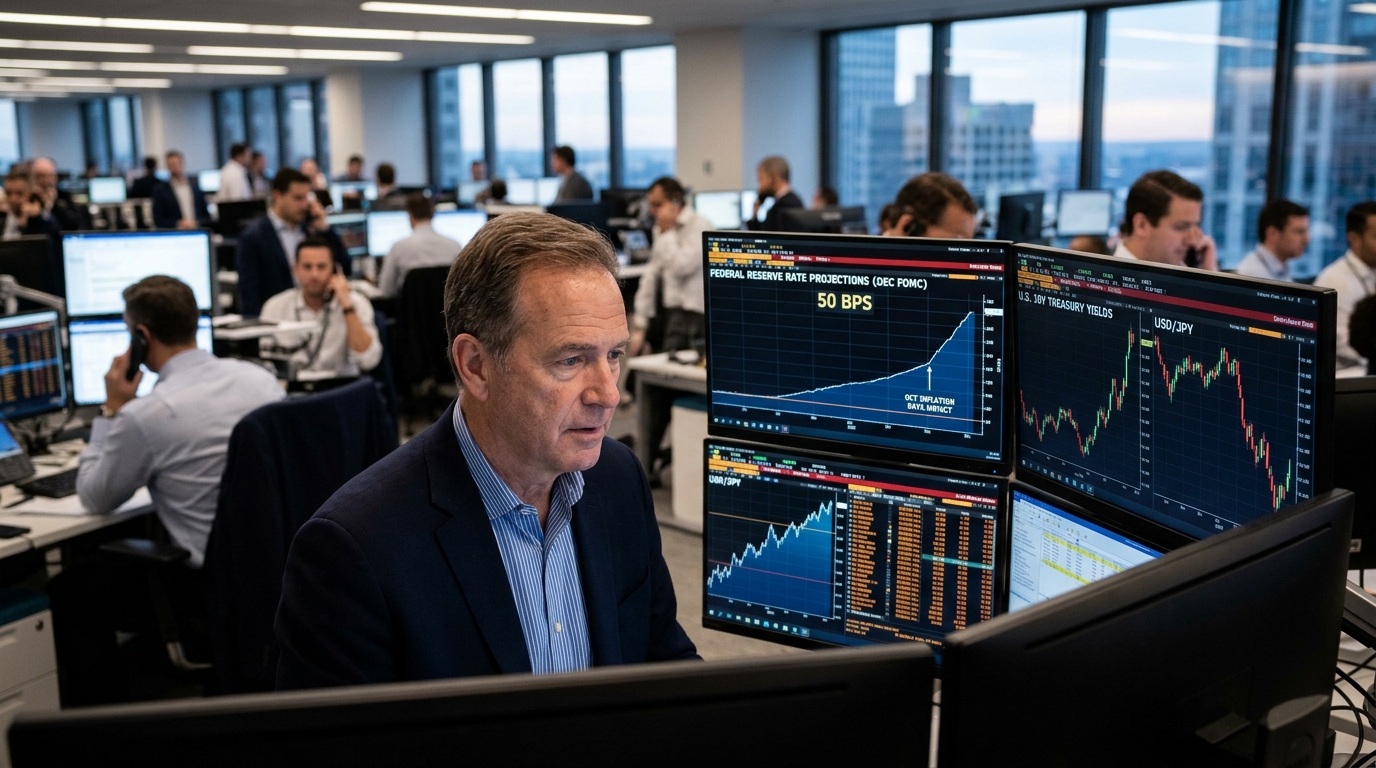
The Fed’s rate debate changed shape Tuesday morning and it has not changed back. Headline inflation came in at 0.4% month over month in October against the 0.3% expected, while core inflation rose by 0.3% month over month versus estimates of 0.2%. That double miss was enough to turn a theoretical risk into a live trade: a half-point move at the December 8-9 FOMC meeting.
Governor Christopher Waller warned that a half-percentage-point rate increase in December may be needed. That was followed by Dallas Fed President Lorie Logan, who signaled she favors further tightening and argued the Fed may need to move more quickly if inflation stays broad-based. Waller was explicit about the threshold: “I believe a 50 basis point hike in the policy rate should be considered at the December meeting.” October’s core reading hit it exactly.
Logan endorsed additional rate hikes, urging prompt action before persistent inflation becomes baked into behavior. Two policymakers, two speeches, one direction.
Based on CME pricing cited by Investing.com’s Fed Rate Monitor early Wednesday, markets were leaning toward a quarter-point move in December, with a meaningful minority assigning odds to a half-point hike. A hold is no longer the market’s base case. The only question is magnitude.
No Bond Market to Buffer the Pricing
Here is the structural problem for today’s session. U.S. stock markets will remain open on Veterans Day, but bond markets and most bank branches will close for the federal holiday. Two-year Treasury yields jumped roughly 17 basis points Tuesday to about 4.74%, while 10-year yields climbed around 11 basis points to just under 5%. Those moves are now frozen in place.
With bond market and fixed income traders out of action, there won’t be the usual response from cash Treasury yields to help gauge whether yesterday’s inflation shock is being digested or priced further. With no live cash Treasury market, equities lose a key reference point for interest rates, so stock moves may respond more to alternative signals such as futures and economic headlines. Equity volume usually thins on Veterans Day, which can magnify price swings in individual names.
Dollar and Yen Carry the Weight
USD/JPY rose to about 158.96 in Tokyo, essentially matching the pair’s recent peak. The U.S. dollar is bullish heading into Wednesday’s trading session, supported by stronger-than-expected U.S. inflation, rising Treasury yields, and expectations of another Federal Reserve rate hike in December. The dollar index is holding near a two-week high, while major currencies including the euro, pound, and Japanese yen remain under pressure.
Japan’s recent record-sized currency intervention means traders should remain cautious about renewed official action if the yen weakens further. The 159 level is not just a round number; it is the zone where Japanese authorities have recently shown a willingness to step in. Dollar bulls need to weigh that intervention risk against rate-differential momentum.
Trading Plan
Jeff Schulze, head investment strategist at the Franklin Templeton Institute, noted that the CPI release “will be a headwind to risk assets as investors price the possibility of a 50bp hike in December and additional hikes beyond, with higher front-end yields and a stronger dollar weighing on equity valuations.”
Rate-sensitive sectors, utilities and real estate in particular, face continued pressure as the market recalibrates a tightening path. For today, that argues for staying short duration and light on rate-sensitive long positions until Thursday, when cash Treasury trading reopens and yields can respond freely.
Watch USD/JPY around 159 for intervention signals, monitor VIX for any volatility spike in thinner conditions, and treat any equity bounce in growth names as a potential fading opportunity rather than a trend reversal. The Fed’s message from Tuesday has not been countered. Until it is, the path of least resistance runs with it.