Oil markets spent all of last week pricing a peace deal that has not been signed. Brent and WTI both posted steep weekly losses as markets bet that the post-election window could open the way to a U.S.-Iran agreement. Brent futures settled at $98.32 a barrel on Friday, November 6, and WTI settled at $90.83. Then the weekend happened.
What Changed Overnight
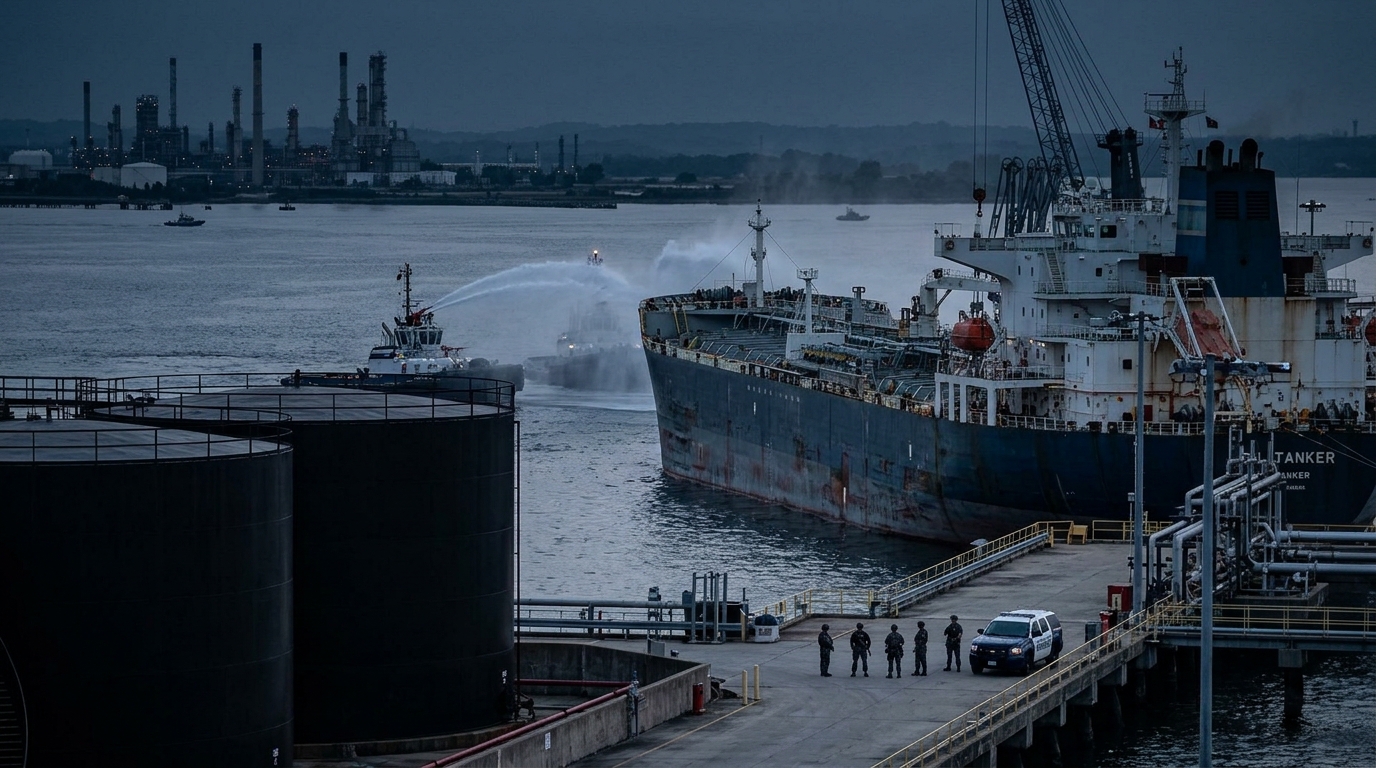
U.S. Central Command said late Saturday, November 7, that U.S. forces disabled a St. Kitts-flagged commercial vessel, the M/V Huda, after it ignored multiple warnings and attempted to leave the region after visiting an Iranian port. Reports tied to the incident said the UAE National Guard rescued 22 crew members after a fire broke out aboard the ship.
CENTCOM has described its naval blockade enforcement as intensifying since July. The M/V Huda episode underscores that the posture is no longer just signaling.
CENTCOM then announced Task Force Iron Gate, expanding its months-long naval blockade by targeting Iran’s land-based routes as well, with the stated aim of preventing the movement of advanced weapons systems, dual-use technologies, sanctioned materials, and illegal revenue streams across Iran’s land borders and the Caspian Sea. The Washington Post reported the task force is based in Tampa and that CENTCOM said the naval blockade has already prevented Iran from exporting more than $25 billion in crude oil.
Simultaneously, Tehran escalated verbally. The Associated Press reported that Iran’s Revolutionary Guard said it has lifted its self-imposed limit of about 2,000 kilometers on the range of its ballistic missiles, raising the prospect of seeking capabilities that could reach more distant targets. Iranian outlets and international reporting also quoted IRGC spokesman Hossein Mohebbi saying Iran should demonstrate capabilities in practice, not just through statements.
The Biggest Opportunity: Crude and Tankers on the Gap Open
Brent at $98.32 heading into Sunday night is a market still substantially discounting a ceasefire. The M/V Huda strike, Task Force Iron Gate’s launch, and Iran’s missile posturing are all pointing in the opposite direction. The asymmetry favors the long side of crude into Monday’s open. The question is how much of Friday’s peace premium unwinds.
The more interesting trade is in tanker shipping. Lloyd’s List reported that a basket of shipping stocks was up roughly 68 percent year-to-date, more than five times the gain of the SPDR S&P 500 ETF, with crude-tanker shares up about 120 percent year-to-date. Separately, some market reporting has described VLCC spot rates pushing past $1 million per day during the crisis, underscoring how extreme freight conditions can get when the Strait of Hormuz becomes a bottleneck.
Frontline (FRO), Teekay Tankers (TNK), and International Seaways (INSW) all sold off hard last week alongside crude, pricing a scenario in which the blockade softens. This weekend’s escalation invalidates that move. Each of those names deserves attention at the open Monday, particularly any that gaps down further on residual peace-deal positioning: that gap would be the entry, not a reason to avoid the trade.
Sector Rotation: Defense Firms In, Tanker Shorts Out
Task Force Iron Gate adds a land-interdiction dimension that widens the conflict’s footprint. That matters for U.S. defense contractors with C4ISR, logistics, and precision munitions exposure. The tanker names benefit from sustained disruption, but defense spending beneficiaries have a different duration profile: government contracts run for years, not freight cycles. Both deserve rotation weight this week, with defense weighted toward longer holds and tankers toward shorter, tactical positions tied to the blockade’s status.
The Trade Invalidation: Qatar’s Channel Is Still Open
Mediation efforts are still active. Axios reported this week that Vice President JD Vance has been involved in indirect talks with Iran and has been speaking frequently with Qatari Prime Minister Sheikh Mohammed bin Abdulrahman Al-Thani about negotiations, with sources describing progress as slow.
Separately, Reuters reported in late September that Iran presented a seven-day trust-building plan via Qatari mediators, and that President Donald Trump rejected that proposal. But rejected is not the same as dead. Any credible signal from Doha that a framework is imminent would push crude lower very fast and punish fresh longs in both crude and tankers. The trade thesis holds only as long as the blockade holds. Watch the Qatar channel daily.
Trader’s Action Plan
The highest-conviction move heading into Monday is a long bias on Brent and WTI, fading last week’s peace-deal discount with the kinetic escalation as the catalyst. Tanker names including FRO, TNK, and INSW are the leveraged expression of that same thesis, with freight rates capable of spiking to extreme levels in a Strait-of-Hormuz disruption. Size conservatively, given how violently these names swung last week. Set a clear invalidation: any confirmed diplomatic breakthrough from Doha reverses this entire trade. Until then, the blockade is being enforced with real force, and the market has not fully priced that.