
June 20, 2026
Musk’s Next Takeover Target
Featured: Amazon Is Lagging the Market. The Business Isn’t.
Dear Reader,
Something strange just happened in Washington…
And, according to research by tech visionary Ian King, “it could hand the world’s richest man an unprecedented amount of power…
While making his backers a fortune.”
To explain all the details, King just released a stunning new presentation.
If his research proves correct, a single move by Elon Musk could reshape the monetary system… beginning in a matter of weeks.
In other words, Elon is about to ‘flip the switch.’
And investors who act today could see the single greatest wealth-building opportunity in decades.
We recently sat down with King – who’s called just about every twist and turn of Musk’s career… including an early bet on Tesla that returned up to 1,000% in a little over a year.
For the time being, you can get his take on Musk’s latest innovation, free of charge, right here.
Regards,

Sarah Williams
Associate Editorial Manager, Banyan Hill Publishing
FEATURED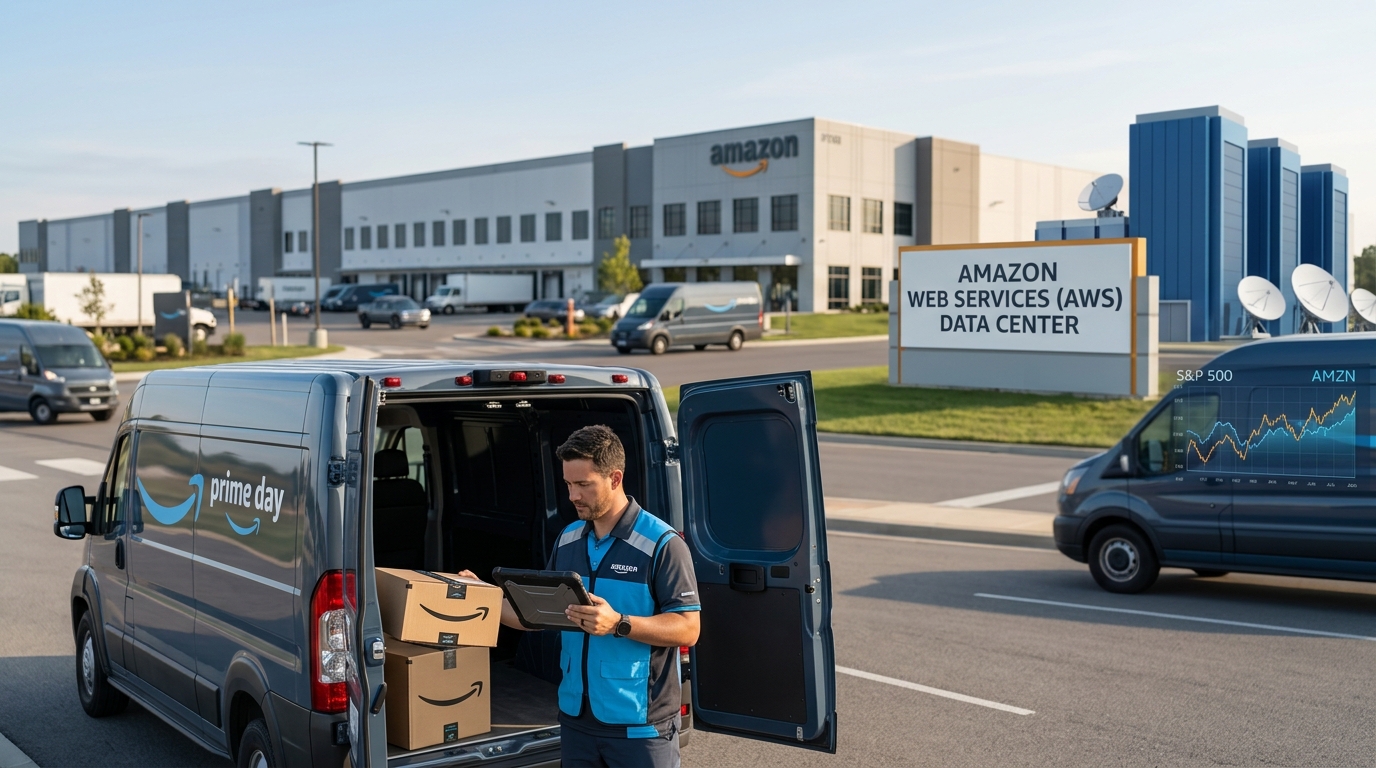
Amazon Is Lagging the Market. The Business Isn’t.
AMZN is up roughly 6% year-to-date, trading near $243. The S&P 500 has outpaced it. For a company running AWS at a $150 billion annualized revenue rate and an advertising business approaching $70 billion in trailing sales, that underperformance is worth examining.
This week matters. Prime Day 2026 kicks off June 23 and runs through June 26 — the first time since 2021 that Amazon has moved the event out of July. Four days, 35-plus product categories, AI-powered deal discovery through Alexa for Shopping, and a retailer that has spent the last decade turning a members-only sales event into the de facto mid-year commerce season.
But here is the thing. Prime Day is almost certainly not the most important thing happening at Amazon right now. It might not even be in the top three.
Pilots Use One. Smart Traders Should Too.
A pilot never takes off without running a checklist. Not because they don’t know how to fly – because they know that the moment something feels routine is the moment a step gets skipped.
Options trading punishes skipped steps faster than almost anything else. So, I put the 7 that matter most on one page.
It’s called the Smart Trade Options Checklist. Normally $29.97. Free today.
Run it before any options trade. Takes about 30 seconds. You’ll catch the bad ones before they cost you.
What the Numbers Actually Say
Q1 2026 results beat expectations on every major line. Net sales hit $181.5 billion, up 17% year over year, clearing the $177.3 billion consensus by 2.4%. AWS grew 28% to $37.6 billion — its fastest pace in 15 quarters — putting the cloud unit on an annualized run rate above $150 billion. Operating income climbed to $23.9 billion from $18.4 billion a year earlier, with the company posting a record 13.1% operating margin. Advertising revenue hit $17.24 billion for the quarter, up 24% year over year.
One note worth flagging on EPS: the reported $2.78 per share included roughly $16.8 billion in pre-tax gains from Amazon’s Anthropic investment. The underlying operational beat was real and significant, but the headline EPS figure overstates the recurring earnings picture. Investors tracking the core business should focus on operating income, which was clean and strong.
The advertising figure does not get enough attention. Trailing twelve-month advertising revenue now exceeds $70 billion. At that scale, Amazon’s ad business is larger than the entire AWS business was in 2018. Most of that revenue carries software-like incremental margins, which is why every point of ad growth matters more for earnings than equivalent retail growth — and why the segment has quietly become the swing factor for quarterly beats.
Wall Street consensus sits at Strong Buy: 45 buy ratings, one hold, with an average price target near $313 — implying roughly 28-30% upside from current levels. Bank of America has a $310 target. BMO Capital, after attending the AWS Summit, set a $355 target and called AMZN a Top Pick.
Prime Day Is the Distraction. Alexa for Shopping Is the Longer Story.
eMarketer expects Amazon’s U.S. Prime Day sales to rise 7.1% this year to $15.68 billion, giving Amazon a 60.3% share of total U.S. ecommerce during the four-day period. More than half of U.S. consumers — 55% — plan to shop this Prime Day, up from 45% who participated last year. Two-thirds expect to spend the same or more.
Bank of America analyst Justin Post is watching something more specific: Alexa for Shopping. He sees the AI assistant as a deal-discovery and purchase-tracking tool with the potential to generate more than $200 billion in incremental GMV by 2035 and $20 billion in incremental retail profit. That is not a Prime Day story. That is a decade-long flywheel story with AI at the center, and most investors are treating it as a footnote. Post separately expects the event to deliver $12.4 billion in incremental GMV in Q2 2026 alone.
The earlier June timing also creates a subtle math problem. Q2 numbers will be flattered by Prime Day volume. Q3 comparisons get harder. Investors focused purely on near-term quarterly beats may miss the more durable structural picture.
They’re calling it the ‘Freedom-Dividend’
Tech titans like Elon Musk, Sam Altman, and Mark Zuckerberg are calling for Universal Basic Income as AI threatens to eliminate millions of jobs.
But there’s a critical question few are asking: Who will pay for it?
Instead of relying on taxpayer funding, Mode Mobile is using attention as currency, already paying out $1B to their users. Deloitte crowned them North America’s fastest-growing software company in 2023 after their revenue soared 32,481%.
And investors have a window to get in early before this becomes the template for post-AI income redistribution.
They’ve secured their Nasdaq ticker $MODE, and their $0.50/share pre-IPO offering may not be open much longer.
Earn up to 20% bonus shares by investing in Mode now.
Please read the offering circular at invest.modemobile.com. This is a paid advertisement for Mode Mobile’s Regulation A Offering.
The Real Debate: Capital, Chips, and Time
In his April 2026 shareholder letter, CEO Andy Jassy disclosed that Amazon’s custom chip business — Graviton, Trainium, and Nitro — has crossed a $20 billion annualized revenue run rate and is growing at triple-digit rates year over year. Jassy added that if the business were sold externally like Nvidia does, it would represent roughly $50 billion in annual revenue. Trainium2 is largely sold out. Trainium3 began shipping in early 2026 and is nearly fully subscribed. Two large customers asked to buy all available Graviton capacity for 2026; Amazon said no.
Amazon has committed roughly $200 billion in 2026 capital expenditure, almost entirely tied to AI infrastructure. That is the central tension on the stock. Free cash flow timing is a legitimate concern. Investors want proof that spending converts into durable AWS revenue acceleration, not just capacity sitting idle. The Q1 acceleration to 28% growth was a meaningful signal. It was not definitive.
The AWS backlog stood at $364 billion as of Q1 — and that figure excludes a recently announced $100 billion commitment from Anthropic. Jassy’s argument on the earnings call was direct: the company is monetizing capacity as fast as it is installed. That claim will be tested in Q2 results, expected July 30.
Separately — and this deserves attention — the FTC drafted a potential complaint against Amazon as of June 16, 2026, over claims the company misled advertisers about ad pricing and terms. The investigation involves multiple state attorneys general and focuses on whether Amazon properly disclosed reserve pricing for search ads. Bloomberg reported the FTC could resolve the matter through a lawsuit or settlement as early as this summer. Amazon’s ad business generated $68.6 billion in revenue last year. A probe targeting that segment, at that scale, is not a peripheral concern.
Scenarios
- Bull: AWS accelerates further into Q3 on AI enterprise demand. Advertising compounds at 20%-plus. Alexa for Shopping begins showing measurable GMV impact. Prime Day beats the $15.68 billion estimate. The stock moves toward analyst consensus near $313 and beyond as capex concerns fade.
- Base: Prime Day delivers in line with estimates. AWS holds 26-28% growth. Advertising maintains high-teens to low-twenties growth. Stock grinds toward $270-280 as execution is steady but capex spend creates near-term free cash flow drag. FTC matter resolves via settlement without structural operational changes.
- Bear: FTC complaint is filed and escalates into a serious structural probe of the advertising business. Capex fails to translate into accelerating AWS revenue. Macro pressure weighs on retail spending heading into H2. Stock retests the April 2026 low near $196.
What investors may be underweighting: Amazon’s three core businesses — retail, cloud, advertising — are increasingly interdependent. Retail generates the consumer data that makes advertising more effective. Advertising margin funds the AI capex. AWS wins enterprise deals partly because of Amazon’s existing data infrastructure advantages. The sum-of-parts analysis most analysts run actually understates the compounding effects of that integration.
Done Trading by 10 AM With Triple-Digit Gains
What if one simple pattern at the market open could hand you gains like 240% on META and 139% on GLD? The Opening Bell Trade Guide reveals the exact setup, the timing, and why this window keeps producing outsized wins. Download it free before we start charging for it.
Technical Overlay
AMZN hit an all-time high of $278.56 on May 5, 2026, then pulled back to the $238-$244 range. The stock crossed below its 50-day moving average in early June and the 10-day has crossed bearishly below the 50-day as well. The 52-week range runs $196 to $278.56. The prior April low near $196 is the key technical level to watch on the downside. A reclaim of the $260 area would be the first meaningful sign that the May pullback is resolving rather than deepening.
The stock is underperforming the market this year. The business is not. That gap tends to close — one way or the other. The next catalyst is Q2 earnings on July 30, where the market will see whether Prime Day and AWS both delivered.
For informational purposes only.