
August 25, 2026
AeroVironment’s Sept. 9 Test: Can Earnings Match the Locust Deal?
The Army’s $400M+ laser award reset the thesis. Now Q1 FY27 results have to validate it.
The stock already moved. AeroVironment (AVAV) closed August 7 at $186.73, up 9.1% on the day and roughly 22% over five sessions, after Bloomberg reported the U.S. Army would purchase at least $400 million of its Locust counter-drone laser systems. By August 24, shares had fallen to $148.20. The contract euphoria has faded. What remains is a September 9 earnings report that must demonstrate whether the income statement can support the new identity the market just assigned to this company.
Analyst Targets
- Raymond James — Outperform, $210 (upgraded July 16)
- Piper Sandler — Buy/Overweight, $235 (reiterated Aug. 11)
- Clear Street — Buy, $247 (reiterated Aug. 7)
- Jefferies — Buy, $229
- Canaccord Genuity — Buy, $280
The Street consensus sits at Buy, with 17 of 20 analysts maintaining positive ratings. Targets cluster well above the current price, but the spread is wide: the high is $326, the low is $166, and the average implies more than 40% upside from Monday’s close. That gap reflects genuine disagreement about how quickly new awards convert to earnings.
Company Profile
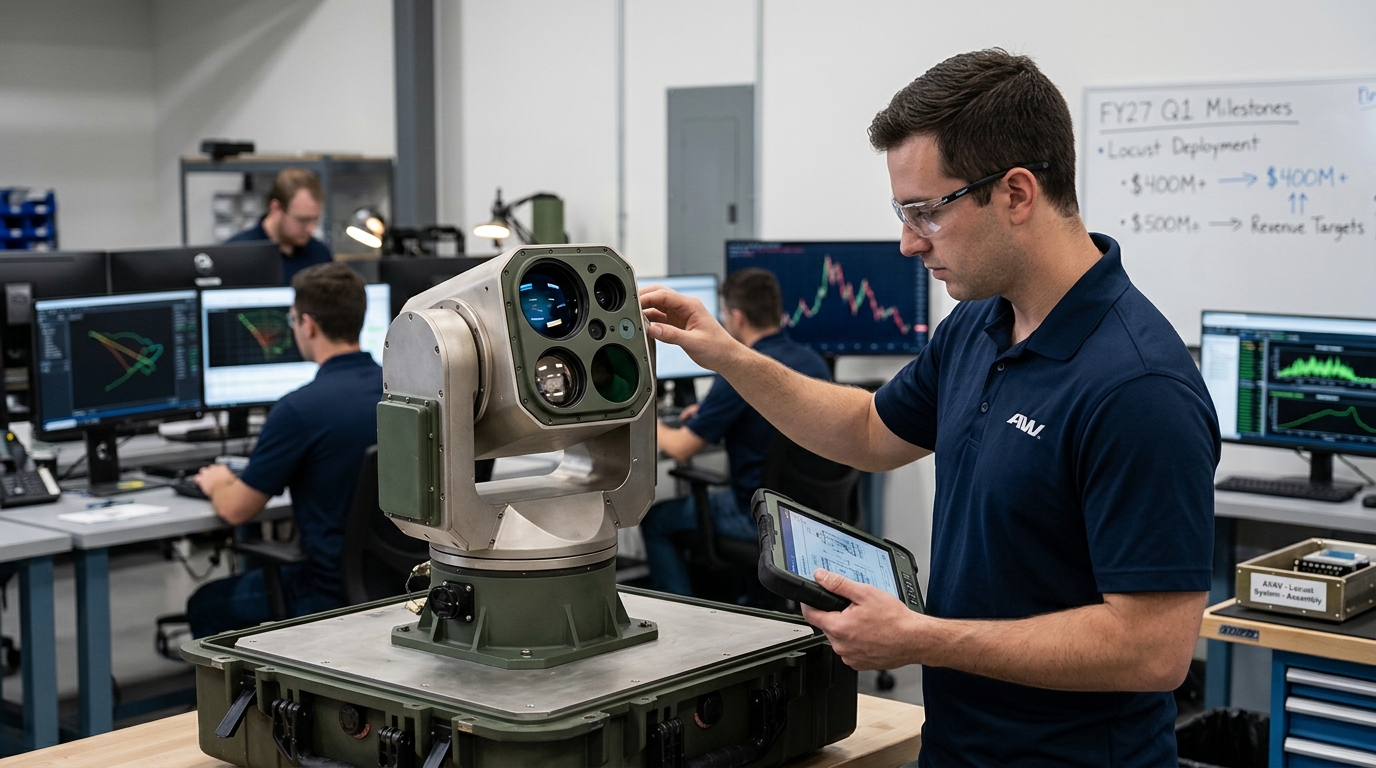
AeroVironment operates two segments: Autonomous Systems, which houses its Switchblade loitering munitions and small unmanned aircraft; and Space, Cyber and Directed Energy, the unit built largely around the May 1, 2025 BlueHalo acquisition. BlueHalo added counter-UAS platforms, cyber, and advanced solutions and nearly doubled the company’s revenue base. The Locust system, which uses AI to track and identify small to medium-sized drones before a high-energy laser destroys them, sits within the directed energy portfolio BlueHalo brought in.
FY26 revenue reached $2.0 billion, up from $820.6 million the prior year, almost entirely acquisition-driven. The funded backlog stood at $1.2 billion as of April 30, versus $726.6 million a year earlier.
Your Download Link Will Expire
If you still haven’t downloaded my free “Safe Trade Options Formula” guide…
…please take a few seconds and download it right now before your new temporary download link expires.
I eventually plan to charge money for this training, so do yourself a favor and download it now…
That way, no matter what it costs in the future, you’ll have a free copy on your computer.
Make sense?
The Numbers That Matter on Sept. 9
Management guided FY27 to revenue of $2.125-$2.225 billion and non-GAAP EPS of $3.02-$3.34, with adjusted EBITDA of $305-$325 million. The company has explicitly flagged results weighted heavily toward the second half of the fiscal year, which makes the Q1 FY27 release deceptively difficult. Consensus estimates for Q1 EPS are low, reflecting that seasonality and the company’s non-GAAP framework.
The structural complication is BlueHalo amortization. In Q1 FY26, intangible amortization and purchase accounting expenses hit $79.7 million at the operating line alone, turning what would have been a profitable quarter into a $69.3 million operating loss. FY26 finished with $240.7 million of goodwill impairment and enough intangible amortization to produce a full-year GAAP net loss of $265.1 million. Non-GAAP metrics strip those charges out, which is why the $3.02-$3.34 EPS guidance looks coherent while GAAP net income guidance for FY27 is only $8-$24 million. Investors must decide how much weight to place on adjusted figures when the amortization drag is this large and this persistent.
Why the Locust Contract Is Structurally Different
The Locust award is not simply incremental backlog. It is a meaningful signal that the Army is moving a directed-energy counter-drone system into production purchasing, not just testing. Bloomberg described the agreement as a purchase of dozens of systems with a minimum value of $400 million. For AeroVironment, moving from prototype to production means spreading manufacturing costs across a genuine production run, which is how directed-energy eventually reaches margin parity with conventional munitions. The counter-UAS market is widely expected to grow sharply through the end of the decade, but the precise spend figures and budget line items matter less than whether this particular program turns into repeatable orders.
Macro and Competitive Context
The operational backdrop remains supportive. CENTCOM launched a multinational attack-drone task force in August, underscoring how quickly low-cost one-way drones are reshaping operational planning. President Trump also announced tariffs targeting imports of unmanned aircraft systems and components in August, with the new duties slated to take effect September 3, 2026, another signal that domestic directed-energy and counter-UAS suppliers may be positioned to benefit. Kratos (KTOS) and Red Cat (RCAT) are active in adjacent markets, but neither is associated with this Army Locust purchase. Lockheed Martin (LMT) and RTX have directed-energy programs, but their scale makes a single $400 million order far less likely to be a strategic pivot.
Don’t sell your shares to him on Friday afternoon…
Every Friday afternoon like clockwork, a legendary trader scoops up shares knowing after-hours breaking news will have traders desperate on Monday morning to buy back from him for 5X… 10X… or even 100X what they sold for.
All the while he gets to collect as much as $9,518 OR MORE just for holding shares over the weekend.
Forward Scenarios Into Sept. 9
Bull: Q1 FY27 revenue comes in above the roughly $460 million implied quarterly run rate for the low end of guidance, organic growth in Autonomous Systems accelerates, and management raises full-year non-GAAP EPS guidance toward the top of the $3.02-$3.34 range. Analyst targets in the $230-$280 band become achievable within six months. The Locust award triggers follow-on orders and international inquiries, extending the backlog beyond FY28.
Base: Q1 FY27 revenue and EPS land near the low end of the run rate given the acknowledged second-half weighting. Management reaffirms full-year guidance without raising it. Shares hold the $145-$165 zone and grind higher through H2 as Locust revenue begins flowing through the SCDE segment. The 200-day EMA at roughly $205 acts as ceiling for several quarters.
Bear: BlueHalo amortization proves stickier than consensus models, and the non-GAAP EPS guidance range gets trimmed at the low end. SCAR-related litigation costs increase. Tariffs on drone components raise input costs faster than management’s manufacturing build-out in Salt Lake City and Huntsville can offset them. Shares retest the $135 June low.
Is the Declaration of Independence Missing its Most Valuable Page?
For 250 years, almost nobody noticed what Joel Litman believes America’s founders left unfinished. Today, he says that forgotten blueprint could help determine where the next $10 trillion of wealth is created.
Technical Overlay
AVAV hit a corrective low of $135.20 in June, completing an 88.6% Fibonacci retracement of the prior advance, and has since reclaimed both the 200-week and 20-week moving averages. The contract-day surge to $187 was real momentum, but the stock has since given back roughly 18% of that move. Current resistance is the $162-$163 zone, near the 50-day average. A close above $200 would break the sequence of lower swing highs and represent a genuine trend change. Until that happens, this is a recovery within a longer downtrend, not a confirmed reversal. Support is firm near $140-$141, where institutional buyers stepped in aggressively through most of Q3.
What to Watch on Sept. 9
- SCDE segment revenue: The unit housing Locust needs to show growth independent of BlueHalo’s acquired base.
- Book-to-bill: FY26 finished strong, but any quarter that dips below 1.0 would signal pipeline concern.
- Amortization schedule: Management commentary on when BlueHalo purchase accounting charges begin to taper is the single most important non-revenue data point.
- Locust program update: Delivery timelines and any additional Army negotiation signals for the Enduring High Energy Laser program.
- Free cash flow guidance: Management has already signaled FY27 free cash flow will be negative given capital expenditure running at 12-14% of revenue for facility expansion.
Bottom Line
The Locust contract settled a strategic question: AeroVironment can win production-scale directed-energy business. September 9 asks a different question entirely, one about execution margin and amortization reality. With shares below their contract-day close and about 64% below their 52-week high, the stock prices in a lot of skepticism. What it does not yet price in is a quarter where the P&L actually reflects the new contract class. That is the moment this thesis either accelerates or stalls again.
For informational purposes only.