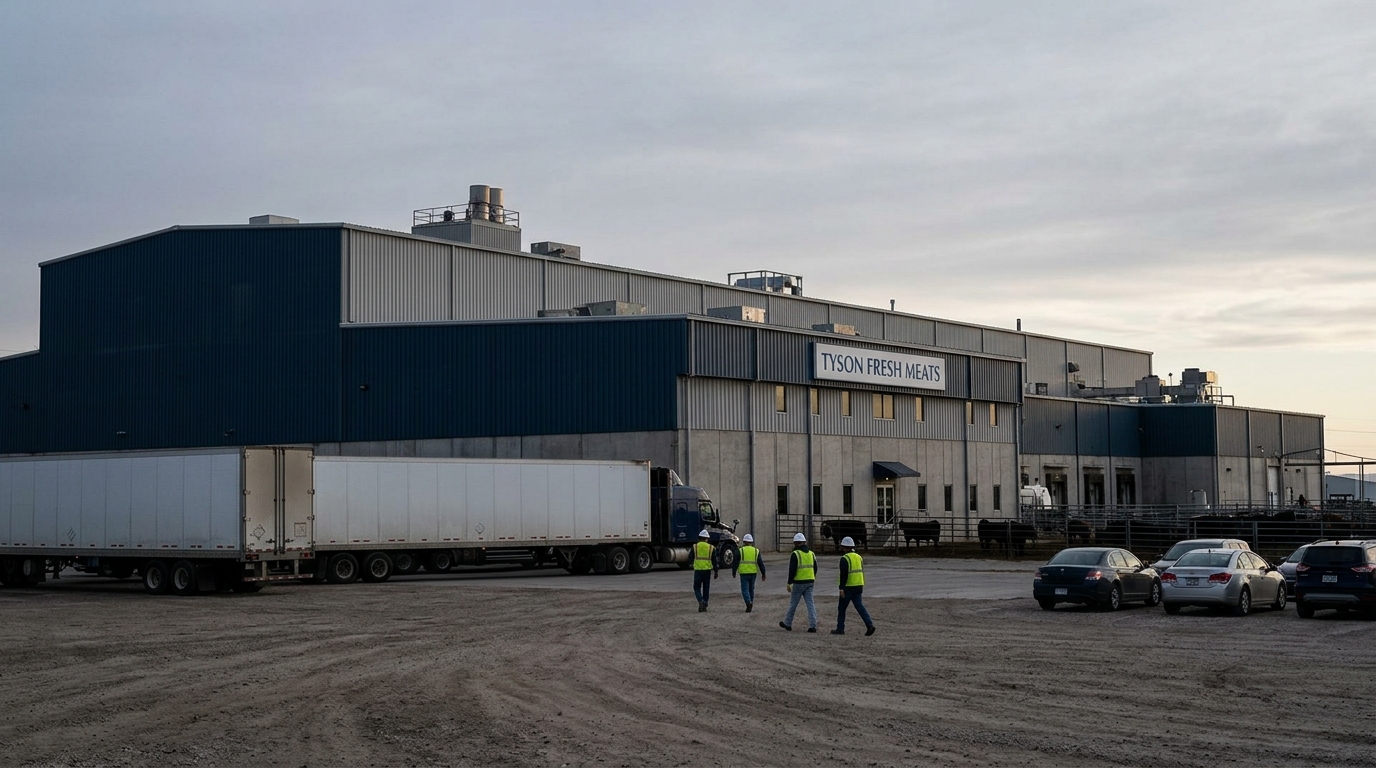
Cattle at a 75-year low. Three plants closing. A beef division bleeding up to $650 million this fiscal year. Before Trump said a word on Friday, Tyson Foods (TSN) was already one of the most consequential stories in U.S. protein markets. The presidential Truth Social post that landed August 28 adds political noise on top of a financial situation that deserves a cleaner read.
What Trump Actually Said, and Didn’t
Trump did not sign a final order Friday; he said he was authorizing legal documents to be drawn. Existing federal inspection and sales restrictions remain in effect. His plan could expand an exemption, make it easier for small facilities to qualify for inspection, or broaden interstate sales, but the administration has not released sufficient details to determine which rules will change. Agriculture Secretary Brooke Rollins signaled that more specific announcements would come Monday, including expanding ranchers’ ability to sell across state lines and support for smaller processors. That is a roadmap, not a regulation. Until the legal documents are published, investors are reacting to a social media post.
Four companies, Cargill, Tyson Foods, JBS USA, and National Beef Packing Co, control about 85% of U.S. beef processing. Eroding that concentration meaningfully would require years of capital investment in small processing facilities, federal inspection infrastructure, and cold-chain logistics. Farm and ranch groups have argued for years that consolidation has made it difficult for small producers to stay afloat because there are not many companies competing to buy their cattle, and they must transport animals to USDA-inspected plants, sometimes at high cost. The grievance is real; the timeline for any structural fix is long.
The Actual Problem Inside Tyson
Tyson on August 3 warned that losses in its beef business would widen as tight cattle supplies keep livestock costs elevated, forecasting an adjusted operating loss of $500 million to $650 million in fiscal 2026 for its beef business, compared with a previous forecast of $350 million to $500 million. In mid-August, Tyson also announced it would close its Joslin, Illinois, and Eagle Mountain, Utah, beef facilities and pursue the sale of its Pasco, Washington, plant.
The cause is structural, not managerial. Cattle supplies shrank to a 75-year low after a prolonged drought burned up grazing lands in the western U.S., compounded by the U.S. suspending live cattle imports from Mexico over New World screwworm. The average retail price of one pound of lean and extra lean ground beef reached a record $8.65 in June, according to federal data. CEO Donnie King has pointed to limited heifer retention as a sign that these supply constraints are likely to persist.
The Offset the Market Keeps Underweighting
Chicken, prepared foods, pork, and international operations delivered solid results in Q3, and Tyson maintained its $2.1 billion to $2.3 billion adjusted operating income outlook while expecting $1.3 billion to $1.7 billion in free cash flow. The chicken segment posted $488 million in operating income at an 11.2% margin, with CEO Donnie King noting that roughly 75% of chicken operating income now comes from a pull-based, value-added model built on strategic customer commitments and branded products. That is not a commodity business reacting to cattle cycles.
Bull and Bear
Bull: Tyson is shrinking its beef footprint deliberately, concentrating capacity around three central plants in Nebraska, Kansas, and Texas. Meatpackers should see some relief as the U.S. begins resuming live cattle imports from Mexico, with shipments starting August 24 through one Arizona port. When the herd cycle turns, a leaner beef network with lower fixed costs could recover faster than the market expects.
Bear: It may take months for Tyson to benefit from the Mexico import reopening, because imported feeder cattle must spend time grazing on grass or being fattened in feedlots before slaughter. Add a regulatory overhang from the DOJ antitrust probe and the political pressure campaign, and the next twelve months carry more uncertainty than the guidance range reflects.
What to Watch
Monday’s USDA announcements are the immediate catalyst. If the administration produces something narrow, expanded interstate sales for state-inspected facilities, for example, market reaction will likely fade quickly and the focus returns to cattle fundamentals. If the order attempts to broadly reduce federal inspection requirements, the food safety backlash will be severe and the legal challenges immediate. Industry groups have already warned that whatever Trump does should not compromise food safety, arguing that weakening inspection standards would put consumers at risk.
For Tyson specifically, the Q4 earnings call and any update to fiscal 2027 beef guidance will matter far more than Friday’s Truth Social post. The stock is not cheap enough to ignore the beef losses and not broken enough to abandon the chicken story. Both things are true at once, and that is the actual decision investors face today.