September 8, 2026
Bonus Content: Bombardier Faces a US Sales Ban. Gulfstream and Textron Stand to Gain.
Dear Reader,
The biggest mistake investors made during America’s first Great Deflation was buying the railroads.
More than 100 of those railroads eventually went bankrupt.
The best investments were the companies that used collapsing freight costs to crush their competition.
And I believe investors are making the exact same mistake with AI today.
They’re piling into the obvious “railroads”: NVIDIA, Microsoft, Meta, and Google.
Meanwhile, one little-known aerospace manufacturer has connected 19 factories around the world into a single AI-ready data system.
And it is already producing remarkable results.
Its record profit margins climbed 25% year over year.
Revenue rose 11% last year.
But I don’t believe the story is finished.
This company isn’t trying to build the next artificial-intelligence empire. It’s using AI to make every factory faster, leaner, and more profitable.
It has now hit all five triggers in my proprietary stock-selection system, including accelerating sales, rising earnings, breakout momentum, insider buying, and meaningful disruption.
Don’t make the mistake of chasing the railroad while this potential “Price Killer” races ahead.
Good investing,
Alexander Green
Chief Investment Strategist, The Oxford Club
P.S. 19 connected factories, record margins, and all five of my triggers tell me the larger story may still be ahead.
See my larger prediction here.
Bombardier Faces a US Sales Ban. Gulfstream and Textron Stand to Gain.
Trump’s trade war with Canada has acquired a precise industrial target. In a Truth Social post on Monday afternoon, the president declared that Bombardier (BBD.B) can no longer sell in the United States unless it builds its jets here. Reuters reported the post came hours before Canada’s counter-tariffs were set to take effect at 12:01 a.m. Tuesday, September 8, 2026, making the timing difficult to read as anything other than deliberate escalation.
The threat is large in ambition and murky in execution. Reuters and local reporting said Trump cited Bombardier’s reliance on the US market, but the company has not consistently disclosed a single, clean “US revenue share” figure in its quarterly headlines, so “more than 50%” is best treated as directional rather than precise. Bombardier fired back with its own footprint claims: 3,500 American employees, 2,800 US suppliers across 47 states, and more than $2.5 billion in annual US spending. It also noted that US workers build wings for its Global program in Texas. The Federal Aviation Administration, not the White House, certifies aircraft for the American market, so the precise legal mechanism for a sales ban remains unclear.
Republican resistance surfaced within hours. Kansas Senator Jerry Moran, whose state hosts Bombardier’s US headquarters in Wichita, contacted the Trump administration directly, noting that the Wichita operation supports more than a thousand local employees tied to defense and aerospace work. His intervention is the latest sign that GOP senators in trade-exposed states are increasingly uncomfortable with how the Canada dispute is landing on their own constituents.
The Competitive Arithmetic
Set the politics aside and focus on the order books. If even a fraction of US corporate flight departments and fractional operators reconsidered a Challenger or Global purchase, there are two obvious beneficiaries.
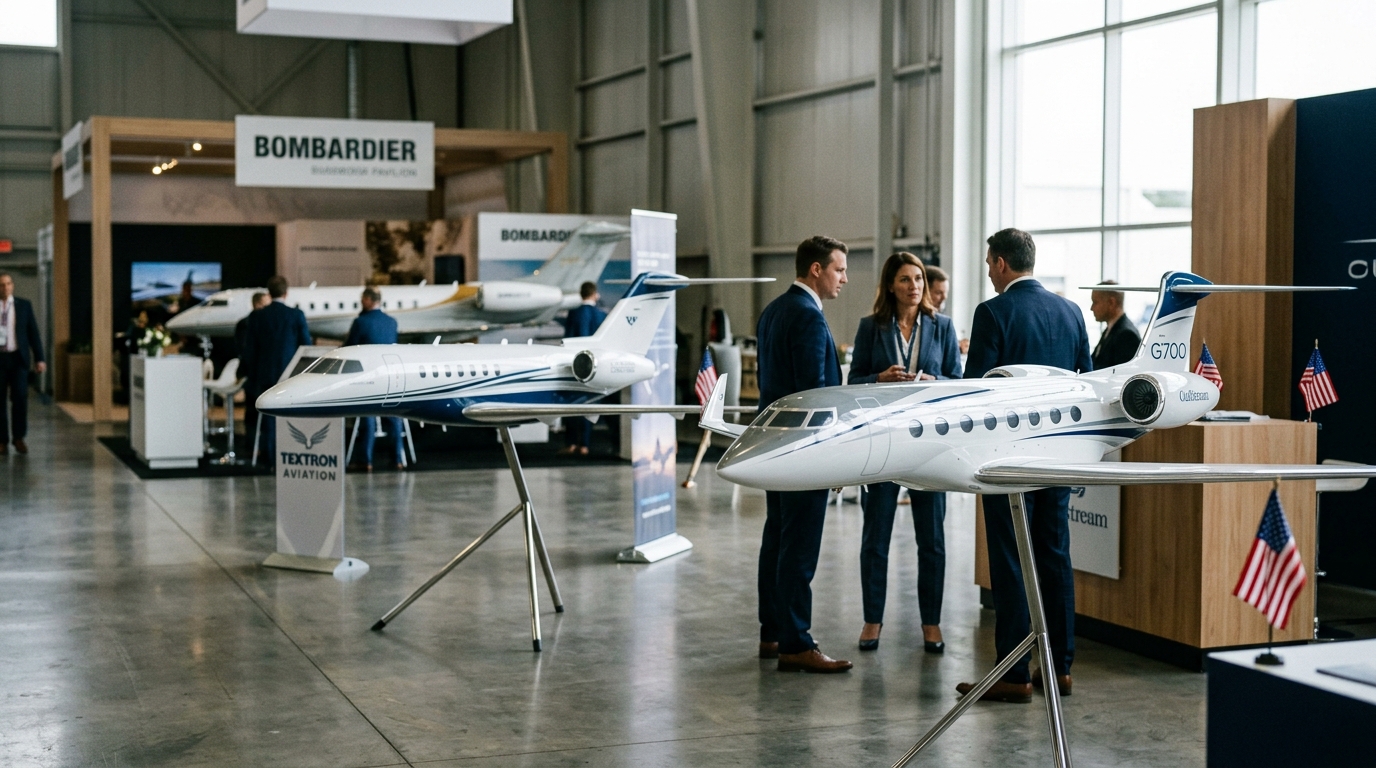
General Dynamics (GD), through Gulfstream, is the natural first call for large-cabin and ultra-long-range buyers. The Savannah line posted its strongest order quarter since 2022 in Q2 2026, booking $5.3 billion in new orders. The Gulfstream backlog reached $24 billion at the end of June. GD also raised its full-year Aerospace revenue guidance to about $13.8 billion, with about 160 planned aircraft deliveries. The G700 recently hit its 100th delivery. The problem for any buyer hoping to capitalize on Bombardier uncertainty: Gulfstream is already selling faster than it can produce, and new-build slots may not open for years.
Textron (TXT) sits in an adjacent but not identical lane. The Citation family dominates the light and midsize segments where Bombardier’s Challenger competes most directly. Textron Aviation carried an $8.0 billion backlog at the end of Q2, but delivered only 40 jets in the quarter against 49 a year earlier. CEO Lisa Atherton has cited 200 annual jet deliveries as the target; the company managed 77 in the first half. Manufacturing inefficiencies and a workforce where half the employees joined fewer than five years ago constrain output. A surge of diverted demand would extend already stretched lead times, not accelerate them.
Bull / Base / Bear
- Bull (GD, TXT): The White House converts the Truth Social post into formal trade action. US fractional operators, led by NetJets, delay Challenger option exercises and redirect fleet orders. Gulfstream backlog and pricing power extend further; Textron wins light-end substitution business. Both stocks re-rate on a durable demand shift.
- Base: The threat stays rhetorical. Bombardier’s demonstrated US footprint, GOP pushback from Moran, and the FAA certification barrier collectively blunt formal action. Buyers pause but do not cancel. Gulfstream and Textron see modest inquiry upticks, nothing that changes delivery schedules in 2026.
- Bear (BBD.B): Even an unenforceable ban creates enough uncertainty that US corporate buyers defer new Challenger or Global commitments into 2027. Bombardier’s backlog of $21.8 billion holds for now, but order intake slows. Its 1.5x unit book-to-bill from Q2 becomes a high-water mark rather than a run rate.
What to Watch
The next signal is whether the White House follows Monday’s post with a formal executive order or regulatory directive, or whether Moran’s intervention absorbs the moment. Watch for any comment from NetJets, which holds options on up to 232 Bombardier Challenger 3500s that Bombardier has said could total more than $6 billion at list. A NetJets statement in either direction would move more than the Truth Social post did.
Canada’s counter-tariffs now cover $27.6 billion of US goods at rates ranging from 15% to 50%. The trade talks that collapsed in August left no obvious off-ramp. Aerospace was not in the original tariff list, which means Bombardier was chosen as a symbol rather than extracted from a formula. That distinction matters for the legal durability of any ban, but it does not make the business uncertainty easier to price.
Bottom Line: Gulfstream and Textron are the mechanical beneficiaries of any sustained Bombardier exclusion, but neither has the spare factory capacity to absorb a meaningful demand shift quickly. The real trade in GD and TXT is not a demand windfall in 2026. It is whether the Canada dispute accelerates the pricing of US-sourced business jet lead times and backlog value that was already under way before Monday’s post.