
Dear Reader,
The Iran war just exposed a terrifying reality:
Modern warfare now belongs to drones, AI, and autonomous weapons.
And one private company is quietly becoming the center of it all.
Its founder is being called…
“The Next Elon Musk.”
And “Silicon Valley’s Oppenheimer.”
The company already has over $26 billion in government contracts tied to AI warfare and defense systems.
But because it’s still private…
Most investors are completely locked out.
That’s why we’re excited to help reveal a little-known 4-letter ticker symbol that gives you rare pre-IPO exposure – completely FREE.
One of our colleagues, a 30-year venture capitalist, found this backdoor.
And you can use it any standard brokerage account.
Early investors could be looking at a potential homerun before the IPO frenzy begins.
👉 Click here now to get the free ticker symbol from our VC friend.
Vail Resorts Reports Monday. The Pass Book Is the Only Number That Matters.
Analyst Targets
- Stifel: Buy, price target $161 (lowered from $167 ahead of earnings)
- Mizuho: Outperform, price target $160 (lowered from $174)
- Morgan Stanley: Equal Weight, $147
- Barclays: Underweight, $119
- Consensus: Mixed, with average targets clustering in the mid-$140s to low-$150s
The Stakes Going In
Vail Resorts (MTN) reports fiscal fourth-quarter and full-year results after Monday’s close, covering the period ended July 31, 2026. Shares are trading near $136 and the stock sits below its 200-day moving average. The market has priced in a difficult year. What it has not yet priced is what comes next.
That answer lives in a single disclosure: the advance-commitment pass sales figure for the 2026/27 North American ski season. Everything else Monday is already broadly known.
What the Business Just Survived
The 2025/26 ski season was, by management’s own description, one of the most challenging in the company’s history. Western snowfall and early-season coverage were weak, and the company said skier visits across its North American resorts were down 14.9% year-over-year, with lift revenue down 5.6%, ski school revenue down 12%, and dining down 11.7% through April. Management also said the Rockies were down 25% for the season.
The damage compounded across every quarter. By the time Vail reported Q3 results in June, Resort EBITDA had dropped to $586.4 million versus $647.7 million a year earlier, and full-year guidance had been cut to net income of $128 million to $162 million with Resort EBITDA of $735 million to $755 million. The quarterly dividend of $2.22 per share remains unchanged.
The Numbers Wall Street Expects
For Q4 specifically, published estimates vary, but the quarter is expected to be a loss quarter on roughly flat year-over-year revenue. Q4 is always a loss quarter: it covers the summer months and generates minimal ski revenue. The real read is the full-year EBITDA result against guidance and, far more importantly, the pass book update.
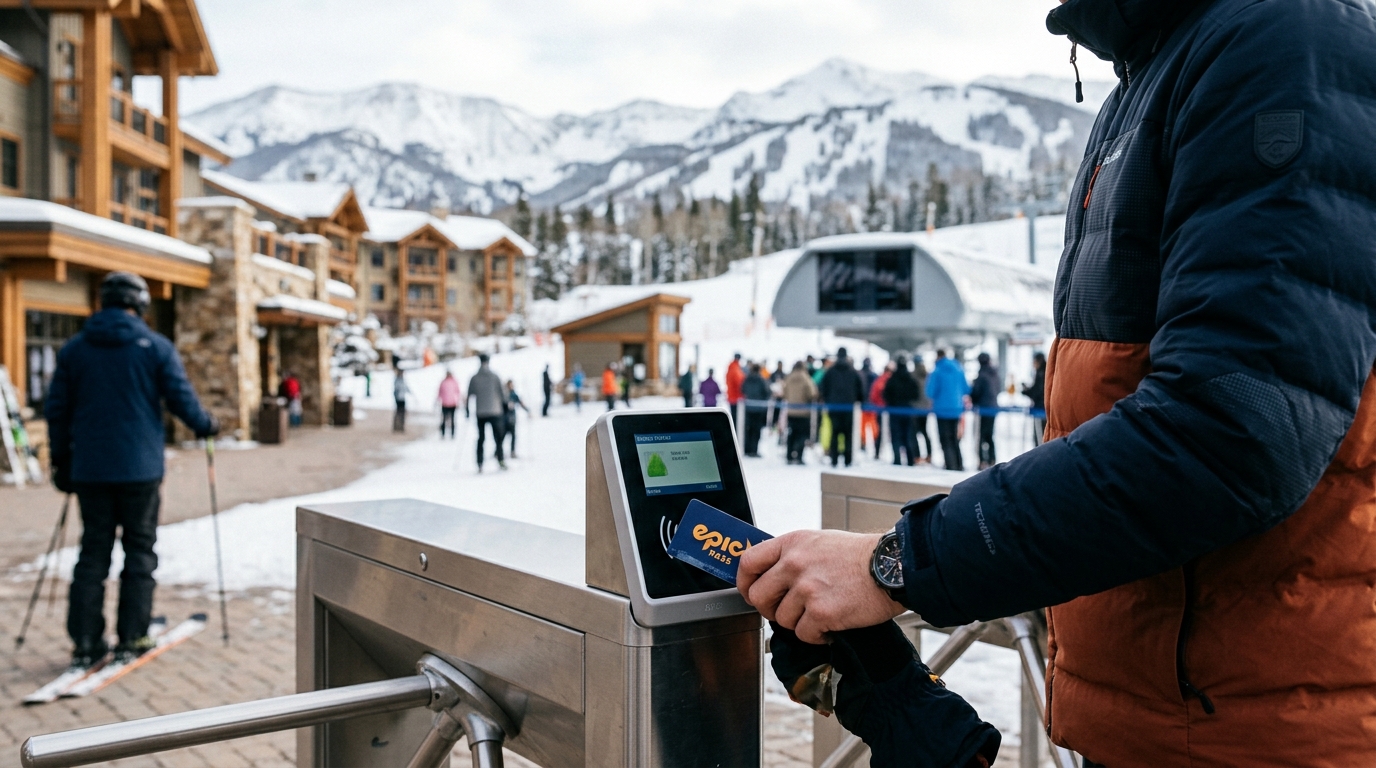
The early signal was brutal. Through the late-May deadline, Vail said North American pass units for the 2026/27 season were down approximately 10%, days sold off 8%, and sales dollars down 5% (inclusive of taxes). Weakness was concentrated in the weather-hit destination markets.
Since Q3, however, the company has pushed hard. Epic Pass pricing deadlines ran through early September, new Young Adult products were outperforming other cohorts as of the Q3 update, and Epic Australia Pass units were up 26% with sales dollars up 31%. The full fall selling period data lands Monday.
The Proxy Fight Reframes Everything
Oasis Management, the Hong Kong-based activist, raised its stake in Vail to about 7.4% as of September 22, 2026. In an amended Schedule 13D, the group disclosed aggregate ownership of 2,623,912 shares and said it paid approximately $373 million (excluding commissions) to acquire the position.
Oasis is pressing for board change. In its filing, Oasis called Vail’s portfolio of 42 mountain resorts across four countries “irreplaceable” and argued a reconstituted board could improve guest experience, pricing and marketing effectiveness, and operational efficiency, including food and beverage and relationships with host communities. Oasis nominated four director candidates, including former Disney CEO Bob Chapek and Olympic ski racer Picabo Street.
A strong pass book hands Katz leverage to resist board changes. A weak one gives Oasis exactly the evidence it needs at the shareholder meeting.
Forward Scenarios
Bull: Fall pass sales show meaningful recovery from the spring trough, with units down less than 5% and dollars roughly flat or positive as higher pricing offsets some unit weakness. Management guides fiscal 2027 Resort EBITDA above $850 million. Shares close the gap toward the mid-$150s within the quarter.
Base: Pass units remain down in the high single digits but the pace of decline has stabilized. Management frames this as recovery in progress, cost efficiency remains on track, and the proxy fight stays contested but contained. Stock trades sideways around current levels through year-end.
Bear: Pass units are still down more than 10%, with no clear inflection. The dividend payout ratio looks unsustainable, the Oasis slate gains institutional support, and MTN retests the low-$120s.
Technical Overlay
MTN is trading below its 200-day moving average, a level that has acted as overhead resistance since the Q3 earnings drop in June. Immediate support sits around $130, with a downside line in the low-$120s as the level below which the fundamental thesis is materially impaired. A pass book that surprises to the upside could push the stock back through $145, the next meaningful resistance zone, in one session.
What Investors Should Watch
- Pass unit change versus the prior selling period: the spring read was down 10%, so any improvement in that figure is the key catalyst
- Sales dollars: Vail has pricing power even in a weak unit environment; dollars down less than units signals the model is holding
- Full-year 2027 Resort EBITDA guidance range: the midpoint relative to $735 to $755 million tells you how fast management thinks the recovery arrives
- Any commentary on Oasis or the proxy timeline
- Dividend coverage language: whether management explicitly defends the payout or hedges it
Bottom Line
The fiscal year is over. The bad winter is priced in. What Monday’s release actually decides is whether the Epic Pass model absorbs a historic weather shock and bounces, or whether the damage was structural enough to delay recovery into fiscal 2028. That question has a direct answer in the pass book. If the fall selling period shows the spring decline was the floor, MTN is cheap. If it confirms the decline is persisting, Oasis has its argument, and investors do not.