
Analyst Targets
- J.P. Morgan — Overweight, $385 target (28% implied upside from Tuesday’s close)
- Wells Fargo — Buy, $362 target (21% implied upside)
- Morgan Stanley — Overweight, $369 target (23% implied upside)
- Goldman Sachs — Neutral, $305 target (roughly in line)
- Talen Energy (TLN): Morgan Stanley Overweight at $514; consensus average near $461
- Vistra (VST): BMO Capital Outperform, $210 target
What Just Happened
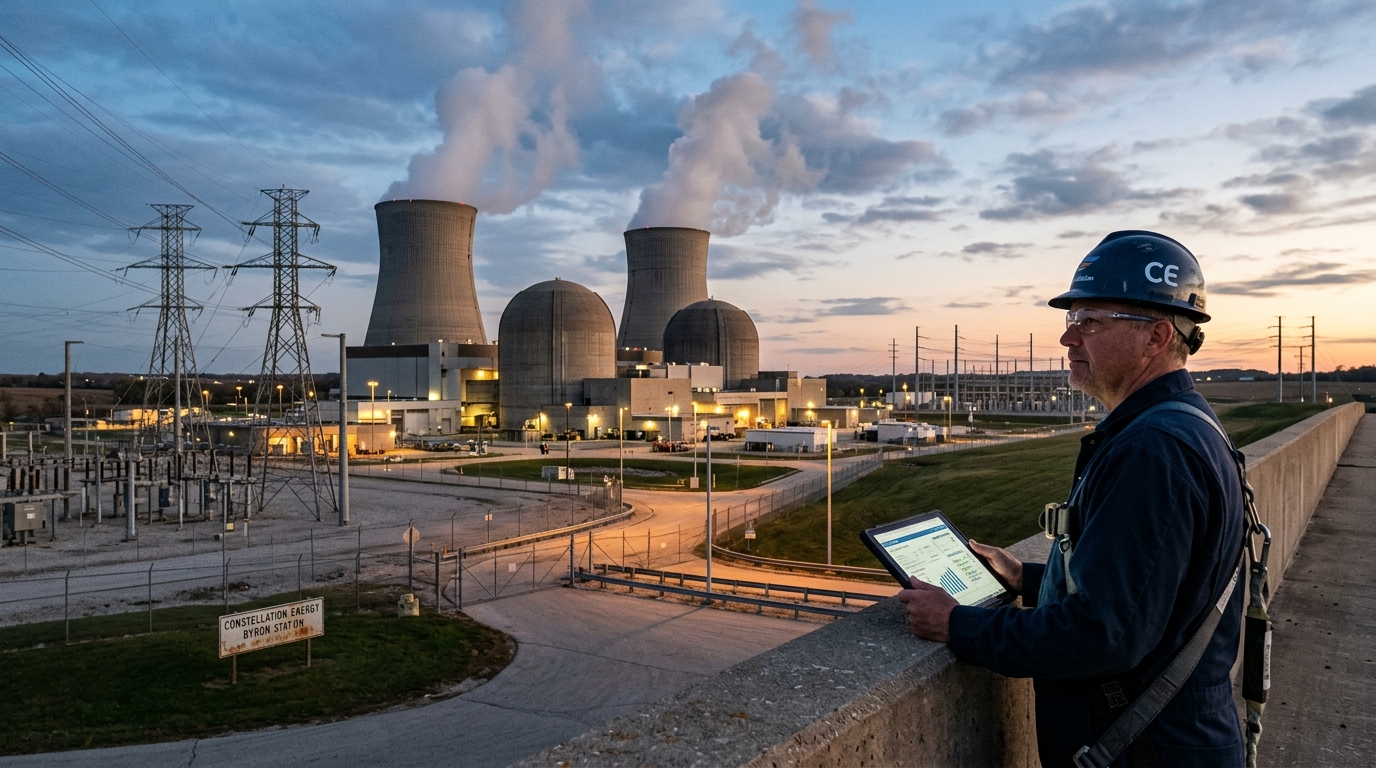
Constellation Energy closed 12.25% higher at $300.40 on Tuesday, October 6, after Google agreed to anchor a major expansion of the nuclear operator’s output. It was the largest single-session gain in the merchant nuclear complex this year, and it did not happen in isolation.
The rally spread to Vistra, up about 8%, and Talen Energy, up about 7%. Vistra and Talen are trading on read-through, since the agreement names only Constellation and Google as parties. The market is pricing the proposition that what Google paid for, Amazon, Meta, and Microsoft will eventually need to match.
The Deal Structure
The catalyst is a Google agreement covering 3,590 MW in the PJM market, combining a 20-year deal for 890 MW of upgraded nuclear capacity with a 15-year deal for 2,700 MW from the existing fleet.
The new capacity will come from upgrades at six existing nuclear sites in Illinois, New Jersey, and Pennsylvania, and will include improvements such as modernized turbines, steam generators, and digital control systems. The first uprate is expected in 2028, with all 890 MW expected to reach the PJM grid before the end of 2032.
Google said the agreement provides Constellation with the revenue certainty needed to invest in updates to 11 of its nuclear units, while ensuring other PJM customers do not incur additional costs stemming from the AI boom. That framing matters: this is a demand anchor, not a subsidy.
Why the Stock Moved, and Why the Gap Is Real
At Tuesday’s close, Constellation’s market capitalization was approximately $106.6 billion. Reversing the 12.25% gain implies a pre-move market value near $95.0 billion. The rally therefore added roughly $11.6 billion of equity value in one session, about 2.7 times the announced $4.3 billion investment.
The market is not mispricing the deal. It is pricing the contract template. The Google deal follows other Big Tech nuclear contracting activity, suggesting hyperscalers may be competing for dependable electricity, not simply buying occasional power. Every long-duration contract signed at a premium resets the floor price for the next negotiation.
The missing number is the price Google will pay. Constellation disclosed more than $4.3 billion of investment, a timetable, and capacity, but neither company published the PPA’s dollars per megawatt-hour. That leaves investors with a strong strategic signal and an incomplete return calculation.
Macro and Industry Context
Big tech companies are looking to squeeze more power out of existing plants because it is cheaper and quicker than building new energy capacity. New power will be added in the PJM Interconnection grid, which needs more supply as data center demand surges.
The Constellation deals are positive for other independent power producers with nuclear plants that are also candidates for uprates, said Nicholas Amicucci, analyst at Evercore ISI, in a note to clients Tuesday. That read-through is why VST and TLN moved without being named in any contract.
Forward Scenarios
Bull: The deal could make Constellation a preferred supplier for future data-center demand. Additional hyperscaler contracts extend contracted cash flows deeper into the 2030s, pull analyst targets toward the $370-$385 range, and compress the discount the stock has traded at since its October 2025 high of $412.70.
Base: The mean analyst target sits at $341.53 with a median of $345.50, implying roughly 13-15% upside from Tuesday’s close. The deal adds revenue visibility without resolving the missing contract price. Shares consolidate near $300 pending further disclosure or another hyperscaler announcement.
Bear: The counterargument is that the stock reacted before investors received the contract price or a project-return forecast, with the first uprate still two years away. Cost overruns, approval delays, or weaker-than-assumed pricing could narrow the return.
Technical Overlay
CEG entered the session with a roughly 24% year-to-date deficit, having carved a channel of lower lows since its October 2025 record high of $412.70. The most recent rally attempt before Tuesday had been thwarted by the stock’s overhead 320-day moving average. Tuesday’s gap-up close at $300.40 reclaimed that level on volume. The prior resistance zone between $295 and $310 is now the key support band. Failure to hold it on a pullback would suggest the move was more sentiment-driven than fundamental.
Bottom Line
The Google deal addresses Constellation’s single biggest problem in 2026: earnings visibility in a merchant power market that punished uncertainty. Two decades of contracted demand across 11 nuclear units is not a rounding error. But the stock added more market value in one day than the total announced capital commitment. The next move in CEG belongs to one number the companies have not yet disclosed: the dollars per megawatt-hour Google agreed to pay. When that lands, whether in a regulatory filing or a quarterly call, it will either validate the premium or hand back a significant portion of Tuesday’s gain.