
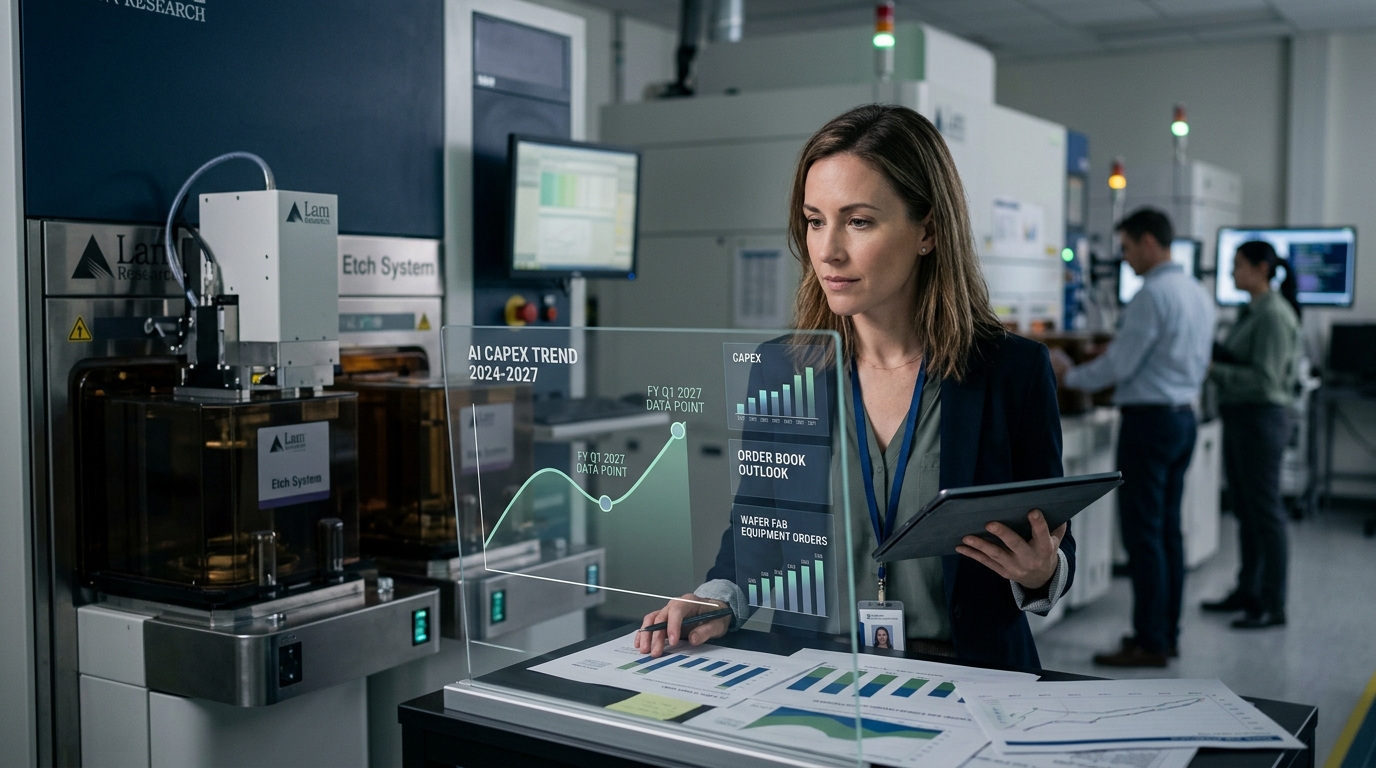
The consensus is $2.17 a share. A year ago it was $1.26. On paper, Lam Research’s fiscal Q1 2027 print Wednesday is a formality. In practice, it is the most consequential data point the semiconductor industry will produce this month.
Not because of the EPS. Because of what management says about where equipment orders go next.
Analyst Targets
- UBS – Buy, $425 target. Analyst Timothy Arcuri called for a “very strong” report and “even more robust” guidance ahead of the Oct. 21 release.
- Morgan Stanley – Overweight, $385 (raised from $367 on Oct. 5). Projects December-quarter revenue above $9 billion and sees Lam as the fastest-growing equipment name for a third consecutive year.
- B. Riley Securities – Buy, $390 (raised from $350 on Oct. 1).
- Needham – Buy, $390 (maintained).
- Mizuho – Outperform, $365.
The Backdrop
Lam reports into the worst stretch for chip stocks since the 2008 financial crisis. The Philadelphia Semiconductor Index fell 16% over eight sessions beginning October 6. Reuters reported during the slide that U.S. semiconductor stocks were on track to lose about $2 trillion in market value. Three forces drove the selloff: hotter-than-expected September CPI data that revived Federal Reserve rate fears, debt-financing concerns surrounding AI cloud infrastructure, and reports that China’s CXMT had made meaningful progress on advanced memory architecture.
That third factor is particularly relevant for Lam. China represented 26% of revenue in the June 2026 quarter, down from 35% in the June 2025 quarter. The Street is watching that number closely.
The Numbers
Lam confirmed it will report after the close Wednesday, Oct. 21. Consensus EPS sits at $2.17 to $2.18 against $1.26 in the year-ago quarter, a 72% jump. Revenue consensus is $8.13 billion, versus $5.32 billion a year ago, a 53% year-over-year comparison that is by any measure favorable. Company guidance issued last quarter called for $8.1 billion plus or minus $400 million, gross margin of 52% plus or minus one point, and EPS of $2.15 plus or minus $0.15.
For fiscal 2027 in full, analysts project $9.34 in adjusted EPS, a 61% increase from $5.81 in fiscal 2026. Full-year revenue estimates sit near $34.9 billion.
Why the Guidance Line Matters More Than the Beat
At its September Citi conference, CFO Doug Bettinger raised Lam’s 2026 wafer-fabrication equipment outlook to the low-$150 billion range, up from the prior $135 to $140 billion estimate, citing sustained AI demand. That forecast, if confirmed or lifted Wednesday, is the cleanest statement any equipment supplier will make about where 2027 AI capex is actually heading.
The WFE outlook does not exist in isolation. TSMC’s six consecutive record quarters and a Q4 guide above consensus offer the clearest upstream read on whether AI fab demand is still accelerating.
Morgan Stanley’s model already prices December-quarter WFE run-rate above $200 billion on a 60% year-over-year basis. If Lam’s own order book corroborates that, the SOX selloff looks like an overreaction to macro noise. If guidance disappoints, it validates every fear the market spent eight sessions pricing in.
The CXMT Variable
CXMT’s DRAM revenue share reached roughly 10% in Q2 2026, up from 4% a year earlier, according to Counterpoint Research. That expansion pressures Samsung, SK Hynix, and Micron on pricing. For Lam, the read is more nuanced: CXMT’s capacity additions require equipment, but U.S. export controls limit how much Lam can ship into China. Watch the China revenue percentage in Wednesday’s results as a leading indicator of how tightly those restrictions are binding.
Bull / Base / Bear
Bull: Lam beats $2.18, raises December-quarter guidance above the $9 billion Morgan Stanley milestone, and lifts its 2027 WFE view. Stock reclaims $300 within sessions as short sellers cover.
Base: EPS in line, revenue roughly at $8.1 billion, and 2027 WFE language broadly constructive but not materially higher. Stock stabilizes. The earnings drift, historically averaging plus 8.6% post-report, reasserts.
Bear: Revenue misses, China exposure shrinks further than expected, and December-quarter guidance comes in below $8.5 billion. The SOX’s momentum accelerates lower, with AMAT and KLAC following.
Technical Overlay
LRCX closed Friday at roughly $264, below its 50-day moving average and sitting near its 200-day exponential moving average in the low-$260s. Momentum oscillators including RSI and Williams %R are in oversold territory. Two unfilled downside gaps from early October, at roughly $304 and $310, act as overhead resistance any post-earnings bounce will need to clear. The 200-day provides the first meaningful floor; a close below it on heavy volume would signal a more serious structural break.
What to Watch Wednesday
- December-quarter revenue guidance versus the $9 billion Morgan Stanley benchmark
- China revenue as a percentage of total, and any commentary on export control impact
- 2027 WFE spending language, any upgrade from the low-$150 billion range is a catalyst
- Gross margin trajectory toward management’s mid-50% long-term target
- NAND upgrade pace versus greenfield, and any updated DRAM/HBM order commentary
Bottom Line
The EPS comparison is easy, the revenue growth nearly certain. None of that is the debate. The stock, down roughly 40% from its 2026 high, is priced for doubt about whether AI capex commitments survive a tighter rate environment and rising Chinese memory competition. Wednesday’s WFE guidance is the first direct answer. It either confirms the cycle or concedes that the eight-session selloff was telling the truth.