
October 23, 2026
Bonus Content: Lockheed Martin’s $292B Backlog Resets the Defense Cycle
Gold and silver are in a powerful bull market – and one ultra-low-priced small-cap precious metals company has quietly built a unique way to capitalize on this historic uptrend.
The company is already generating record revenue from producing gold and silver mines.
It has attracted some of the biggest names in the resource arena.
And it just announced the largest transaction in its history.
Yet incredibly… shares remain largely undiscovered below $1.
That creates an intriguing opportunity to get in early and low as this fast-emerging company enters its biggest growth phase yet.
What makes this story especially compelling is the business model.
Unlike the typical mining firm, this company doesn’t have to build or operate a single mine.
Instead, it puts its capital to work in carefully selected mining projects in exchange for a share of the gold and silver produced:
✔ Exposure to multiple producing mines without operating them
✔ Exploration upside and mine-life growth funded by mine operators
✔ Diversification across multiple metals and jurisdictions
✔ Growing cash flow to be deployed into new royalties and streams
✔ Powerful leverage to rising gold and silver prices
In other words… put capital to work once… generate cash flow… reinvest that cash flow into the next opportunity… rinse and repeat.
That’s the power of the royalty and streaming model – and this soon-to-be-known sub – $1 company is reaching a critical inflection point as you read this.
And there’s another piece of this story you absolutely need to know.
Behind the company is a longstanding strategic relationship with a major mining-focused investment firm – giving it direct access to a steady pipeline of deals across the global mining landscape.
And we’re already seeing that secret weapon hard at work.
The company has just inked a new gold streaming deal on an established producing gold mine – by far the largest transaction in its history – signaling just how much bigger this story is becoming.
And the smart money is already paying attention.
One of the sector’s best-known financiers has put his own money behind the firm and believes it has a durable competitive advantage in the royalty and streaming space.
Better still, he joins the company’s CEO in our exclusive interview.
We’ve put together a FREE online report revealing the full story – including:
✔ The royalty and streaming advantage
✔ Producing assets already generating cash flow
✔ Largest transaction in company history
✔ The secret weapon driving the deal flow
✔ Our exclusive in-depth interview with the CEO and special guest
And with shares still below $1, the opportunity to get in early is right now.
Click here for instant access… and discover this fast-emerging gold-silver royalty firm before the rest of the market catches on.
Lockheed Martin’s $292B Backlog Resets the Defense Cycle
Analyst Targets
- Citigroup — Buy, $691
- UBS — Buy, $674
- Morgan Stanley — Equal-Weight, $690
- Rothschild & Co — Buy, $650 (initiated Oct. 6)
- Vertical Research — Buy, $600 (upgraded Oct. 14)
- RBC Capital — Sector Perform, $550
- Bernstein — Market Perform, $564
- Consensus (22 firms) — Moderate Buy, $627 average target
The Quarter in Brief
Lockheed Martin reported third-quarter 2026 earnings per share of $7.97, beating Wall Street’s $7.52 estimate, while revenue of $20.7 billion topped forecasts of $20.48 billion. The beat and the raised 2026 guidance for sales, EPS, and free cash flow drove a 6.96% regular-session gain.
Backlog reached a record $292.0 billion, up $113 billion versus the third quarter of 2025, with a book-to-bill ratio of 4 times. That figure reframes the stock. Lockheed is no longer pricing a cycle; it is pricing a decade.
Company Profile
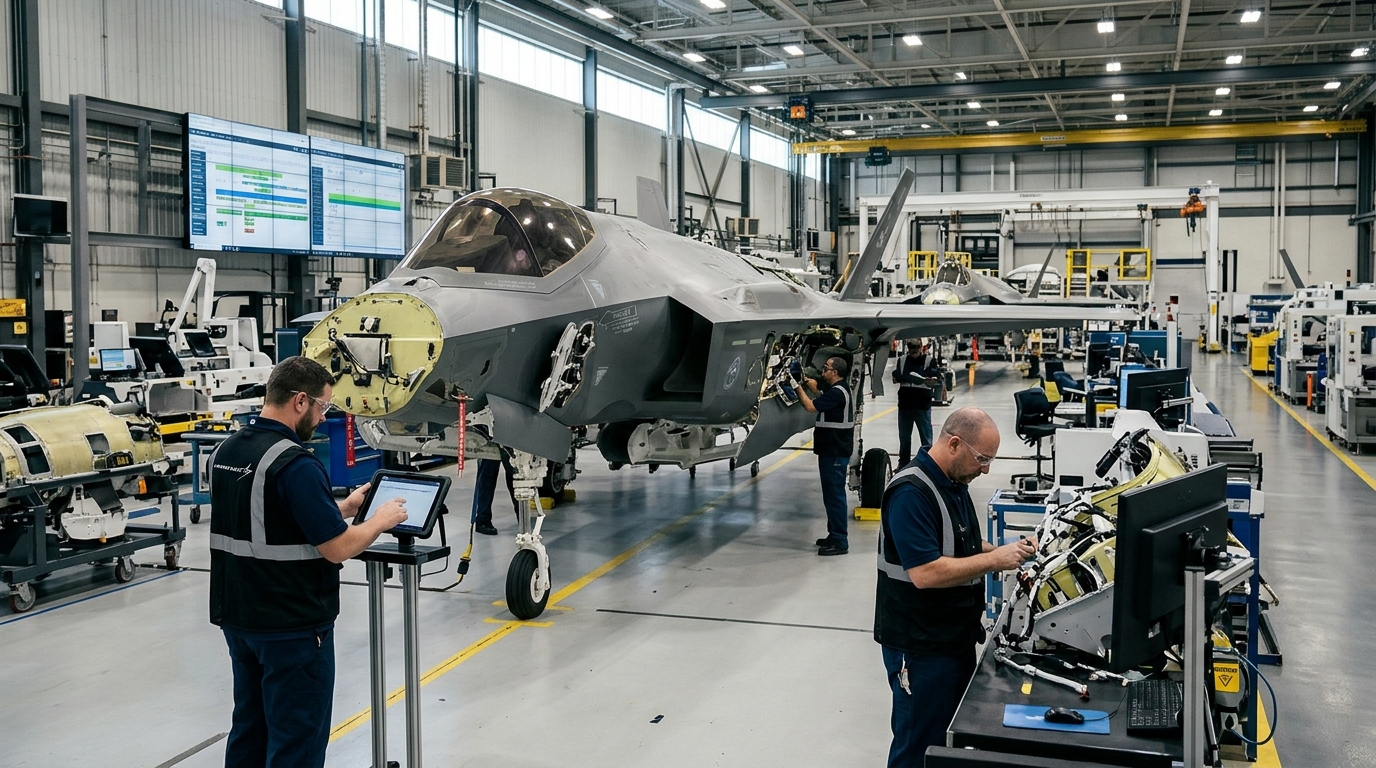
Lockheed Martin is the world’s largest defense contractor, organized across four segments: Aeronautics, Missiles and Fire Control, Rotary and Mission Systems, and Space. The F-35 is its flagship platform, but the growth engine right now is Missiles and Fire Control, where PAC-3 interceptors, THAAD, GMLRS, and the Precision Strike Missile are all ramping simultaneously.
The Numbers
- Revenue: $20.7 billion, +11% year over year vs. $18.6 billion in Q3 2025
- Net earnings: $1.85 billion, +14%; EPS $7.97 vs. $6.95 a year earlier
- Segment operating profit: $2.229 billion at a 10.8% margin
- Cash from operations: $3.4 billion; free cash flow $3.0 billion
- Backlog: $292.0 billion record, including $52.5 billion associated with the multi-year award to produce PAC-3 MSE interceptors
- Missiles and Fire Control: $4.501 billion in sales, up 24%
- Aeronautics: $8.214 billion, up 13%, on higher F-35 production volume and $270 million of higher sales on the C-130 program
Full-year 2026 guidance was raised to sales of $80 billion to $82 billion, segment operating profit of $8.575 billion to $8.675 billion, cash from operations of $10 billion to $10.2 billion, and free cash flow of $7.8 billion to $8.0 billion. This marks the second consecutive quarter management has raised its financial guidance.
Why the Stock Is Moving
Three things are happening at once. First, the earnings beat is clean: $0.45 above consensus on EPS, and about $220 million above on revenue, with growth in every segment. Second, the guidance lift is material, particularly on free cash flow, where the midpoint rose by roughly $800 million from the prior range.
Third, and most consequential, is the backlog. The Missiles and Fire Control segment alone accounts for approximately $142.5 billion of total backlog, reflecting substantial demand for missile defense and precision-strike capabilities. The largest contributor in the quarter was the PAC-3 seven-year multi-year award, which brings that multi-year contract to a total value of up to $58.62 billion. A $292 billion order book against trailing twelve-month revenue near $78 billion implies roughly 3.7 years of revenue already under contract. That kind of visibility is extraordinary in any industry.
Backlog size alone does not determine returns. General Dynamics shows how a record order book can still leave investors waiting if production capacity cannot keep pace.
Macro Context
NATO members are spending at levels not seen since the Cold War. Allied demand for air-defense interceptors, in particular, has outrun production capacity across the Western industrial base, which is why the U.S. Army committed to a seven-year PAC-3 multi-year rather than the standard annual contract structure. On the F-35 side, the company continues to lean on multi-year procurement lots and a long runway of global demand, but specific aircraft counts and per-year production rates depend on contracting lots and customer delivery schedules. Peers RTX and NOC face similar demand curves but lack Lockheed’s concentration in missile defense, the segment where the funding urgency is highest.
RTX faces the same structural demand curve, with Raytheon’s SM-6 and SM-3 interceptor contracts reflecting the same NATO-driven urgency. RTX entered Q3 with a $289 billion backlog built on missile-defense contracts that mirror Lockheed’s PAC-3 surge.
Forward Scenarios
Bull
Guidance proves conservative again in Q4. MFC margins expand as the PAC-3 line scales. International PAC-3 orders add another leg to the backlog. LMT re-rates toward $700, reclaiming its March 2026 highs.
Base
Management raises full-year guidance for the second consecutive quarter, citing accelerated momentum in munitions production and stability in the F-35 program. The stock consolidates between $580 and $620 as the market digests the backlog and awaits Q4 cash conversion confirmation.
Bear
The disagreement among analysts centers on missile demand versus delays in U.S. defense funding. A continuing resolution or budget sequester compresses near-term awards. The gap between backlog and recognized revenue widens, and the stock fades back toward the 200-day moving average near $540.
Technical Overlay
The stock’s 52-week range spans $437.25 to $692.00. Yesterday’s close of $589.91 fills the gap left after the April selloff and places LMT back above its 50-day and 100-day moving averages. The RSI level cited in the original draft could not be verified from primary company materials and varies materially by data vendor and lookback assumptions, suggesting short-term momentum should be treated qualitatively rather than as a precise point estimate. The first meaningful resistance is the $620 to $640 zone where several analyst targets cluster. Support on any pullback sits near $560 to $565, last week’s pre-earnings base.
Bottom Line
The debate around Lockheed is no longer about whether demand is real. A 4x book-to-bill and a $292 billion backlog settle that. The question investors should be asking now is whether Lockheed’s manufacturing base can convert that backlog into cash fast enough to justify the current multiple. A backlog of this size gives the company substantial visibility into future performance, with significant work already under contract and in progress. The risk is execution, not demand. Watch free cash flow conversion in Q4 and any further guidance revisions as the decisive signal.