
November 6, 2026
Bonus Content: Atlassian Raised Guidance. The Market Is Selling the Seat.
Dear Reader,
Across America, there’s been violence, protests, lawsuits, canceled projects, and campaigns to impose statewide moratoria to stop AI’s impact on cities and small towns across the nation.
And Whitney Tilson, the man CNBC once named “The Prophet,” believes these frustrations are only going to get worse.
Because now that our midterm elections are over, he believes it’s all going to come to a head.
And it will have huge implications on your portfolio.
If history is any indication, those on the winning side of this divide could see their wealth grow exponentially…
While the losers could see their portfolios cut in half – or more – within the next six months.
That’s why today Whitney is sharing all the details of this divide with you.
And what you must do right now to protect your wealth.
When “The Prophet” makes predictions, people listen…
In 2000, he called the dot-com crash before many investors lost everything.
He predicted the bankruptcies of Bear Stearns and Lehman Brothers during the Great Financial Crisis.
He appeared on 60 Minutes and called the bottom of the stock market right before the longest bull market in history.
Today, he’s sharing all the details of his new prophecy…
One that could be the most consequential to your wealth to date.
Regards,
Matt Weinschenk
Publisher and Director of Research, Stansberry Research
P.S. Whitney believes what’s happening today could reset the financial system now that America has voted. If he’s even half-right, it’s going to have a huge impact on your money and your future. Get the details here…
Atlassian Raised Guidance. The Market Is Selling the Seat.
Analyst Targets
- Guggenheim: Buy, $280 (raised, October 18)
- Canaccord Genuity: Buy, $175 (maintained, August 7)
- Cantor Fitzgerald: Overweight, $252 (raised from $220, November 2)
- Oppenheimer: Outperform, $275 (raised from $200, October 22)
- TD Cowen: Hold, $180 (raised from $145, November 3)
- Truist: Buy, $250 (raised, October 21)
What Just Happened
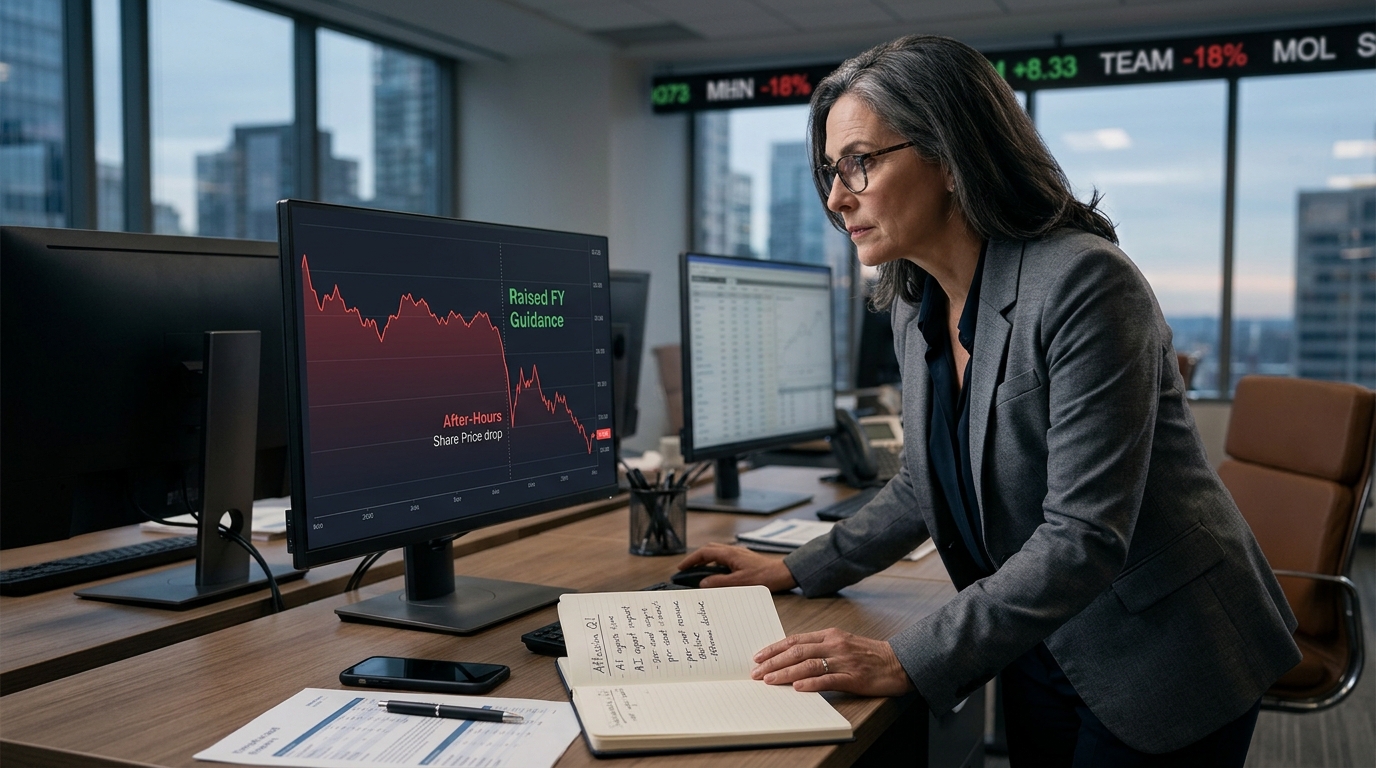
Atlassian raised parts of its fiscal 2027 outlook on Thursday, November 5, 2026, and the stock dropped about 17% to 18% in after-hours trading. The numbers themselves were unambiguous: revenue rose 24% year-over-year to $1.772 billion, ahead of roughly $1.71 billion in consensus estimates, while adjusted EPS came in at $1.65 versus about $1.43.
The beat wasn’t the problem. The forward read was.
The Numbers
- Revenue: $1,772 million, up 24% year-over-year
- Cloud revenue: $1,302 million, up 31% year-over-year
- Subscription ARR: $6,812 million, up 23% year-over-year
- Remaining performance obligations: $4,746 million, up 44% year-over-year
- Free cash flow: $463 million, a 26% margin; GAAP operating margin: 11%
For Q2 FY2027: total revenue is projected between $1,825 million and $1,835 million, with Cloud revenue growth expected at approximately 27%. For the full year: Atlassian expects subscription ARR growth of approximately 18.5% year-on-year, total revenue growth of approximately 13.75%, Cloud revenue growth of approximately 26%, and Data Center revenue growth to decline by approximately 16%.
Why the Stock Is Moving
Atlassian shares declined in after-hours trading following results that failed to satisfy buy-side expectations for further Cloud and Subscription ARR acceleration, even with a full-year guidance raise. The raise itself was modest: Atlassian lifted its Cloud revenue and Subscription ARR growth outlooks by about 50 basis points to roughly 26% and 18.5%, respectively, and total revenue growth by about 75 basis points to roughly 13.75%.
Investors focused on the implied slowing in subscription growth, with Atlassian forecasting subscription ARR growth of approximately 18.5% for fiscal 2027 versus 23% reported in Q1. Cloud deceleration added pressure: second-quarter Cloud growth is guided to approximately 27%, down several points versus Q1.
On the earnings call, CFO James Chuong also pointed to a deceleration in second-quarter Cloud revenue growth and suggested subscription ARR growth would step down over the next several quarters.
The Seat Question
None of this sells off a stock 18% in isolation. The accelerant is what the market believes AI agents do to Atlassian’s core monetization mechanism. The bear case is that AI changes the unit economics of seat-based software. AI agents can consolidate developer tasks, potentially reducing the number of seats customers require, which could pressure recurring revenues over future contract cycles.
Atlassian did not provide a single headline metric that conclusively settles the seat question in this quarter. Tonight’s setup, ARR slowing from 23% to a guided 18.5%, is exactly the kind of data point that reactivates that fear. A raised outlook that still implies slowing recurring revenue growth is not a reassuring combination for investors already modeling seat compression risk.
Macro Context
Atlassian is not alone in this dynamic. The broad worry across subscription software is that agentic automation could pressure per-seat pricing models, particularly in tools tied closely to knowledge work and software workflows. ServiceNow (NOW) and Datadog (DDOG) have navigated adjacent versions of the same question recently. The difference with Atlassian is that Jira and Confluence sit squarely in workflow categories most often cited as AI-automatable. The debate is whether Atlassian’s AI integration creates enough incremental value to offset any seat compression, or whether it mainly slows disruption.
ServiceNow faced the same structural question heading into its own results. ServiceNow’s bears were pricing in stalling AI adoption and deteriorating margins — and none of it showed up in the numbers.
Forward Scenarios
Bull
Management has highlighted that customers moving from Data Center to Cloud tend to expand spend materially over time, and the company continues to point to strong momentum in its service-management suite, including a customer base above 70,000 and over $1 billion in ARR growing north of 30% year-over-year. If the platform upsell cycle offsets any seat compression, ARR re-accelerates in FY2028 and the stock recovers toward pre-earnings levels.
Base
Cloud growth holds near 26%, ARR settles into the high teens, and the Data Center decline stays mechanical rather than demand-driven. The stock finds a floor in the $160s and grinds sideways until the seat compression story has cleaner resolution.
Bear
ARR decelerates below 15% by mid-FY2027 as seat compression accelerates faster than bundle cross-sell can offset. Management has also indicated Subscription ARR growth is expected to decline over the next several quarters due to lapping factors. If organic demand is weaker than those lap effects, the numbers worsen before they stabilize.
Technical Overlay
The stock closed Thursday, November 5, 2026 at $183.29, implying a market cap around $46.4 billion, and it fell roughly 17% to 18% after hours. That move puts TEAM back toward the $150 zone, erasing a meaningful portion of the post-earnings premium. The next key question is whether buyers defend the first area of support created by the recent run-up, or whether the market forces a broader reset until the per-seat and agent monetization debate clears.
What Investors Should Watch
- Leading indicators of seat expansion in Q2 FY2027: do customers keep adding users, or do deployments flatten?
- Cloud growth trajectory against the guided ~27% for Q2: any miss sharpens the deceleration concern
- Analyst target revisions in the next 72 hours as Street models are recut
- Competitor earnings: how NOW and DDOG frame the agent-versus-seat debate will set the sector tone
Bottom Line
Atlassian delivered a clean beat and a real raise. The market sold it because the guidance math, ARR decelerating from 23% to 18.5% and Cloud stepping down into the high-20s, arrived while seat-based SaaS sits under heightened structural scrutiny. Management said customers are adding more people, more agents, and more workflows on Atlassian, contributing to larger, longer-term commitments. The RPO data, up 44%, supports that. What the after-hours move says is that the market wants to see that commitment show up as durable ARR acceleration, not just longer contracts. Until it does, good quarters can still get sold.