
For a while now, I’ve been showing regular traders like you how to take advantage of a specific 60-minute window…
One that lets us go after 50% returns every morning – whether the market opens higher… or lower.
Here’s what I mean…
If you had spotted this 60-minute opportunity yesterday morning… all you would’ve had to do was place a quick trade before 10 am…

Went ahead with your morning plans and when you return a couple of minutes later, there’s a good chance you’d find $500 in extra income sitting in your account (on a 1k stake)
It wouldn’t have mattered what happened with the overall market… this 60-minute window would have been all you needed to target cash.
Today? Same story.
Place a quick trade, grab your coffee… and let the setup do the heavy lifting.
And just 60 minutes later… come back to what could be a nice $500 in extra income sitting in the brokerage account.
I designed the setup to be that straightforward.
Granted, there will be trades that won’t work out
But if you want in?
Cisco’s $9 Billion AI Order Book Faces Its First Real Test
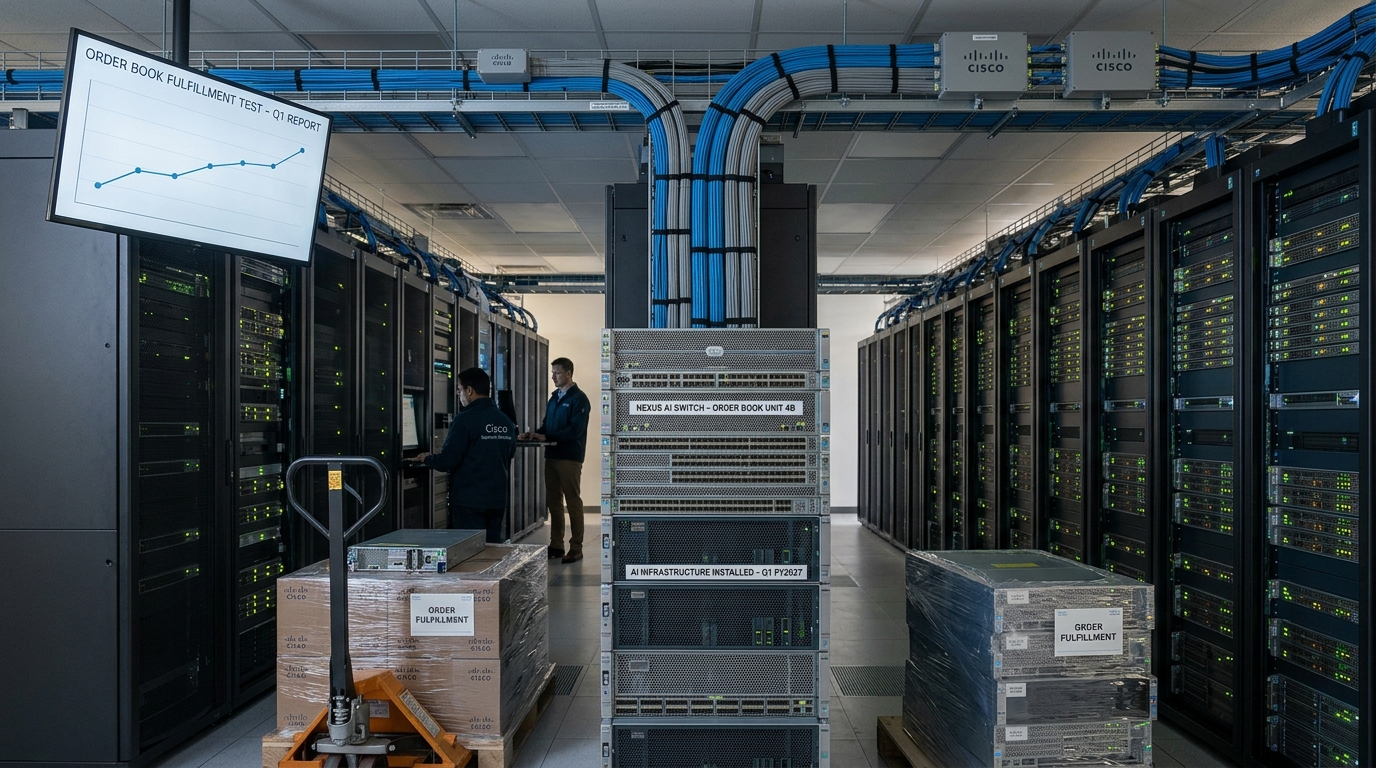
The number that matters most on Thursday is not revenue or EPS. It is the AI infrastructure order line. Cisco booked $4 billion of AI infrastructure orders in the fourth quarter of fiscal 2026, taking total orders for the year to $9.3 billion. That figure grew sevenfold in nine months. Now, in its first quarter under the fiscal 2027 outlook, the market wants to see it translate into shipped product and recognized revenue.
Analyst Targets
- Morgan Stanley (Meta Marshall): downgraded to Equal Weight, $120 price target
- Citi (Atif Malik): Buy, $139 price target
- Piper Sandler (James Fish): Neutral, $125 price target
- Barclays: Equal Weight, $123 price target
- UBS: Buy, $138 price target
What Changed This Week
Cisco enters Thursday carrying fresh damage. Shares fell below their 200-day moving average on November 5 after Morgan Stanley downgraded the stock from Overweight to Equal Weight and cut its price target from $135 to $120. The firm cited concern that faster AI-infrastructure growth could bring a less profitable product mix, pressuring gross margins and earnings growth.
The Arista results released four days earlier did not calm that concern. Arista delivered Q3 2026 revenue of approximately $3.66 billion, exceeding guidance of $3.3 billion while growing 58.5%, the highest year-over-year revenue growth since its IPO. Non-GAAP EPS of $1.20 beat estimates by $0.12. The stock jumped about 12% in after-hours trading on November 3, then gave back all of it and more: Arista fell 10.8% on Thursday, November 5, while the S&P 500 lost 4.4%. Several AI stocks, among them Nvidia, fell amid heightened political and regulatory uncertainty around data-center buildouts, and the retreat extended to the networking group.
The margin anxiety is not unique to Cisco. Broadcom faced the same investor skepticism about whether custom AI silicon revenue could scale without compressing the gross margins that justify its premium valuation.
That sequence reframes Cisco’s Thursday report. Arista’s beat was real and unambiguous. The market sold it anyway. Cisco now has to deliver not just on the order line but on the gross margin question Morgan Stanley raised.
The Setup Ahead of Thursday
Cisco has scheduled its conference call for Thursday, November 12, 2026, at 1:30 PM PT to announce first quarter fiscal year 2027 financial results for the period ending October 24, 2026.
The consensus is high. Analysts expect earnings of $1.32 per share and revenue of $18.11 billion for Q1 2027. That would represent a 32% EPS increase from the year-ago quarter. Management guided Q1 revenue to between $18.0 billion and $18.2 billion, against $14.9 billion in fiscal Q1 2026.
Last quarter set the baseline. Q4 fiscal 2026 revenue came in at $17.3 billion, up 18% year over year, with product orders up 35% and networking product orders up 40% for an eighth consecutive quarter of double-digit growth. Cisco recognized $4 billion in AI infrastructure revenue in fiscal 2026 and expects that figure to reach $7.5 billion in fiscal 2027.
The margin pressure Cisco faces is not unique to networking. Dell’s record $60.9 billion AI order quarter raised the same question about whether hardware-heavy revenue mix can sustain operating margins.
Bull / Base / Bear
Bull: AI order intake in Q1 sustains the $4 billion quarterly pace, management reaffirms the $7.5 billion fiscal 2027 AI revenue target, and gross margin guidance for the year holds at 65% to 66%. The Morgan Stanley downgrade looks premature, and the stock recovers toward the $136 consensus target.
Base: Orders come in at $3 billion to $3.5 billion for the quarter, revenue meets the $18 billion midpoint, and management points to backend weighting in AI revenue delivery. Stock reacts modestly either way, stays rangebound near $95 to $105 until the February quarter confirms trajectory.
Bear: Lower-margin hardware, pulled-forward customer orders, and valuation limit near-term upside if the order rate decelerates materially below $3 billion or gross margin guidance narrows. That would validate Morgan Stanley’s concern and pressure the stock toward the $110 Bernstein target.
Technical Overlay
Cisco shares broke below their 200-day moving average on November 5, trading as low as $95.43. The 52-week range runs from $70.54 to $130.37. With the stock sitting near $95, any earnings beat that also defends gross margin guidance could trigger a gap fill back toward the $103 to $105 zone where the stock traded before the Morgan Stanley action. A miss or margin disappointment opens the low-$80s.
Cisco is not the only networking-adjacent name where a single revenue line has become the market’s entire verdict. Broadcom faced the same dynamic when its $16 billion AI semiconductor guidance became the only number analysts were willing to price.
What to Watch
- AI infrastructure order total for the quarter. The critical comparison is against Q4’s $4 billion.
- Non-GAAP gross margin guidance for the full year. Management guided non-GAAP gross margin to 65% to 66% for Q1 fiscal 2027. Any revision lower confirms the Morgan Stanley thesis.
- Arista guided Q4 revenues between $3.9 billion and $4.0 billion with non-GAAP operating margin of 48% to 49%. Cisco’s order commentary will serve as a cross-check on whether that level of demand is sector-wide.
Bottom Line
Cisco’s $9.3 billion AI order book is the most credible evidence the networking supercycle is real. The question Thursday answers is whether that book is growing or plateauing. Arista’s 58% revenue growth proved demand exists. The market’s subsequent 10.8% sell-off in Arista proved that demand alone no longer moves the stock. Cisco needs to show orders, margin, and guidance all holding together at the same time. If even one leg weakens, the Morgan Stanley downgrade will look early rather than wrong.