Dear Reader,
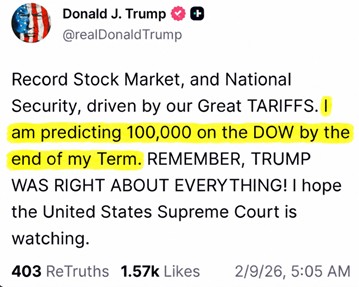
Earlier this year, President Trump made a prediction that raised plenty of eyebrows on Wall Street.
He said the Dow could reach 100,000 by the end of his term.
Now, you can agree or disagree with the President’s politics.
But there’s a much bigger question investors should be asking:
Could the stock market really double over the next few years?
According to economist Dr. Mark Skousen, the possibility deserves serious consideration.
And if it happens, the implications for investors could be staggering.
This kind of market move could be worth $80 trillion? (Yes, trillion, with a “T.”)
It sounds like an extraordinary prediction.
But Dr. Mark Skousen, the economist who told his readers to sell everything a few weeks before Black Monday, has been studying the possibility of another historic market boom.
And his analysis suggests the market could double by 2029.
Not because of any one politician or policy, but because of the powerful economic and market forces he believes could drive the next wave of wealth creation.
He says, “If history repeats, the market could double from here. And when it does, it will create more new wealth than any boom America has ever seen.”
For good reason.
All the stocks in America are now worth about $80 trillion. So a double would add $80 trillion more.
But something even more spectacular could happen.
Skousen says most of that money will rush into a small handful of stocks most people have barely heard of. And those who know where to look could make a fortune.
For the full story, click here.
Good investing,
Rachel Gearhart
Publisher, The Oxford Club
Rheinmetall’s 2030 Promise Goes Under the Knife in Hamburg
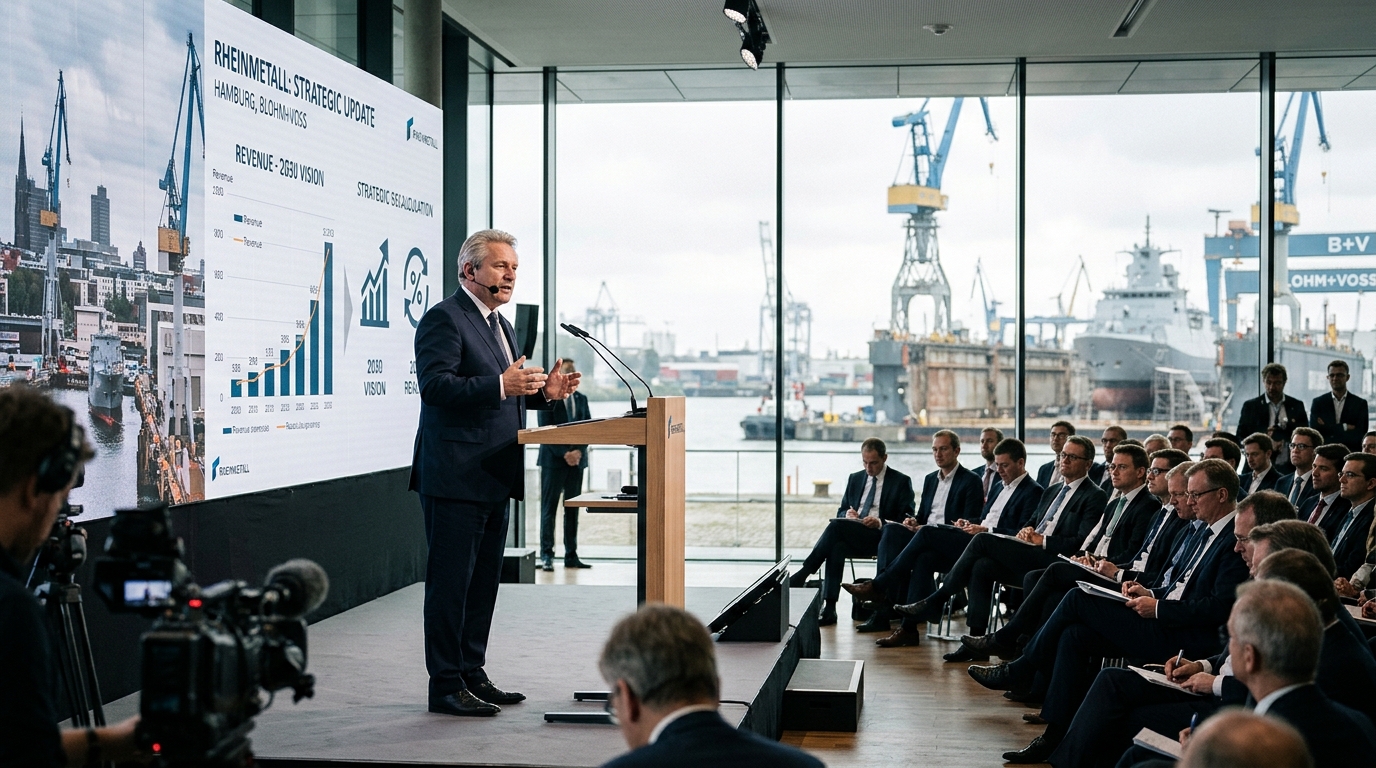
CEO Armin Papperger takes the stage at Blohm+Voss in Hamburg this morning to do something the sell-side has been demanding since the November guidance cut: replace an aspirational 2030 roadmap with numbers the market can actually believe. The question is whether the medicine hurts less than the disease.
Analyst Targets
- Goldman Sachs: Buy, target EUR 1,350 (cut from EUR 2,100)
- Barclays: Overweight, target EUR 1,340 (cut from EUR 2,000)
- BofA Securities: Neutral (downgraded from Buy), target EUR 900 (cut from EUR 1,300)
- Berenberg: Hold, target EUR 900 (cut from EUR 1,020)
- Citi: Buy, target EUR 1,099; 2030 revenue estimate cut 15% to roughly EUR 30.3bn
- RBC Capital Markets: Outperform, target EUR 1,300 (cut from EUR 1,600)
Where the Stock Stands
The 52-week high is EUR 1,966. On Xetra, the stock closed at EUR 765.70 on Thursday, November 26. On Lang & Schwarz in early trading this morning, shares traded around EUR 783, about 2% above Thursday’s Xetra close. The drawdown from that January peak runs to roughly 60 percent. That the stock has been rising into this event tells you something: bad news, credibly delivered, is preferable to ambiguity.
The Numbers That Caused the Damage
Revenue for the first nine months of 2026 reached EUR 8,376 million, a 38% increase, with operating profit of EUR 1,339 million. Yet operating free cash flow over the same period came in at minus EUR 1,698 million. Orders keep arriving; cash keeps leaving. In early November, Rheinmetall trimmed its full-year 2026 revenue forecast. Management blamed delays tied to the Bundeswehr’s Arminius programme and on acceptance schedules for artillery ammunition. The margin line moved too: the operating margin forecast was trimmed to around 18.5% from roughly 19%.
What Hamburg Must Deliver
The event runs 25-27 November 2026, and Barclays analyst Afonso Osorio expects management to present cautious planning for 2027 alongside a rewrite of its long-term targets. That rewrite matters because Rheinmetall’s existing ambitions, EUR 50 billion in revenue and a margin above 20% by 2030, no longer match what the market is actually paying for.
According to Osorio’s calculations, the current share price already reflects only around EUR 30 billion in 2030 revenue at an 18.5% margin. Barclays expects management to guide toward EUR 35-40 billion in 2030 revenue. Goldman’s Sam Burgess expects a more conservative revenue plan than the roughly EUR 50bn targeted, and floats EUR 35bn as a possible revised figure, an analyst’s projection, not a company decision. Barclays has explicitly described more realistic targets as a possible foundation for a share-price recovery.
The Kuwait Strike
An Iranian drone attack on Kuwait on Thursday killed two Italian civilians during an assault on a “vital” facility and injured two others. Italy’s Foreign Ministry said the two Italians were technicians from Rheinmetall Italia and died in an explosion caused by the drone attack while carrying out maintenance work on detection antennas for the Skyguard air-defense system used by the Kuwaiti Armed Forces. Iranian officials denied responsibility.
This is not primarily a financial event, but it sharpens the geopolitical argument for European air defense at precisely the moment Rheinmetall needs investors to extend it faith on delivery.
A New Revenue Leg: The Palantir Play
Rheinmetall and Deutsche Telekom are working to exploit declining trust in US software provider Palantir with a joint offering. According to WirtschaftsWoche, the AI-powered platform would run on German cloud infrastructure and combine satellite imagery with data from commercial sources into a unified operational picture. Rheinmetall will supply military customers while Deutsche Telekom takes over sales to civilian clients, with that rollout expected from the end of Q1 2027. It is a small revenue line today; the strategic signal is not.
Bull / Base / Bear
Bull: New 2030 targets land in the EUR 35-40bn range with a credible delivery and cash-conversion path. The gap between current pricing and even reduced estimates closes sharply. Prior downgrades become the floor.
Base: Management cuts to around EUR 35bn with cautious 2027 guidance. Stock consolidates above EUR 750, analyst revisions stabilize, and the investment case shifts from “what will be missed” to “what can be executed.”
Bear: BofA’s concern materializes: Vehicle Systems revenue falls short of EUR 10-11bn by 2030 versus company targets of EUR 13-15bn, and the restocking cycle for 155mm artillery is pushed back and possibly scaled back. Free cash flow stays negative through 2027 and further downgrades follow.
Technical Overlay
The stock broke key support at EUR 901.9 and fell to a deep Fibonacci level at the 61.8% retracement. This week’s recovery above EUR 765 on Xetra represents the first four-day winning streak since the November guidance cut. The 200-day moving average sits far above, and a credible plan from Hamburg is the minimum condition for any sustained mean-reversion trade.
Bottom Line
The 2030 target was always a compass bearing, not a contract. What matters today is not by how much Papperger cuts the number, the market has already priced a reduction, but whether he can demonstrate that the EUR 78 billion backlog converts into revenue and cash on a schedule investors can track. Operating free cash flow came in at minus EUR 1.7 billion over the first nine months of 2026, a wider outflow than a year earlier. A convincing outlook would need to spell out how Rheinmetall intends to make contract execution more dependable. The Iran-Kuwait attack confirms the demand; Hamburg must confirm the capacity to meet it.