August 19, 2026
Four Memory Stocks, One Bottleneck
Featured: Four Memory Stocks, One Bottleneck
Dear Fellow Investor,
Most people think gold is a “pet rock.”
They’re wrong.
The market has a “math glitch” right now that is about to be corrected on September 30th.
There is a company sitting on 88 million ounces of gold-equivalent resources.
At near today’s prices, that’s $431 billion in the ground.
Yet, the stock is trading for a fraction of that value.
Why?
Because the “Gold Cartel” has used paper contracts to suppress the price for decades.
But the leash just snapped.
On September 30th, a federal legal deadline forces the “Paper Gold” market to face reality.
When that happens, this stock won’t just move – it will reprice.
I’m targeting 1,000% gains as this “Shadow Miner” becomes the most valuable asset on the planet.
Check the math and get the ticker symbol here >>>
“The Buck Stops Here,”
Dylan Jovine, CEO & Founder
Behind the Markets
Four Memory Stocks, One Bottleneck
The Bottleneck Nobody Fixed
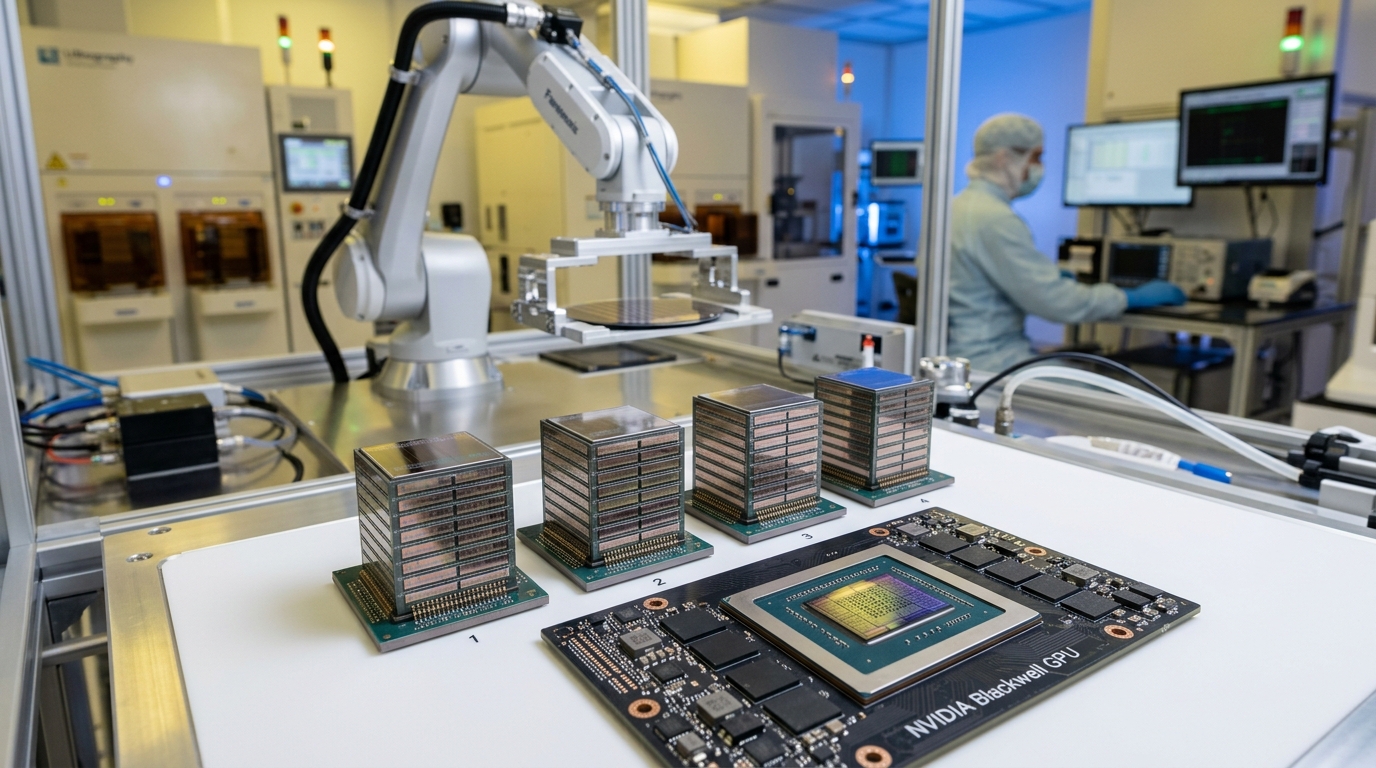
The three companies that control over 90% of global DRAM production have sold out their entire output, not just through year-end but through all of 2027. Micron’s CEO told CNBC the company can supply key customers roughly 50% to two-thirds of what they need. That gap is not closing. The cause is architectural: a single AI server consumes 8 to 10 times the DRAM of a traditional server, global AI server shipments are forecast at 1.5 million units in 2026, and every HBM wafer committed displaces two or more conventional DRAM wafers. No fab schedule absorbs that math cleanly.
The shortage also explains why AI’s biggest infrastructure companies are racing to control more of their own chip economics. Amazon’s push into Trainium and other custom silicon is one example of hyperscalers trying to reduce dependence on a supply chain where GPUs, memory, networking and power can each become the next constraint.
The Four Names
Micron (MU) reported fiscal Q3 2026 revenue of $41.46 billion against a $35.84 billion estimate, with EPS of $25.11 versus $20.20 expected. Core data center revenue reached $11.5 billion, up more than sevenfold year over year. All four business units grew by multiples simultaneously. The stock has extended sharply from every major moving average. At current levels, Micron is the most priced for good news of the four, and the September earnings report is where that confidence gets tested.
SK Hynix (HXSCL) holds approximately 62% of HBM shipments as of Q2 2026, with UBS projecting a roughly 70% share in the HBM4 market for NVIDIA’s Rubin platform. Q2 operating margin hit 76%, EBITDA margin reached 81%, and operating profit rose 557% year over year. The stock fell 9.6% on results because HBM4 shipments came in below projections. U.S.-listed shares sit near the bottom of their 52-week range. The market is pricing in the shortfall. It is not pricing in a confirmed H2 HBM4 ramp or the company’s August board approval of 54 trillion won in new fab investment.
Samsung (005930.KS) is the catch-up trade. The company reported an all-time quarterly high for memory revenue and operating profit in Q2, signed an MOU with AMD to supply HBM4 for the next Instinct MI455X accelerators, and is targeting roughly 50% HBM production capacity growth in 2026. The central risk is qualification timing. Hyperscalers are not waiting for Samsung to clear HBM4 validation before committing allocation to SK Hynix or Micron, and yield stabilization is a prerequisite Samsung has not yet publicly confirmed at scale.
The larger point is that memory isn’t operating in isolation. AI infrastructure spending has shifted from experimentation toward a capacity buildout, putting simultaneous pressure on accelerators, networking, memory, power and data center capacity. That makes today’s DRAM shortage more difficult to solve than an ordinary semiconductor inventory cycle.
Marvell (MRVL) does not produce a single DRAM die. It builds the infrastructure that moves memory data at AI scale: custom ASICs, PCIe 6.0 SSD controllers, CXL memory expansion, and rack-scale optical interconnects. At FMS 2026, the company unveiled the Bravera SC6 controller and pod-level optical shared memory solutions targeting hyperscalers. Q1 FY2027 revenue was $2.42 billion, up roughly 28% year over year. The August 27 earnings report is the first test of whether those product launches are converting into booked revenue.
Amazon’s custom-chip strategy shows why cost per inference and infrastructure efficiency have become central to AI economics. Marvell is attacking the same problem from networking, connectivity and memory movement rather than DRAM production itself.
Bottom Line
The differences between these four names are about timing, positioning, and valuation rather than the underlying demand thesis. SK Hynix is operationally dominant and trading near a 52-week low, which makes it the most asymmetric risk-reward of the three DRAM producers at current prices. Micron carries the clearest earnings momentum and the richest market pricing. Samsung offers the highest potential re-rating if HBM4 qualification accelerates, and the most execution risk if it does not. Marvell is the only one unconstrained by wafer capacity, because its bet is on organizing and moving memory rather than making it. August 27 at Marvell and late September at Micron are the next two dates that force the market to revise one of those judgments.
For informational purposes only.