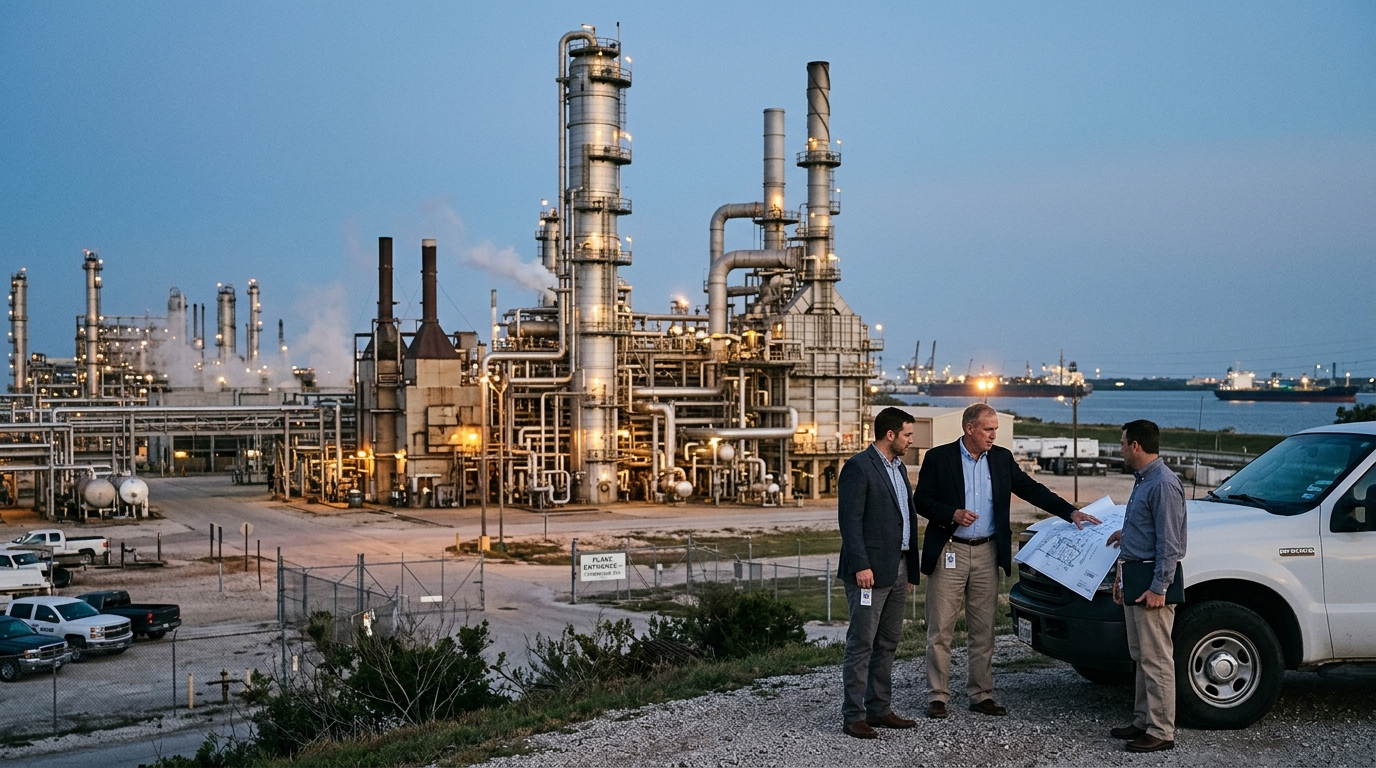
The Financial Times reported Monday that Shell has drawn non-binding bids for its U.S. chemicals portfolio from ExxonMobil, LyondellBasell, Apollo Global Management, and the chemicals arm of Kuwait Petroleum Corporation. The four facilities, located in Louisiana, Texas, and Pennsylvania, could fetch up to $8 billion. Non-binding offers have already been submitted; the process is moving.
The anchor asset is the Monaca petrochemicals complex in Pennsylvania, which commenced operations in November 2022. Shell invested approximately $14 billion in Monaca, which has a designed output of about 1.6 million tonnes of polyethylene annually. A sale of the wider portfolio at $8 billion would represent a substantial discount to Shell’s invested capital. That discount is the starting point for the committee’s analysis, not the ending point.
Buying capacity at a fraction of replacement cost is only compelling if the buyer can extract mid-cycle returns that justify the outlay. The relevant question is what $8 billion implies per tonne of capacity and whether a rational operator can close the gap to mid-cycle margins. LyondellBasell’s Q2 2026 results offer a timely reference: EBITDA excluding identified items reached $2.1 billion, with the company operating its advantaged North American assets at approximately 90% utilization and reporting substantially improved O&P Americas results versus the prior quarter. That acceleration was partly driven by Middle East supply disruptions tightening the global petrochemical cost curve. Buying Shell’s U.S. ethane-advantaged assets now, at trough-adjacent multiples, is precisely the kind of cycle-aware capital allocation the committee exists to evaluate.
The rational owner question has a clear answer. ExxonMobil brings a fortress balance sheet, regulatory predictability, and the integration logic of adjacent Gulf Coast operations. LyondellBasell brings operational expertise in exactly this asset class, an ongoing portfolio transformation toward advantaged feedstocks, and a fresh strategic mandate. LYB completed the divestiture of four European assets in Q2 2026, paying a $310 million cash contribution at closing to exit, as part of its push to concentrate the portfolio around more advantaged positions. Acquiring Shell’s U.S. crackers at cycle-trough pricing would be a direct extension of that logic.
The caveat is leverage. LYB carried total liquidity of about $7.1 billion at June 30, 2026, with $2.6 billion in cash. An $8 billion transaction would require significant financing, and the company’s cash improvement plan is designed to generate incremental cash flow, not absorb a large acquisition debt load. Exxon, by contrast, can write a check without straining its credit profile.
Any transaction of this magnitude will require Hart-Scott-Rodino review, and regulators could scrutinize whether an Exxon or LYB acquisition substantially reduces competition in specific chemical markets. A foreign buyer from Kuwait faces additional national-security considerations. The eventual owner, and the price at which they win, will determine whether this becomes a value-creative trough acquisition or simply Shell’s problem in new hands. The committee’s view is that a disciplined, ethane-advantaged buyer at the right price has a durable investment case. The process is worth watching closely.