
August 27, 2026
Bonus Content: SPCX at the IPO Line: Policy Tailwind, Supply Overhang
Editor’s Note: See the following from our friend Josh Baylin. Josh is one of the greatest tech investors in America. For years, he helped manage $200 million at SAC Capital (the elite fund run by Steve Cohen, who owns the NY Mets). He purchased two $60,000 Nvidia supercomputers to run his own quant fund. And he even broke tech stories at Bloomberg for many years. But what he’s sharing next could be the biggest call of his career…
What Sam Altman’s launching next could be 500 times bigger than ChatGPT, unlock an industry worth over $1 million per American, and send one small group of stocks soaring as this news spreads.
Click here to learn about the stocks tied to Sam Altman’s Next Venture.
At test sites across America, even the cleaning staff could go to prison if they told you what they’ve seen.
That’s because, at these sites, Sam Altman’s next venture is officially live.
It’s a new use for AI that may sound “disturbing” to some.
But like it or not… it’s already working 10,000 times faster than many of the smartest human scientists in the world.
It’s backed by Jeff Bezos, Peter Thiel, and Elon Musk (who calls the underlying tech “the most disruptive force in history”).
And it threatens to destabilize one of the world’s largest (and most-disliked) industries… saving millions of innocent people in the process.
To learn about this before the average investor is reading all about it in the news…
Click here to learn what’s happening – and to see the critical stocks to own as this takes off.
Regards,
Josh Baylin
Analyst, Stansberry Research
P.S. What I’m sharing with you today is the same investing blueprint that would have turned $1,000 into $3 million… and even $5.8 million in the past. Click here to see how getting in early on Sam Altman’s next big move could be the best decision you make all year.
SPCX at the IPO Line: Policy Tailwind, Supply Overhang
A financial disclosure signed August 12 and made public August 22 confirmed that President Trump bought between $15,001 and $50,000 of SpaceX stock on June 23, less than two weeks after the company priced its IPO and began trading. SPCX closed Monday at $135, exactly its IPO price. The arithmetic is not the point. The policy is.
On August 20, Trump released an updated National Space Transportation Policy memo targeting over 1,000 commercial launches and reentries annually by 2030. The memo frames this as a step-change from recent activity levels, though published totals vary by whether you count FAA-authorized commercial operations only or broader launch activity. SpaceX set the orbital-launch cadence record in 2025 with 165 launches, accounting for the majority of U.S. volume. No other domestic operator is positioned to absorb a multi-fold increase in cadence. SpaceX remains the best-positioned prime beneficiary of any commercial-first procurement push.
Company Profile
SpaceX operates three segments: Space (launch services and Starshield defense contracts), Connectivity (Starlink satellite broadband), and AI (the former xAI business, merged in February 2026). The company IPO’d on Nasdaq on June 12, 2026, valuing it at roughly $1.77 trillion.
The Numbers
- Q2 2026 Revenue: $7.81B vs. $6.93B expected, up 92% year-over-year
- Net Loss: $541M, improved from about $1.0B in Q2 2025
- Adjusted EBITDA: $3.5B, up 191% year-over-year
- Space Segment Revenue: $962M vs. $835M estimate
- Government Contracts Won (Q2): Over $6B in multi-year Starshield awards
- Cloud Services Contracted Sales: $14.1B signed through the quarter
- Capex: $18.4B, driven by AI infrastructure and Starship development
- Management Target: $100B annualized revenue run rate by December 2026
Analyst Targets
- Bernstein: Buy, $248 (raised from $239 post-earnings)
- Citi: Buy, $200
- Bank of America: Buy, $235
- Cantor: Buy, $246
- Macquarie: Buy, $250
- Argus Research: Buy, $160 (upgraded post-Q2)
- Wolfe Research: Outperform, $175
- Piper Sandler: Hold, $140
- CFRA: Sell, $115
Consensus across 35 analysts: Buy, average target $213.50.
Why the Stock Is Pinned at $135
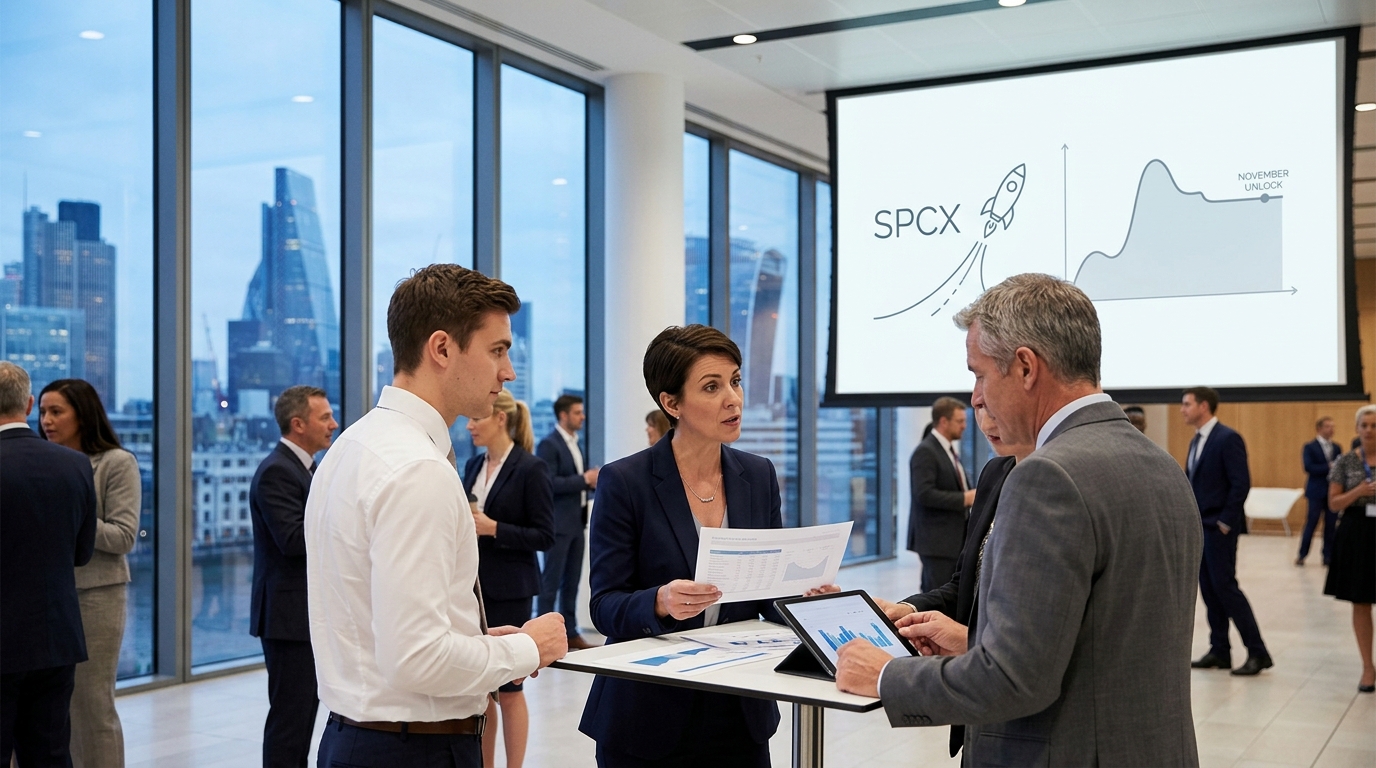
The business fundamentals are not the constraint. The float is. SpaceX launched its IPO with only about 4% to 5% of shares publicly tradable. After subsequent unlock tranches, the freely traded float has expanded materially versus day one, with shares outstanding of roughly 13.1 billion on a pro forma basis. Each tranche has tested the market and the core takeaway has been consistent: demand is real, but it is sensitive to incremental supply. The $135 level is simultaneously IPO cost basis for many passive investors, a round-number psychological anchor, and the point where supply pressure tends to materialize.
Macro and Policy Context
Trump’s space transportation memo is structurally bullish for launch-cadence revenue. SpaceX scaled from 25 orbital launches in 2020 to 165 in 2025. A government commercial-first mandate could accelerate permitting, expand access to launch infrastructure, and support higher utilization across the industry. Separately, CNBC and other outlets reported that Nvidia disclosed a large SpaceX position in Q2 filings, and the companies have discussed partnership around AI infrastructure and compute. Hedge fund ownership has also been building post-IPO; some disclosures have highlighted sizable positions, including D.E. Shaw.
Forward Scenarios
Bull
The November share unlock around Q3 earnings is absorbed as cleanly as the August tranche. Q3 revenue validates the $100 billion annualized run rate trajectory. Starship V3 achieves the next reusability milestone before December. SPCX rallies through $175 resistance and the Nasdaq-100 rebalance in September lifts passive buying. Target: $200+.
Base
The November unlock creates weeks of chop between $120 and $145. Q3 earnings land broadly in line with elevated expectations. Policy tailwinds are acknowledged but not yet priced beyond the Space segment. SPCX ends the year between $140 and $165, with Musk’s June 2027 unlock setting the next major test.
Bear
November’s tranche triggers meaningful insider selling. Starship misses another milestone, pressuring out-year revenue models that depend on high-frequency launches. AI capex at $18.4 billion per quarter runs ahead of contracted revenue. Stock retests the $105-$108 range seen in early August.
Technical Overlay
SPCX is consolidating exactly at IPO price, a level that has acted as both a floor and a ceiling since mid-July. The 52-week range is $104.83 to $225.64, with the current price sitting in the lower third. Pre-market today indicated $134.20. Resistance is layered: $145, then $155, then $175 where Wolfe has its target. Support is $120, then $105.
What Investors Should Watch
- November unlock volume and insider selling disclosures in the weeks following Q3 earnings
- Starship Launch 14 and any reusability data: the entire long-term revenue model requires high flight cadence
- Nasdaq-100 weight after the September rebalance
- Additional government contract awards tied to the new launch cadence mandate
- Any revision to the $100B annualized revenue target on the Q3 call
Bottom Line
Trump’s SpaceX position is a footnote in dollar terms. The space transportation policy signed in the same window is the substance. With a government commercial-first mandate, over $6 billion in Q2 defense contracts, and a launch cadence goal that SpaceX is structurally best positioned to serve, the contract pipeline debate is likely to stay live. The stock’s next move is not determined by fundamentals. It is determined by whether November’s unlock finds buyers or doesn’t. That is the event. Everything else is context.