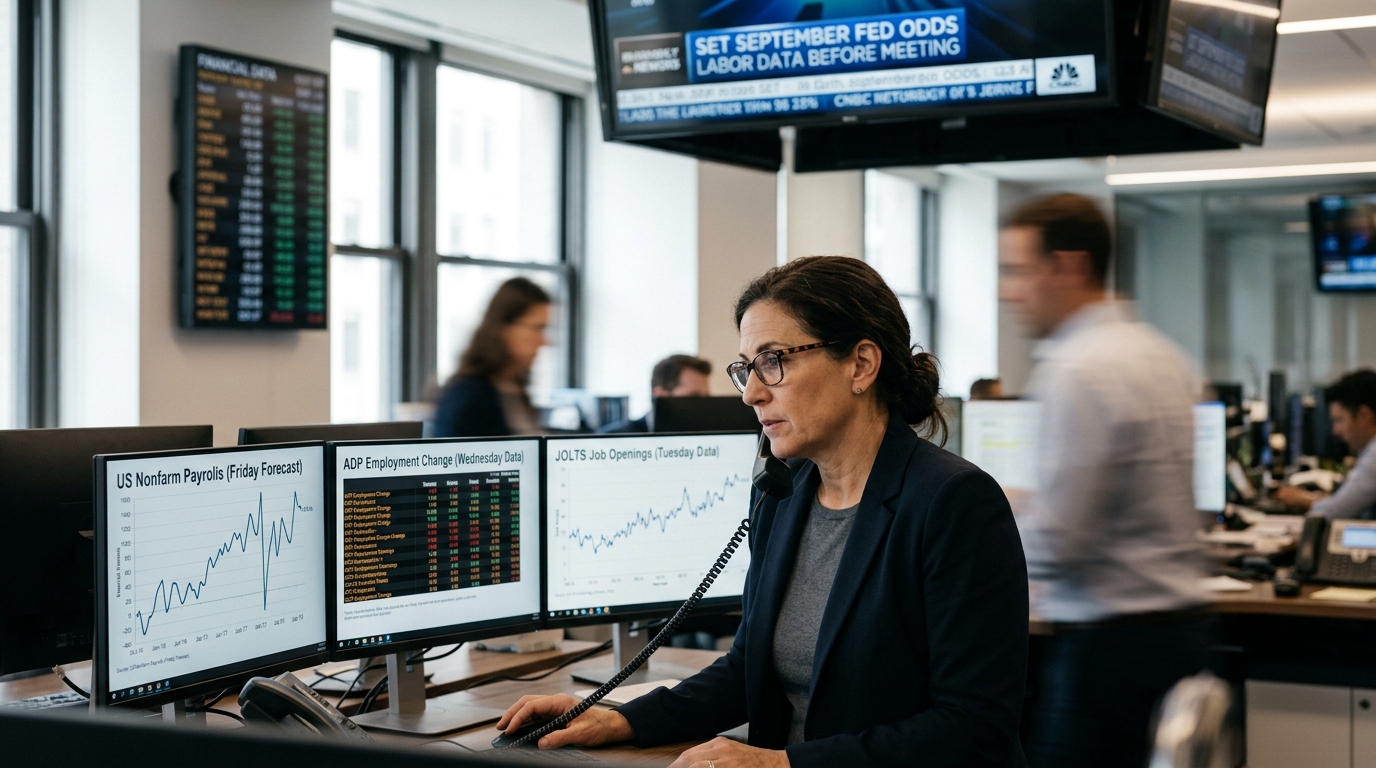
The next 96 hours will do more to shape the September 15-16 Federal Reserve meeting than any single speech or survey. Three sequential labor releases land before the weekend, each one adding or removing support for what is now a firmly consensus-leaning bet on a rate hike.
The Calendar, in Order
Today, 10:00 a.m. ET: JOLTS (July openings). The BLS’s June read showed job openings little changed at 7.4 million, with hires little changed at 5.3 million and total separations little changed at 5.4 million. That surface stability masks a downward drift: job openings in June fell by 178,000 to 7.359 million. May openings were revised down by 57,000 to 7.5 million in that same release. Today’s July number is the first fresh demand-side read since then. A print below 7.2 million would reinforce the softening trend; anything above 7.5 million reopens the argument that labor demand remains stickier than the headline payroll figures suggest.
Tomorrow, 8:15 a.m. ET: ADP National Employment Report (August). The August ADP report drops September 2 at 8:15 a.m. ET, following July’s private-sector gain of just 44,000 jobs with pay up 4.4% year-over-year. That July figure was already a steep step down from June’s 98,000. The weekly ADP Pulse data offered mixed signals in early August. A monthly ADP figure above 80,000 would complicate the soft-labor story. Below 50,000 keeps it intact.
Friday, 8:30 a.m. ET: August Employment Situation (BLS). The July BLS report unexpectedly showed a loss of 23,000 jobs, following a downwardly revised 20,000 gain in June, with combined revisions putting employment 103,000 lower than previously reported. Capital Economics is projecting August nonfarm payrolls of just 90,000, citing immigration restrictions limiting labor supply. The unemployment rate is broadly expected to hold near 4.2% after July came in at 4.1%.
What Moves the Hike Odds
As of Monday August 31, the CME FedWatch Tool showed a 66% probability that the FOMC would raise the federal funds rate by 25 basis points at the September meeting. Two drivers lowered the bar for a September hike: higher energy costs linked to the war in Iran, and increased investor doubt about the Fed’s willingness to contain inflation after it left rates unchanged in July. The PCE price index held at 3.7% year-over-year in July, contributing to expectations of a 25 basis point move in September.
For traders, the threshold question is simple. The Fed needs cover to hike into a labor market that is losing momentum. Strong data across all three releases this week provides that cover. Weak data, particularly a Friday payroll number below 50,000, forces a genuinely contested vote rather than a comfortable majority. Three FOMC members already dissented in favor of a hike at the July meeting, so the dovish camp is not dominant, but it is real.
The Cheat Sheet
- Top Theme: Labor data sequencing controls September FOMC odds more than any single Fed speaker this week.
- Stock to Watch: Rate-sensitive financials and regional banks move directly on hike odds; watch KRE and XLF for same-day reactions to each release.
- Sector to Watch: Utilities and REITs face the clearest binary risk: strong labor data pushes yields higher and pressures both sectors immediately.
- Biggest Risk: A hot ADP number tomorrow followed by a weak Friday BLS report creates maximum confusion, because the two series have diverged repeatedly in 2026, leaving traders with conflicting signals going into the FOMC blackout period.
- One Thing to Remember: The 66% hike probability is already priced. What is not priced is a clean sweep of soft data across all three releases. That outcome, low JOLTS plus weak ADP plus a miss on Friday, is the one scenario that could move the needle meaningfully before September 15.