
September 16, 2026
Bonus Content: Dave & Buster’s Lost $12.5 Million Last Quarter. The Real Problem Is What Stopped Paying.
Wall Street loves a new story.
But sometimes the more interesting opportunity is a company that has been waiting years for the market to catch up.
One little-known Nasdaq company has spent more than 25 years developing professional drone technology that is now a priority in Washington.
This is not a company trying to invent itself around D.C.’s latest push.
It was developing these technologies long before America’s current drone demand started.
That experience matters as the Pentagon looks for scale and Washington directs more attention toward domestic manufacturers.
Yet the company is still trading under $5… for now.
If America’s drone industry is entering a much bigger chapter, investors may want to know why this pioneer remains so overlooked.
Dave & Buster’s Lost $12.5 Million Last Quarter. The Real Problem Is What Stopped Paying.
Analyst Targets
- Texas Capital: Buy, target cut to $16 from $23
- Gordon Haskett: Hold, target cut to $9 from $13
- Freedom Capital: Hold, target cut to $9 from $13
- UBS: Neutral, target cut to $9 from $12
Multiple analysts maintained their ratings while cutting targets sharply following the report. The broader consensus across Wall Street still leans constructive, but the stock’s move suggests investors are discounting that optimism against shares trading around the high single digits.
What the Quarter Actually Said
Dave & Buster’s reported Q2 fiscal 2026 revenue of $544.1 million, a net loss of $12.5 million, and diluted EPS of negative $0.36, compared with revenue of $557.4 million, net income of $11.4 million, and diluted EPS of $0.32 in the year-ago quarter. That swing, from an $11.4 million profit to a $12.5 million loss in twelve months, is the number the market priced in on Tuesday, September 15, 2026.
Revenue of $544.1 million declined 2.4% year over year. Adjusted EBITDA came in at $98.9 million versus $129.8 million a year earlier, an 18.2% margin versus 23.3% in the prior-year quarter. Operating margin fell to 3.6% from 9.5% in the same quarter last year.
The Split Inside the Quarter
This is where institutional investors need to look carefully, because the aggregate numbers obscure a structural divergence. Food and beverage was a rare bright spot, with comparable sales rising 7.6% for the fifth consecutive quarter. Special-events revenue also grew for the seventh consecutive quarter.
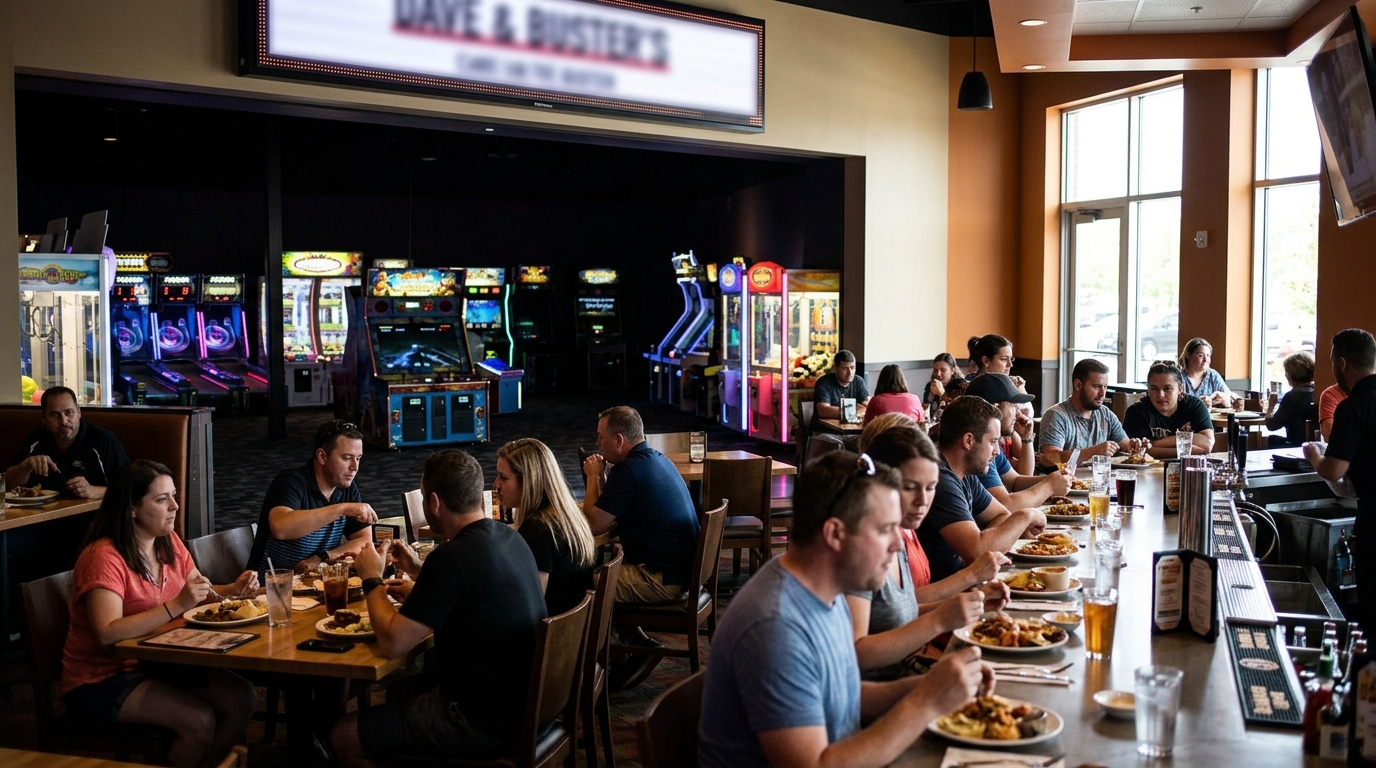
The biggest weakness came from the core entertainment business. Entertainment-related sales fell about 9% to $332.6 million. Guests are walking in, sitting down, and ordering. They are not feeding the arcade machines.
Mix shifted toward higher food and beverage sales and away from entertainment, increasing product cost percentage and pressuring margins. That mix shift matters because entertainment carries structurally higher margins than food. As the mix degrades, every incremental dollar of food revenue does less for the bottom line than the entertainment dollar it replaced.
Why the Stock Moved
Total operating costs rose to 96.4% of revenue from 90.5% in the prior-year quarter. That compression, nearly six points of operating leverage evaporating in a single year, is what converted a modest revenue decline into a net loss. Wall Street did not just sell a bad quarter; it sold a business where the highest-margin product is in a sustained decline.
Some peers moved modestly in sympathy, but the reaction was muted. The market read this as a Dave & Buster’s execution issue, not a broad-based entertainment-sector reset.
Macro and Industry Context
Consumer discretionary spending on experiences has been bifurcating throughout 2026. Premium live events and sports remain resilient; mid-tier entertainment venues that compete on price and novelty are losing. Dave & Buster’s sits squarely in that middle band, and the roughly 9% entertainment revenue decline reflects wallet pressure on exactly the income cohort that drives arcade spend. Management has pointed to cost savings initiatives as it responds to pressure on value-conscious guests.
Forward Scenarios
Bull
The decline in same-store sales narrowed to negative 1.6% in July, compared with negative 5% in June, and management said momentum improved in the early weeks of the third quarter. If that trajectory holds and cost actions gain traction, EBITDA could stabilize at a meaningfully higher run-rate than the market is currently discounting. The stock is cheap on that outcome.
Base
Entertainment remains under pressure through fiscal year-end as the consumer stays selective. Cost savings provide some buffer, but margin recovery is measured in quarters, not weeks. PLAY trades sideways at distressed multiples.
Bear
Debt remains heavy. Long-term debt, net, was about $1.5 billion as of August 4, 2026. If entertainment trends do not turn positive by mid-fiscal 2027, leverage becomes the story. A further deterioration in EBITDA would compress liquidity and raise refinancing risk on a balance sheet with little room for error.
Technical Overlay
With the stock below key moving averages, trend resistance remains overhead. Until shares can reclaim those levels and hold, the chart reads as damaged, with support dependent on whether fundamentals can stop deteriorating.
Bottom Line
The question for Dave & Buster’s is not whether food and beverage or special events can grow. They can, and they are. The question is whether entertainment, the reason the venues exist and the engine of margin, ever recovers. Same-store sales improved sequentially to down 2.9% in Q2 from down 5.4% in Q1, which management will use as evidence of inflection. But persistent entertainment weakness is not a one-quarter event. CEO Darin Harper’s back-to-basics strategy buys time. What truly determines the next move is whether the company can reignite high-margin gameplay fast enough to keep leverage from becoming the dominant variable.