Bullet Summary
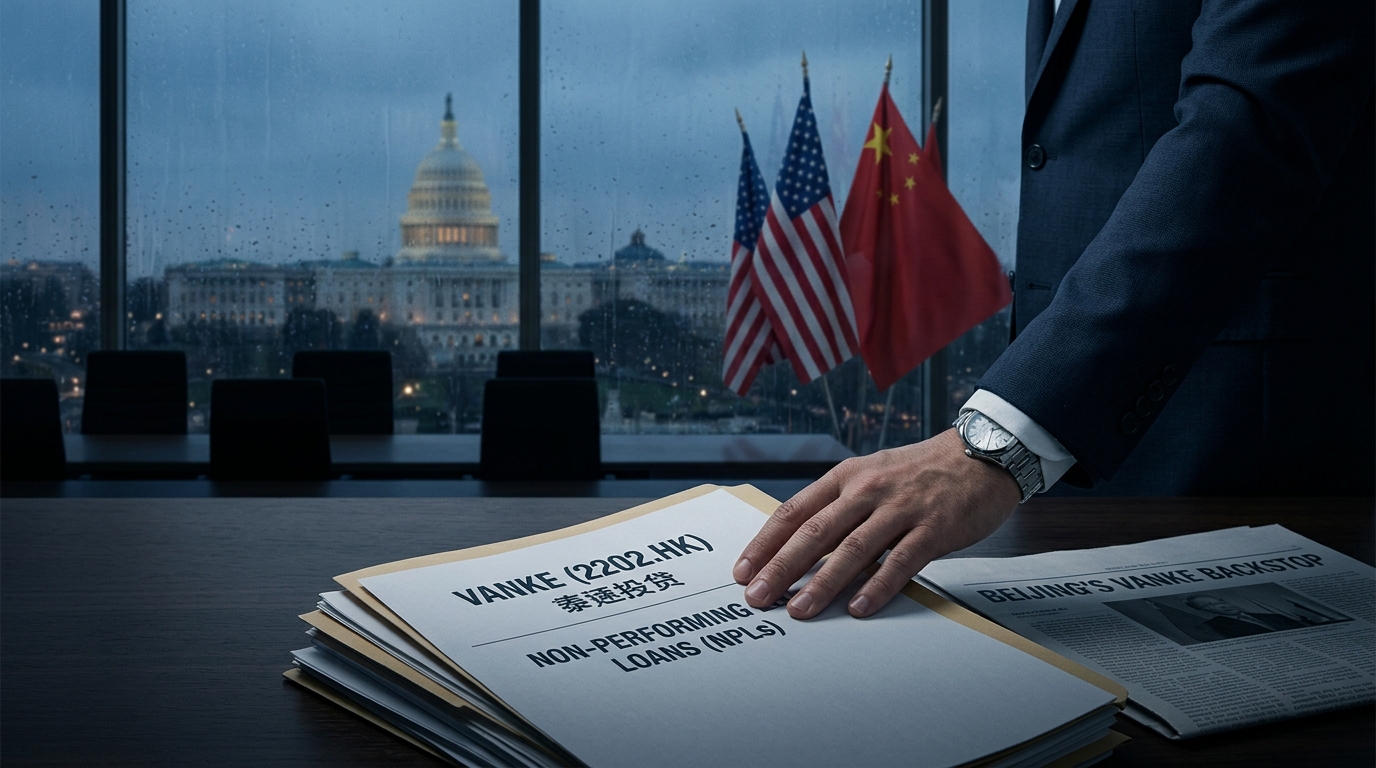
- Chinese financial regulators issued informal “window guidance” directing mostly state-owned banks not to classify overdue China Vanke (2202.HK) loans as non-performing.
- Shenzhen-listed Vanke shares jumped 3.7% to 3.95 yuan Wednesday; Hong Kong-listed shares rose 4.6%.
- Vanke posted a record 88.56 billion yuan net loss in 2025 and had RMB 264 billion in bank loans as of end-June 2025, with roughly 62% secured by collateral.
- In January, lenders agreed to let Vanke shift from quarterly to annual interest payments, deferring dues in the coming months to September 2026. Any further extension beyond September 2026 has not been publicly confirmed.
- Regulators also asked select banks to delay collecting interest payments on Vanke obligations, though no aggregate amount was disclosed.
- Xi Jinping’s Washington state visit runs September 23 to 25, 2026, with trade, AI, Taiwan and Iran among the central agenda items cited in pre-summit briefings.
- The non-performing classification window was left open-ended, contingent on property market conditions and further Vanke discussions.
Market Context Analysis
The property sector intervention and the geopolitical calendar are converging in a way that demands precise trader attention today. Xi Jinping is making a state visit to the United States from September 23 to 25, 2026, for talks with President Donald Trump. The trip marks Xi’s first state visit to Washington since 2015. Both leaders have structural political reasons to avoid messy headlines. That shared incentive is now visibly shaping financial regulation in Beijing.
The summit is not likely to produce many deliverables. At most, analysts expect a temporary tariff truce extension, some agricultural and energy purchases by China, and an AI dialogue. Any surprise trade friction, particularly around tariffs or Taiwan, would hit China-exposed assets hard before the weekend close.
Sector Breakdown
China’s property sector, once a key growth driver, sank into a downturn after a government campaign to curb developers’ heavy borrowing led to a liquidity crunch. More than five years in, home prices are still falling and construction investment continues to decline. Against that backdrop, financial authorities want to prevent a “risk event” at a developer so closely tied to a state shareholder, given the damage it could do to market confidence.
The directive targeted large state-owned lenders. Keeping overdue Vanke loans out of the non-performing category changes what shows up in bank results: a non-performing tag forces banks to book higher loan-loss provisions, dragging on profits and weakening capital ratios, while delaying the label keeps near-term NPL ratios steadier at large, mostly state-owned lenders even if the underlying property stress persists. Iron ore traders should note that a managed Vanke slowdown, rather than a hard default, removes some of the most acute near-term demand destruction risk from China’s construction pipeline, though it resolves nothing structurally.
Stock-Specific Financial Breakdown
Vanke’s situation warrants more than a one-session read. Vanke reported a record loss of 88.56 billion yuan in 2025 amid weak sales, which eroded its cash position. The company had RMB 264 billion in bank loans as of end-June 2025, with about 62% secured by collateral. In January, Vanke struck a deal with domestic banks including Bank of China to defer loan interest payments due in the coming months to September, allowing cash-strapped Vanke to shift from quarterly to annual payments. The arrangement was coordinated by the State-owned Assets Supervision and Administration Commission of Shenzhen Municipal People’s Government. September has arrived. Rather than force a reckoning, regulators issued fresh guidance to roll the situation forward again.
The flip side is that losses, if they materialize, get recognized later, so markets may have to work harder to judge bank balance-sheet health from headline numbers alone. Watch FXI and KWEB for how U.S.-listed investors price this dynamic at the open.
Technical / Trading Framework
Vanke’s 3.7% gap higher in Shenzhen on Wednesday establishes a short-term support level near 3.95 yuan. Any retest of that level intraday would indicate whether institutional buyers are defending the move or using the gap as an exit. FXI and KWEB should be tracked against their 20-day moving averages; both were coiling near resistance before this catalyst. Volume confirmation on the Hong Kong shares, which surged 4.6%, is essential before traders treat the move as a trend rather than a headline reaction. VWAP anchored from Tuesday’s close is the cleaner reference for intraday mean-reversion positioning than the prior session’s range.
Scenario Modeling
Bull Case: The Xi-Trump summit produces a joint statement with trade concessions, a tariff truce extension, or credible agricultural purchase commitments. Risk-on flows into China-exposed equities accelerate, amplified by the Vanke stabilization removing one property-sector tail risk. FXI and KWEB test multi-month highs; Vanke holds above 4.00 yuan in Shenzhen.
Base Case: The summit generates diplomatic optics without binding deliverables. Regulators keep the non-performing loan window open-ended, with treatment depending on property market conditions and further Vanke discussions. Vanke shares consolidate the Wednesday gain, Chinese bank stocks trade flat to slightly lower, and investors continue to discount headline NPL ratios from state lenders as unreliable signals.
Bear Case: The summit produces unexpected friction on tariffs, secondary sanctions related to Iran, or Taiwan. Risk-off reverses any geopolitical optimism bid in China-exposed assets. Banks typically step up collection efforts or demand additional collateral once a loan is classified as non-performing, and any signal that the window guidance could be reversed would compound selling pressure in Vanke and Chinese financials simultaneously.
Active Trader Strategy Framework
Geopolitical binary events require defined risk parameters before the session opens, not after. Traders with China exposure should establish clear stop levels on FXI and KWEB positions relative to pre-summit closing prices, avoiding the temptation to add during the summit window without confirmation of a constructive outcome. Vanke itself carries low liquidity for most U.S.-based participants; the cleaner expression of the Vanke stabilization theme is through sector ETFs with defined exit triggers. Volatility in Hong Kong-listed names will likely spike into the September 25 summit close, with the risk of sharp reversals if summit rhetoric shifts.
Professional Conclusion
The Vanke guidance extension is not a resolution. It is a delay, and the terms of that delay remain open-ended. What distinguishes today’s session is the collision of a managed property-sector intervention with a geopolitical event that could, in either direction, overwhelm the modest sentiment support the regulatory directive provides. Disciplined traders will size positions to survive the summit outcome rather than bet on it, keep stop levels firm, and treat the Wednesday share price reaction as a positioning signal rather than a fundamental reset. Preparation, not prediction, is the edge here.