October 9, 2026
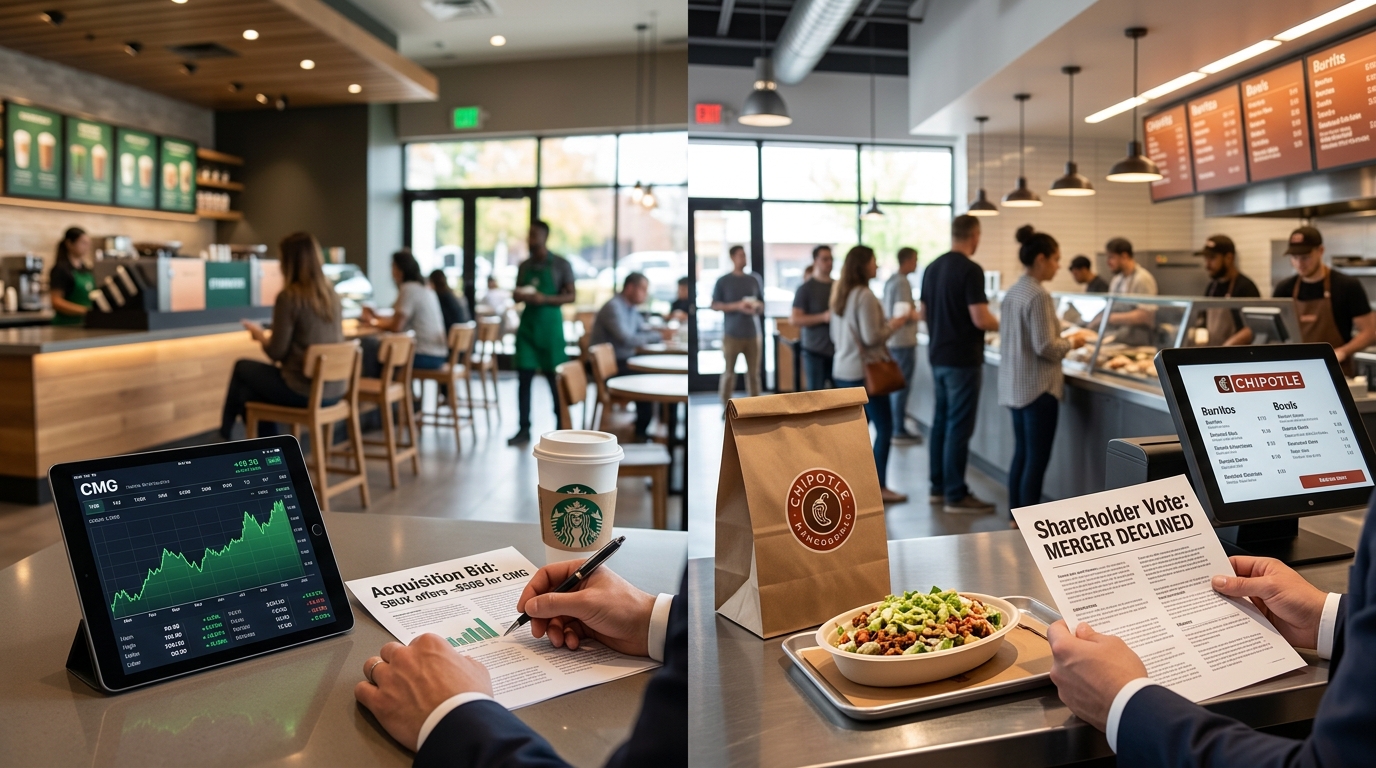
Bonus Content: Starbucks Would Pay Around $50 Billion for Chipotle. Shareholders Said No.
Dear Reader,
A wild rumor has been going around our office.
When I first heard it, I almost laughed it off.
The rumor was this:
You can get exposure to Anthropic, the company behind Claude, today. Before its IPO. Through a stock you can buy in a regular brokerage account for less than $80.
We traced this rumor back to tech visionary Matt McCall, who has tabbed 50 stocks that went on to peak gains of 1,000% or more over the last 20 years.
And he insisted it’s true.
He calls this setup a “Second IPO.” And he believes it could cause one company to double or triple in the wake of Anthropic’s IPO over the next few years, starting this fall.
We sat him down in front of our cameras to get the whole story. He even gave away the name and ticker.
For the time being, you can watch it free, right here.
Yours in smart speculation,
Stephen Prior, Publisher
Monument Traders Alliance
Starbucks Would Pay Around $50 Billion for Chipotle. Shareholders Said No.
Analyst Targets
- D.A. Davidson (Matt Curtis): Rates deal completion probability at roughly 20%, views odds as “relatively low”
- William Blair (Sharon Zackfia): Reiterates SBUX rating; estimates likely acquisition price near $50 billion; sees no obvious revenue synergies
- TD Cowen: Views deal as a “low-probability outcome at this stage”
- BTIG (Pete Saleh): Questions deal timing while Starbucks turnaround is still mid-execution
- Melius Research (Jacob Aiken-Phillips): Sees limited synergies; needs considerably more detail before assessing value creation
What the FT Said
Starbucks has been working with advisers on a takeover proposal of Chipotle Mexican Grill in recent months, according to the Financial Times, citing people familiar with the matter. The publication described the plans as early-stage and warned that the deal might never get off the ground given its complexity. No formal offer has been disclosed, and no price, exchange ratio, or deal structure has been confirmed.
Chipotle’s shares rose a little more than 6% while Starbucks’ stock fell sharply in intraday trading after the report. By the close, Starbucks finished down about 0.4% after being down roughly 7% at its worst point. That intraday reversal matters: the initial gut reaction from SBUX holders was unambiguous rejection, even if calmer heads brought the stock back.
Company Profiles
Starbucks operates more than 41,000 company-operated and licensed stores globally. Chipotle has more than 4,200 restaurants, the vast majority in the U.S.
The Price Tag
This is where the deal’s logic gets difficult to defend.
With an enterprise value in the mid-$40 billions in early October, Chipotle would represent the largest-ever restaurant acquisition. William Blair estimates a likely acquisition price closer to $50 billion, similar to the 20% premiums that Inspire Brands paid for Dunkin’ and that JAB paid for Panera Bread. For context, such a transaction would surpass Burger King’s roughly $11.4 billion purchase of Tim Hortons in 2014 by more than three times.
Funding that number is the larger problem. Starbucks had a net debt position as of the end of June, but the specific net debt figure and leverage ratio cited here could not be confirmed from Starbucks’ June 28, 2026 quarterly filing. William Blair’s Zackfia estimated that if Starbucks paid a 20% premium and financed the deal primarily through debt, its leverage would balloon to roughly six times. That lands on a balance sheet already committed to a renovation program targeting thousands of stores. Starbucks could fund the deal, likely through a combination of stock and debt, though Zackfia suggested the coffee chain could sell its Japan business and use those funds to help buy Chipotle.
Why the Stock Is Moving
The SBUX selloff encodes a specific investor view: this deal is expensive, consumes management bandwidth, and the synergies do not justify the outlay.
William Blair analyst Sharon Zackfia wrote that the proposed acquisition offered “no obvious revenue synergies,” even if the companies could reduce expenses by combining certain operations. The analysis estimated potential corporate and technology savings at roughly $300 million, but saw limited traditional supply-chain overlap because Starbucks and Chipotle source fundamentally different products. Melius Research’s Jacob Aiken-Phillips added: “It’s not like Starbucks has a grill.”
BTIG analyst Pete Saleh wrote that acquiring Chipotle “could consume significant senior management time on financing, integration, organizational design, systems, and personnel,” asking: “Why introduce another major strategic initiative before demonstrating that Starbucks can deliver sustainable margin recovery?”
The Turnaround Context
The timing argument against this deal is real. Starbucks reported a 7.9% rise in global comparable store sales for its fiscal third quarter, driven by a 4.2% increase in transactions and a 3.5% improvement in average ticket, and raised its full-year adjusted EPS guidance to a range of $2.55 to $2.65. Niccol recently declared the turnaround complete. Injecting a $50 billion M&A process into that moment carries genuine execution risk.
The Bull Case: A Multi-Brand Platform
The strongest argument for doing this deal is not cost cuts. It is geography. A potential acquisition could accelerate Chipotle’s international expansion, but the specific claim that Chipotle has “only 100 locations” outside the U.S., and that Starbucks has “22,000” locations outside the U.S., could not be verified from primary filings or company disclosures on a tight timeframe. Northcoast Research analyst Jim Sanderson noted what he liked about the potential: “the opportunity CEO Brian Niccol would have to leverage Starbucks’ licensed partnerships in Europe to expand Chipotle more aggressively.”
Real estate overlap is real, but the specific statistic that roughly 90% of Chipotle restaurants are within one mile of a Starbucks could not be verified from a primary source.
Forward Scenarios
Bull: Deal materializes at a modest premium; Niccol’s operational knowledge compresses integration risk; Chipotle’s international revenue grows through Starbucks’ licensing infrastructure; combined entity re-rates as a diversified restaurant platform. CMG holds above $38, SBUX recovers toward $100.
Base: No deal is formally announced; both stocks drift toward pre-report levels as M&A optionality is priced out. CMG faces its own traffic recovery challenge. SBUX continues turnaround execution. The report functions as a floor for CMG and a tax on SBUX sentiment for several weeks.
Bear: A formal offer emerges at $50 billion-plus, funded heavily with debt. SBUX leverage surges, credit agencies flag the balance sheet, and Niccol’s management focus fragments. CMG integration costs eat into Starbucks’ newly recovered margins. SBUX breaks below $87.
Technical Overlay
Starbucks traded near $108 in early September, near $93 by late September, and toward $96 in early October before gapping to a low near $87 on Thursday’s report. SBUX sits below its moving averages at $94.16 and $98.03. A recovery back through $94 is the first level to reclaim. CMG, meanwhile, closed Thursday at $32.68, well off its 52-week high of $42.82, with volume running roughly 70 million shares on the news day versus about 12.5 million the prior session.
Bottom Line
The question is not whether Niccol understands Chipotle. He built the playbook there. The question is whether Starbucks shareholders want to pay $50 billion, plus the leverage cost, for a chance to run an experiment he could theoretically run more cheaply through licensing agreements and shared technology. William Blair’s Zackfia noted that such a deal could signal “that management has less confidence in Starbucks’ future growth prospects.” Thursday’s sharp intraday drop in SBUX, and the slow recovery to a near-flat close, says the market is not yet willing to dismiss that reading.