
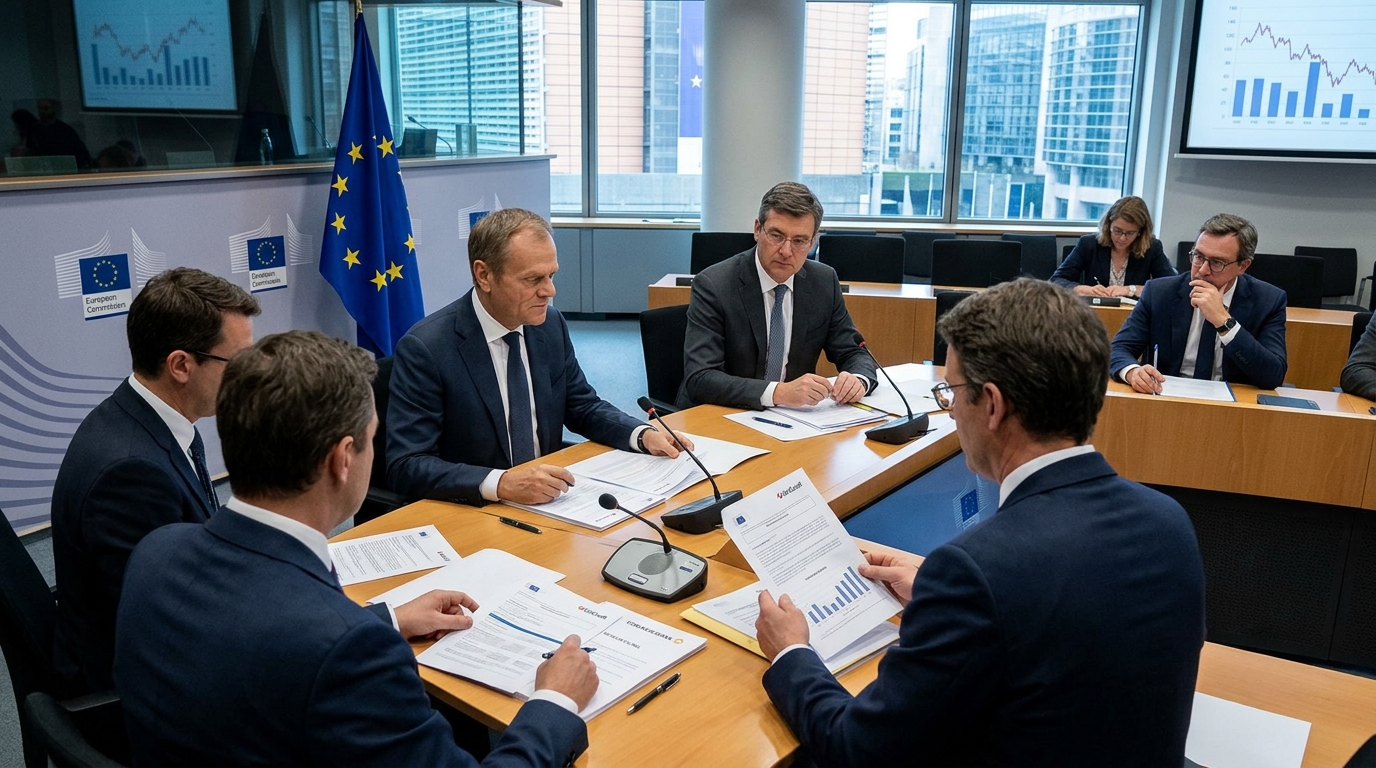
There is now a hard date on the calendar. On October 9, UniCredit formally sought EU antitrust approval for its takeover of Commerzbank, with the European Commission setting a November 16 deadline for its Phase 1 decision. After two years of political brinkmanship in Berlin, this is the first regulatory milestone with a fixed end point, and it reframes the Commerzbank trade entirely.
UniCredit has already secured nearly half of Commerzbank’s share capital. That position was not built quietly. The Italian lender accumulated its holding through open-market purchases, derivative positions, and a voluntary exchange offer, absorbing German government resistance and a hostile Commerzbank board along the way. Commerzbank shares have increased sharply since UniCredit first disclosed its initial stake acquisition in September 2024. A significant portion of that re-rating is deal premium. Investors now need to decide how much of it survives each of the three scenarios Brussels can deliver.
The Company Behind the Bid Target
Commerzbank is headquartered in Frankfurt and serves private, business, and corporate customers across Germany and internationally. It is a leading bank for the German Mittelstand and accounts for about 30% of German foreign trade, which gives it strategic importance that Berlin has used as political cover for its resistance. Total assets stood at €603.3 billion as of Q1 2026, and the bank employs about 40,000 people. Underlying fundamentals have improved sharply: trailing twelve-month revenue is €11.88 billion, net income is €2.87 billion, and EPS has grown 25.6% year-over-year.
The HVB Angle Changes the Arithmetic
The deal is no longer a simple bid. Commerzbank CEO Bettina Orlopp confirmed on September 24 that one possible structure involves Commerzbank acquiring UniCredit’s German subsidiary HVB in shares, a route she described as one of several “options on the table.” RBC analyst Pablo de la Torre estimated HVB could be valued between €22 billion and €28 billion in an all-share deal, and that such a reverse merger would lift UniCredit’s Commerzbank stake from just under 50% to approximately 70%.
The German government’s position has also softened measurably. After almost two years of confrontation, some senior figures in Berlin are now prepared to discuss the sale of the state’s remaining stake, provided an agreement is reached on Commerzbank’s strategy and future. Berlin’s stated conditions include preserving the Frankfurt headquarters and maintaining Commerzbank’s credit supply to German mid-sized enterprises.
Forward Scenarios: Bull, Base, Bear
Bull. The Commission clears the deal without conditions at Phase 1, on or before November 16. Berlin finalizes the terms under which it sells its remaining stake to UniCredit. A full merger or HVB absorption follows, with combined cost savings and cross-border scale justifying a meaningful re-rating of the merged entity. Commerzbank shares price toward the upper end of the deal structures on offer.
Base. The Commission clears the deal with concessions during its preliminary review, requiring UniCredit to offer remedies around market overlap, particularly in German corporate lending where both HVB and Commerzbank compete directly. The process moves to a negotiated close in early 2027. Deal premium in the share price holds but compresses modestly as the timeline extends.
Bear. Brussels opens a full Phase 2 investigation, citing competition concerns in German corporate banking. The timetable slips into mid-2027 at the earliest. If talks collapse and UniCredit withdraws without a takeover offer, the takeover speculation would evaporate from the price, leaving Commerzbank to prove its earnings targets can stand without merger support. RBC already moved to reflect this risk, cutting its Commerzbank rating from Outperform to Sector Perform and trimming its price target from €43 to €40.
Technical Overlay
CBK traded around €37.92 on October 9 following the filing. The stock’s 52-week range runs from €29.01 to €43.37, placing it in the upper half of its annual band but well below the peak reached during the peak deal-momentum phase. The November 16 Commission date functions as a near-term catalyst, with the stock likely to consolidate in the €37 to €41 range until an outcome is known. A Phase 1 clearance would be the trigger to test €43 resistance again. A Phase 2 referral reopens the gap back toward €33 to €35.
What Investors Should Watch
- November 5: Commerzbank publishes third-quarter 2026 results, the last major fundamental read before the Commission rules.
- November 16: Phase 1 decision date. Clearance with or without remedies versus a Phase 2 referral is the binary that defines the trade.
- German government stake: Berlin still holds a stake of about 13% of Commerzbank. Any signal that it will sell to UniCredit on agreed terms would be a significant positive for the share price.
- Capital position: Analyst notes flag that UniCredit’s strong capital position has given it room to pursue the transaction without immediate pressure on its CET1 ratio, but an HVB absorption at the high end of RBC’s €28 billion valuation would test that flexibility.
Bottom Line
The Commerzbank trade has spent two years as a political story. As of October 9, it is a regulatory one. The November 16 deadline determines whether this consolidates as Europe’s largest cross-border banking deal in a generation or reverts to a stand-alone earnings story trading at a far lower multiple. The stock currently trades at a P/E of roughly 14.5x versus approximately 11.1x for the broader European banking sector, meaning investors are already paying for optionality the Commission has not yet granted. The position is only worth that premium if Brussels delivers a Phase 1 clearance. Everything else is downside from here.