
When the two largest Medicare Advantage insurers in the country are walking away from close to a million members, that is not a routine market adjustment. Humana is ending plans covering roughly 600,000 members, and UnitedHealthcare is closing plans covering about 390,000 more, both for the 2027 plan year, with coverage changes taking effect January 1, 2027. The beneficiaries now shopping for new coverage are, by definition, someone else’s opportunity. The only large managed-care company that has repeatedly told investors it priced this year correctly is CVS Health, and it reports Wednesday morning before the open.
Why Wednesday’s Number Is Different This Quarter
CVS is slated to announce its fiscal Q3 2026 results before the market opens on Wednesday, November 4. Analysts are forecasting about $1.66 in earnings per share and roughly $104.7 billion in revenue. Those estimates matter less than the single ratio buried inside the Health Care Benefits segment: the medical benefit ratio, or MBR, which measures how many cents of every premium dollar get spent on actual medical costs.
The trajectory here has been sharp. CVS’s Aetna business posted an MBR of 84.6% in Q1 2026, well below the prior year’s 87.3%. In Q2, the ratio rose to 87.4% but still fell from 89.9% in the year-ago period, driven by improved performance in the government business. That is a significant shift from Q3 2024, before current CEO David Joyner took the reins in October 2024, when Aetna’s medical benefit ratio topped 95%, driven by higher utilization and a premium deficiency reserve tied largely to Medicare Advantage.
The question Wednesday answers is whether those gains were structural or opportunistic. In Q2, the company attributed the year-over-year MBR improvement mainly to stronger underlying performance in the government business and the absence of the prior-year premium deficiency reserve. Management also raised full-year MBR expectations in connection with its updated 2026 outlook, which signaled confidence that the improvement was not confined to a single quarter.
Raised Twice, Still Cautious
CVS raised full-year 2026 guidance after Q1, lifting adjusted EPS guidance to $7.30 to $7.50 from $7.00 to $7.20. After Q2, it raised again, moving adjusted EPS guidance to $7.90 to $8.10 and cash flow from operations guidance to at least $11.5 billion. That is a $0.90 per-share lift over two quarters, at a company that had been synonymous with missed guidance as recently as 2024.
What makes the streak notable is the industry backdrop it ran against. Rivals UnitedHealth and Humana have pointed to higher medical costs within Medicare Advantage and a widening mismatch between reimbursement and medical cost trends. CVS was not immune to the same reimbursement headwinds, but Aetna has said it priced 2026 plans more conservatively, deliberately accepting membership losses to protect the ratio.
The Architecture Rivals Cannot Copy Quickly
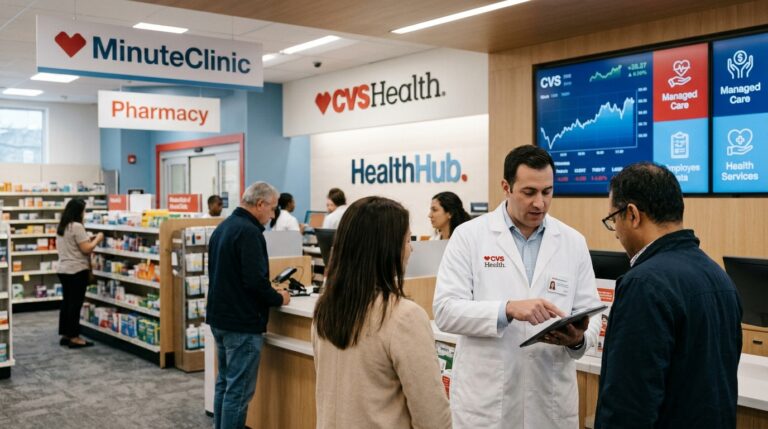
CVS is the only large managed-care company that combines an insurance arm, a pharmacy benefit manager, and a retail pharmacy chain under one roof. That integration is the bull case in concentrated form. When an Aetna member fills a prescription through Caremark and picks it up at a CVS MinuteClinic, CVS captures the margin at every step. CVS’s health services segment, which includes Caremark, saw revenue increase 11% in Q1 2026.
The sector context also shifted last week on the ACA side. The enhanced premium tax credits that reduced ACA health coverage costs for millions expired at the end of December 2025 after Congress failed to renew them. What happens to marketplace enrollment after that change is still unfolding, and it is too early to treat any single enrollment drop as settled fact. A more pressured individual exchange market and a chaotic Medicare Advantage reshuffle are the conditions under which CVS’s disciplined pricing strategy either proves durable or gets tested.
The Bear Case
CVS guided for only single-digit earnings growth in the second half of the year, and its initial 2027 outlook of at least $8.44 per share offered limited upside beyond existing expectations. Additional concerns include weaker expected client retention and regulatory pressure on Caremark, alongside uncertainty over rising medical costs. CVS Caremark’s claim volume has declined for two consecutive years, even as Express Scripts pulled ahead. Winning the insurance margin battle while losing PBM share is not a sustainable equation.
What to Watch
Wednesday’s Q3 MBR is the fulcrum. An MBR below 89% confirms the pricing discipline held through a second consecutive tough quarter. Anything above 90% reopens the debate about whether Q1 and Q2 were favorable development releases dressed up as operational progress. Cigna reports Thursday and Humana on Friday, making this the most concentrated three-day read on managed-care fundamentals since the MA cost spiral began. If CVS beats while both rivals disappoint, the gap in pricing sophistication that management has been describing for three quarters will finally be visible in side-by-side results.