
Dear Friend,
Google is paying Elon $920 million a month.
Anthropic is paying him $1.25 billion a month.
The richest companies on Earth are renting his computer because they can’t build what he has.
Together, about $26 billion a year.
Now the Pentagon, the biggest buyer on Earth, wants its own.
Every dollar of it rides on one tiny company Elon couldn’t build around.
I call it the X-Grid stock.
I expect it to be the biggest winner of the entire AI buildout.
Get the name of the company collecting underneath Elon >>
The Buck Stops Here,
Dylan Jovine
Founder, Behind the Markets
CVS Health Is the Last Managed-Care Name Still Beating. Wednesday Tells You Why.
Analyst Targets
- Barclays: Overweight, $108
- Argus: Buy, $114
- Piper Sandler: Buy, $112
- UBS: Buy, $118 (lowered from $126 in September)
- Jefferies: Buy, $120
- Consensus (23 analysts): Moderate Buy, avg. target $107.24
Why Wednesday Matters More Than Usual
CVS Health reports Q3 2026 results before the market opens on Wednesday, November 4. Cigna follows Thursday, November 5, and Humana on Friday, November 6. Three managed-care reads in three days, during the first open-enrollment season where the enhanced ACA subsidies are gone and Medicare Advantage is shedding counties at scale.
The market is not just pricing a quarter. It is pricing which model survives a restructuring of the two largest government health programs simultaneously. CVS is the only company in this week’s earnings sequence that operates an insurer, a pharmacy benefit manager, and a retail pharmacy chain under one roof. That integration is either a margin hedge or a margin trap. Wednesday’s medical loss ratio will do most of the arguing.
Company Profile
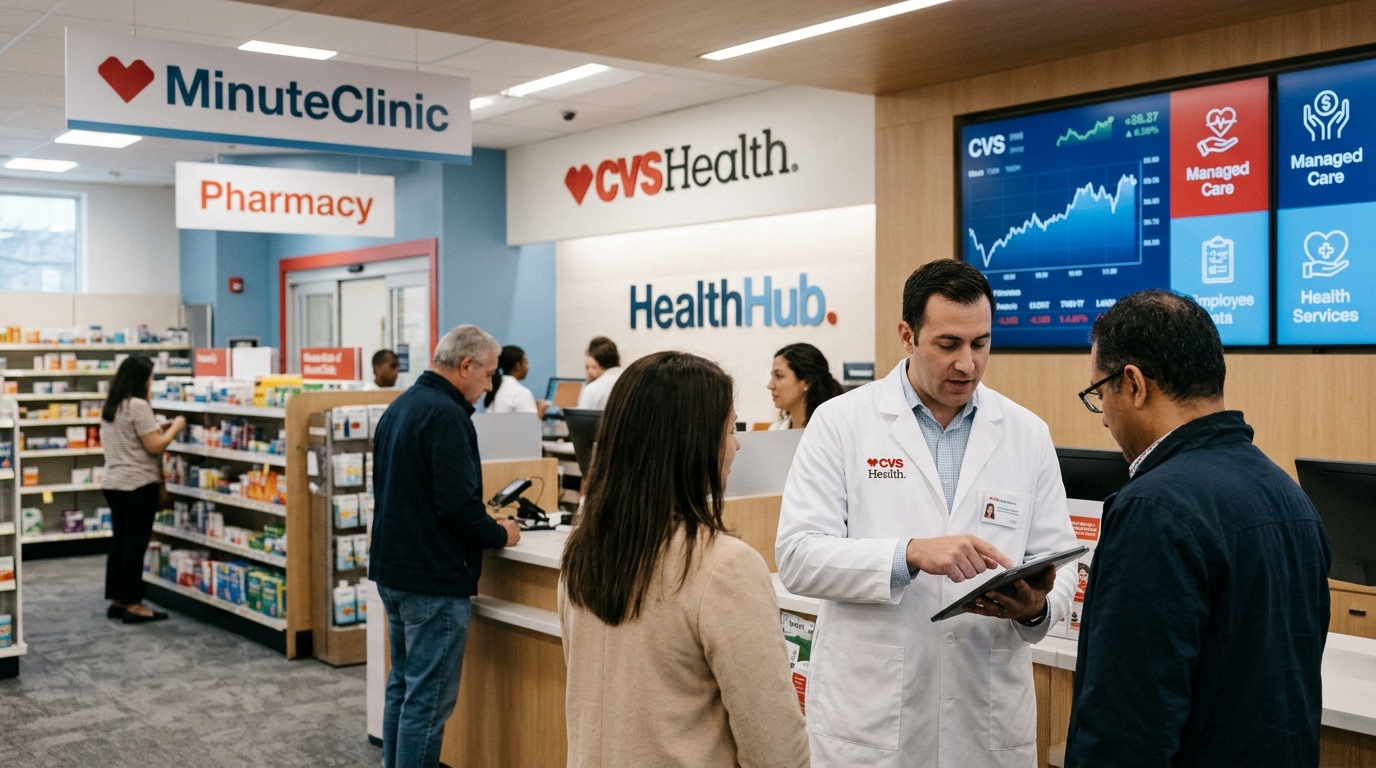
CVS Health delivers services through its Health Care Benefits, Health Services, and Pharmacy & Consumer Wellness segments. Health Care Benefits is the Aetna insurance business, with roughly 26 million covered lives. Health Services is Caremark, one of the three dominant pharmacy benefit managers in the country. Pharmacy & Consumer Wellness is the retail chain and MinuteClinic network. The combination creates revenue corridors competitors cannot replicate: a member who fills a prescription, uses a clinic, and carries an Aetna card generates margin at three separate stops.
The Numbers
Analysts expect CVS to post earnings of $1.65 per share on revenue of $104.72 billion for Q3 2026. In the same quarter a year earlier, CVS reported $1.60 per share on revenue of $102.87 billion. The bar looks manageable on its face, but the bar has looked manageable all year and CVS has cleared it decisively each time.
- In Q1 2026, CVS reported EPS of $2.57 against a $2.18 estimate (+17.9%). In Q2 2026, it reported $2.58 against a $1.85 estimate (+39.5%).
- Aetna’s medical benefit ratio in Q2 fell to 87.4% from 89.9% in the prior year.
- The full-year medical benefit ratio is now expected at 89.75%, plus or minus 25 basis points.
- Full-year adjusted EPS guidance stands at $7.90 to $8.10, raised from $7.30 to $7.50 in Q2.
- Full-year revenue guidance stands at at least $414 billion, raised from at least $405 billion.
Management projected only single-digit earnings growth in the second half, while its initial 2027 outlook of at least $8.44 per share offered little upside beyond existing expectations. That 2027 figure is the one investors will pressure on Wednesday.
Why CVS Has Beaten While Rivals Retreat
The divergence inside managed care this year is not subtle. Rivals including UnitedHealth and Humana have detailed higher medical costs within Medicare Advantage and a gap between government reimbursement and how much insurers are spending on members’ medical services. CVS told a different story. The company reported an 84.6% medical loss ratio in Q1, declining from the 87.3% rate a year ago, due in part to improvements in the performance of Aetna’s government plans.
The structural reason: CVS reset pricing on its Medicare Advantage book aggressively heading into 2026, accepting membership losses in exchange for margin. That tradeoff is now paying off as competitors scramble.
Nationally, UnitedHealth Group is leaving 228 counties and entering nine for 2027. Humana is leaving 62 and entering four. A UnitedHealth spokesperson confirmed about 390,000 members are in plans being discontinued, and Humana has said its exits will affect about 600,000 enrollees. Those displaced members need somewhere to go during open enrollment, and Aetna is positioned to absorb a portion of them at rates set on its terms.
Macro Context
Open enrollment for 2027 ACA marketplace coverage started November 1, 2026. Premiums are still elevated after enhanced subsidies expired at the end of 2025, and as of now they have not come back. Policy analysts at KFF and other health policy groups say marketplace enrollment fell in 2026 after the subsidies ended, with additional attrition expected as higher premiums and nonpayment filter through. A smaller, sicker risk pool is precisely the environment where a PBM’s drug-cost leverage and a diversified insurer’s pricing discipline matter most. CVS has all three levers. Pure-play insurers have one.
The subsidy expiration is not just a headline risk for insurers. Out-of-pocket premiums rose 58 percent after enhanced subsidies expired, and a second consecutive double-digit hike is now loading into 2027 enrollment.
Forward Scenarios
Bull
Q3 MLR comes in at or below 89%, management raises 2027 guidance above $8.44 EPS, and the Caremark membership concern proves manageable. Displaced Humana and UnitedHealth Medicare Advantage members flow into Aetna at higher margins. Stock re-rates toward the $114-$120 target range.
Base
Q3 comes in roughly in line. Management confirms 2027 guidance without increasing it. The stock holds recent gains and awaits Cigna and Humana results as sector context. Gradual drift toward analyst consensus near $107.
Bear
Weaker expected client retention and regulatory pressure on Caremark, alongside uncertainty over rising medical costs, weigh on results. MLR surprises higher, 2027 guidance is left unchanged or lowered, and the stock gives back a portion of its 2026 gains.
Humana’s own trajectory adds a layer to that bear scenario. Humana’s flagship contract climbed back to four stars in the 2027 Medicare Advantage ratings, reinstating federal quality bonus payments worth roughly $1.5 billion of EBIT by 2028.
Technical Overlay
CVS has recovered sharply from its 2025 lows, with the stock trading well above its 200-day moving average heading into the earnings report. The gap from Q2’s earnings surge in August remains partially unfilled. A clean beat with 2027 guidance confirmation keeps that gap as support. A miss or a guidance hold risks a fill back toward the mid-$80s, where the 50-day sits.
Bottom Line
The question Wednesday is not whether CVS can beat a $1.65 EPS estimate. It has beaten by double digits in each of the last four quarters. The question is whether the 2027 pricing commentary gives investors enough confidence to hold through a sector still under cost pressure, a post-subsidy individual market, and a Medicare Advantage industry in active contraction. CVS executives have said the company is on track for planned Medicare Advantage margin improvements by 2028. The MLR trend through Q3 is the evidence that keeps that timeline credible, or challenges it. That number, more than EPS, is what moves the stock on Wednesday.