Dear reader,
This stock trades for under $5 today.
Dr. Mark Skousen believes it could hit $50 by January 1st.
Why?
It’s one of the top stocks Elon Musk is targeting.
He’s revealing the key details in his latest briefing.
Click here for the story before it’s too late to take advantage.
Good investing,
Rachel Gearhart
Publisher, The Oxford Club
ULA’s Vulcan Rocket Fails. Amazon’s 2029 Deadline Gets Harder.
Subjects: BA, LMT, AMZN
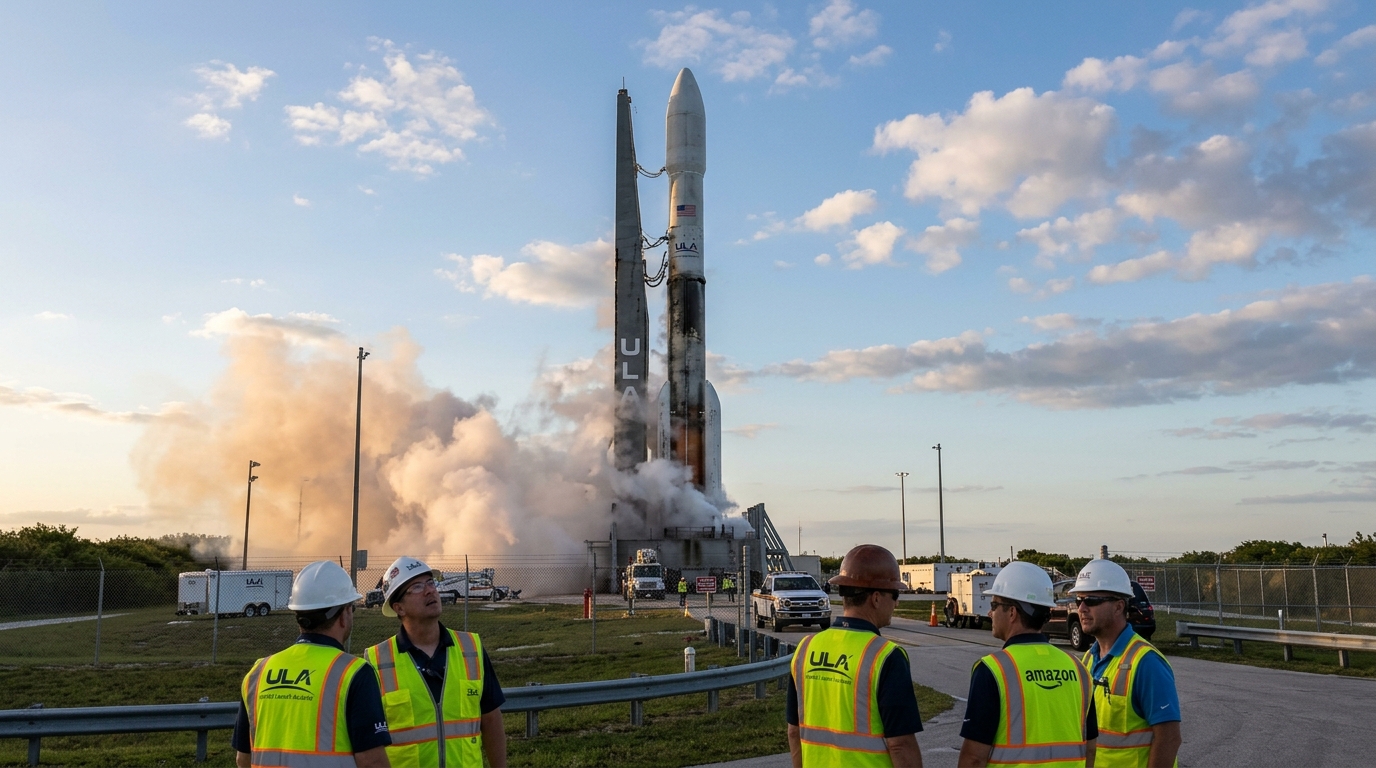
In a major setback for United Launch Alliance, the company’s Vulcan rocket, carrying a batch of Amazon Leo internet satellites, malfunctioned during the climb to space Sunday, dooming the payload and throwing a costly wrench into the launch schedules of both companies. It was the first outright failure of a United Launch Alliance rocket since the company, a partnership between Boeing and Lockheed Martin, was formed in 2006.
The Vulcan Centaur lifted off from Cape Canaveral Space Force Station at 12:40 p.m. ET, hauling 40 satellites for the Amazon Leo broadband constellation toward low Earth orbit. They never got there. “Based on data received by our Launch Director, we confirm that the Vulcan vehicle launched from Space Launch Complex 41 suffered an anomaly 10 minutes into the flight and failed to deliver the Amazon mission to orbit,” ULA said.
Beyond that statement, the company has not publicly identified what failed, and Vulcan now faces a potentially significant grounding while engineers review telemetry and implement fixes.
What This Means for ULA, Boeing, and Lockheed
Vulcan is not a mature rocket. It was only the fifth Vulcan flight, and the first in nine months. ULA and its suppliers spent that time resolving nozzle problems on the GEM 63XL solid-rocket boosters after an anomaly on an earlier flight. Sunday’s mission was supposed to be the clean break that reset confidence in the program.
After Vulcan’s earlier grounding cut into ULA’s launch revenue, Lockheed Martin disclosed in its July 2026 quarterly filing that it had guaranteed up to $500 million of ULA’s borrowings and that its ULA equity-method investment stood at $617 million as of late June 2026. A second failure investigation reopens every question about ULA’s financial sustainability that those numbers were meant to answer.
The failure puts pressure on Boeing and Lockheed Martin to identify the cause and restore confidence in the Vulcan rocket. Earlier this year, the Space Force paused Vulcan national security launches while officials investigated the prior Vulcan anomaly, saying the review could take many months. A repeat of that dynamic, applied now to both national security and commercial missions, would effectively shut ULA’s main revenue line.
Amazon’s 2029 Problem Is Now Acute
The numbers make this more than a reputational setback. Amazon needs 3,232 satellites deployed by July 30, 2029. The FCC granted Amazon Leo a waiver that eased the interim milestone pressure while keeping the July 30, 2029 final deadline intact. Before Sunday’s mission, roughly 398 Amazon Leo satellites had been launched, including two prototypes, leaving the company with a long runway still to cover.
Sunday’s launch was the first of 38 Vulcan flights Amazon purchased for its Leo satellites. Amazon has also signaled it wanted a faster cadence after this mission, but that now depends on how quickly ULA can complete the investigation and return Vulcan to flight. With roughly 2,800-plus satellites still needed by the July 30, 2029 deadline, any prolonged Vulcan stand-down forces Amazon to wring more cadence from its other providers.
Amazon has booked launches across multiple providers, including ULA (Atlas V and Vulcan), SpaceX (Falcon 9), Arianespace (Ariane 6), and Blue Origin (New Glenn). The Atlas V campaign is nearing its end rather than having concluded already. Separately, Reuters reported this month that Blue Origin pushed New Glenn’s return to flight to January 2027. That leaves the constellation heavily dependent on a Vulcan that is now grounded with no return-to-flight date, and a New Glenn that is not yet fully operational.
Competitive Context: SpaceX Widens Its Lead
Starlink operates about 11,000 satellites in low Earth orbit, while Amazon has only a few hundred launched and fewer operational on station. Every month Vulcan stays grounded is a month SpaceX puts more distance between the two constellations. In a recent regulatory filing, SpaceX reported 13.6 million Starlink consumer subscribers as of September 30, 2026. Amazon Leo has not yet opened consumer service.
Bull / Base / Bear
- Bull: Investigation identifies a discrete, isolated anomaly in the LEO-optimized Centaur V upper stage. ULA resolves it within 90 days, Vulcan flies again by February 2027, and New Glenn begins its Amazon cadence on schedule in Q1 2027. Amazon can still reach a critical service density ahead of the 2029 deadline, with Ariane 6 bridging the gap.
- Base: Vulcan stands down for four to six months, consistent with the prior investigation timeline. New Glenn slips further from its January 2027 target. Amazon reaches adequate constellation density in 2028, with consumer service delayed into that year and the 2029 FCC deadline met narrowly, requiring FCC flexibility.
- Bear: A systemic problem in the Centaur V upper stage requires major redesign, grounding Vulcan for most of 2027. With New Glenn still early in its maturation, Amazon’s orbital cadence collapses. The FCC declines further waivers and Amazon risks partial forfeiture of spectrum rights, while ULA’s finances require another round of parent-company support.
What Investors Should Watch
- ULA’s root cause disclosure: whether the fault lies in the LEO-optimized Centaur V or elsewhere determines how long the stand-down runs.
- Space Force posture on NSSL missions: a second national security pause would signal a longer grounding than ULA or its parents are publicly projecting.
- Lockheed’s next earnings commentary on ULA equity earnings; any revision lower will be the first financial footprint of Sunday’s failure.
- New Glenn’s return-to-flight date, which now carries more weight for Amazon’s deployment cadence than at any point since the program began.
Bottom Line
This is not a setback that gets priced away in a week. Vulcan is ULA’s only path forward, and it now has a confirmed failure on its fifth flight following a nine-month stand-down from an earlier anomaly. In 2026, Vulcan faced a GEM 63XL solid-rocket-booster anomaly that prompted a Space Force pause for national security missions, and ULA’s parent companies disclosed financial backstops tied to Vulcan-related performance challenges. Sunday’s failure compounds every one of those pressures.
For Amazon, the question is whether its deliberately diversified launch portfolio can absorb a prolonged Vulcan absence without breaking the July 30, 2029 timeline. That answer depends on New Glenn and Ariane 6 performing at cadences neither provider has yet sustained. The FCC deadline is not theoretical. The math, as of the morning of November 16, 2026, is uncomfortable.