Morgan Stanley analyst Kristine Liwag did something Monday she hadn’t done in years: she moved Lockheed Martin to Overweight. Her new price target of $835, lifted from $690, implies roughly 38% upside from Friday’s close of $604.18. The stock responded, closing at $635.20 on October 26, up 5.13% from the previous close on volume of about 2.67 million shares, nearly double the 30-day average. That kind of volume on an upgrade day is institutional, not retail.
Why This Stock Now
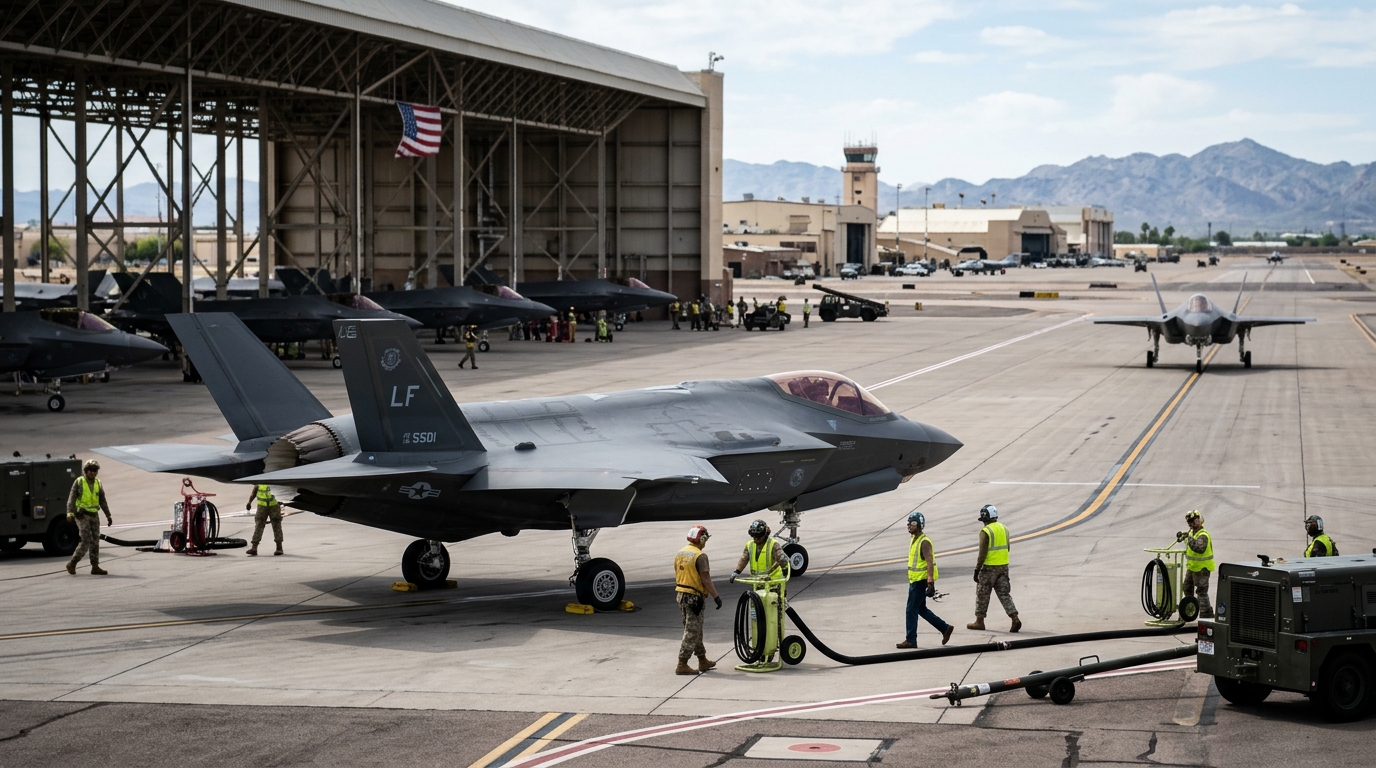
The catalyst isn’t a vague macro tailwind. The U.S. Department of Defense and Lockheed Martin announced on October 22 that they reached a framework agreement for ten years of F-35 production and long-term sustainment. The agreement guarantees a minimum of 850 U.S. aircraft and includes associated initial spares, 10 years of modification kits and sustainment, and international customer orders across Lots 21 through 30, at a continued production rate of 156 aircraft per year. That single agreement removes what had been the loudest open question about Lockheed’s revenue line for the rest of this decade.
The Business
Lockheed is the only company on earth building the F-35, and that won’t change. The jet is embedded into the force structures of the U.S. military and more than a dozen allied nations. Lockheed said the framework is expected to save taxpayers billions of dollars through long-term pricing and industry volume discounts, which means pricing pressure is less of a lever adversaries can pull on the company than in a year-to-year negotiation.
The F-35 framework lands on top of an already-accelerating fundamental picture. Lockheed’s third-quarter 2026 results showed revenue reaching $20.7 billion, up about 11% year over year, and earnings per share of $7.97. The order backlog hit a record $292 billion. A 4x book-to-bill is not a company scraping for work. It is a company choosing which work to take.
Why Wall Street Is Paying Attention
Morgan Stanley raised its price target on shares to $835 from $690, suggesting roughly 38% upside from Friday’s close. Liwag’s prior rating was Equal Weight, meaning she was effectively sitting on the sidelines while the stock fell from its 52-week high of $692 to the low $400s last year before recovering. The framework deal changed her calculus because it converts what was a negotiation risk into a planning certainty for both Lockheed and its supply chain.
She is not alone in growing more constructive. UBS raised its price target from $653 to $692 and kept a buy rating on October 23, and Citigroup maintained a buy rating with a $706 target the same day. Even JPMorgan, still neutral, raised its price target from $620 to $665 on October 23.
What Could Go Wrong
The honest answer starts here: the agreement is not yet a formal procurement contract, and pricing and aircraft numbers still require negotiation. It is also subject to Congressional approval and funding. Congress funded just 47 F-35s in fiscal 2026 versus the framework’s implied annual cadence of 85 for the U.S. military alone. That gap between intent and appropriation is real and worth watching.
Then there is the analyst distribution. One equities research analyst rates LMT with a Strong Buy, ten have assigned a Buy rating, ten have assigned a Hold rating and one has given a Sell rating. Roughly half the street is still waiting. If the hold camp doesn’t move, the upgrade cycle may be shorter than the $835 target implies. The framework also stipulates that Lockheed Martin would self-fund at least $7 billion for initiatives that support the F-35 program, which is capital that won’t flow to buybacks or dividends over that period.
The Bottom Line
Lockheed Martin enters this week with three things rarely aligned at the same moment: a decade-long production framework on its most important programme, management lifting its full-year 2026 revenue outlook to a range of $80 billion to $82 billion, and a top-tier analyst upgrade with a price target implying nearly 40% upside. The stock has already run strongly year-to-date, so the easy money is gone. But the F-35 framework resolves the single biggest commercial question the stock faced, and a backlog of $292 billion means revenue visibility that most industrial companies would envy. That combination makes Lockheed Martin the most compelling defense equity available today.