November 1, 2026
Bonus Content: Uber Reports Wednesday. Brazil and Robotaxis Hold the Answers.
If you still haven’t downloaded my “Simple Options Trading For Beginners” book…
…please take a few seconds and download it right now before your new temporary download link expires.
I eventually plan to charge for this book, so do yourself a favor and download it now…
That way, no matter how much it is in the future, you’ll have a copy on your computer already.
Make sense?
FREE: Simple Options Trading For Beginners << Download Now
Good Trading,
Bill Poulos
P.S. Go here to save a copy of my “Simple Options Trading For Beginners” book to your computer before I start charging for it.
Uber Reports Wednesday. Brazil and Robotaxis Hold the Answers.
Analyst Targets
- Guggenheim , Buy, $125 price target (reiterated October 16)
- Wells Fargo , Overweight, $92 price target (raised from $89 on October 5)
- Citizens , Market Outperform, $100 price target
- Consensus (42+ analysts) , Average 12-month target near $103, roughly 57% above the current price of ~$65.25
The Setup Going In
Uber enters its November 4, 2026 third-quarter report with strong operating growth but heightened scrutiny. The stock is down roughly 20% year-to-date, trading near its 52-week low with a 52-week range of $64.04 to $100.35. A company that was reporting record free cash flow just twelve months ago is now being re-evaluated by investors who are no longer sure what the business model looks like in three years.
That skepticism is the context for Wednesday’s number. The bookings figure will either confirm the growth story or crack it further.
The Numbers Wall Street Is Watching
- Gross Bookings (guidance): $58.25 billion to $60.25 billion, representing constant-currency growth of 18% to 22% year-over-year. Consensus sits near $59.7 billion.
- EPS (guidance vs. consensus): Management guided $0.84 to $0.88, below the $0.91 analyst consensus. The broader street expects about $0.90 per share on revenue of $14.67 billion.
- Adjusted EBITDA (guidance): $2.86 billion to $2.96 billion.
- FX drag: Management assumed a roughly one percentage-point currency headwind to total reported year-over-year growth.
More than the financial numbers, it is the guidance that investors will watch closely. Q4 direction on both bookings and the autonomous vehicle spending commitment will matter more to the stock than whether Uber lands at $59.1 billion or $59.8 billion in gross bookings.
The Brazil Problem
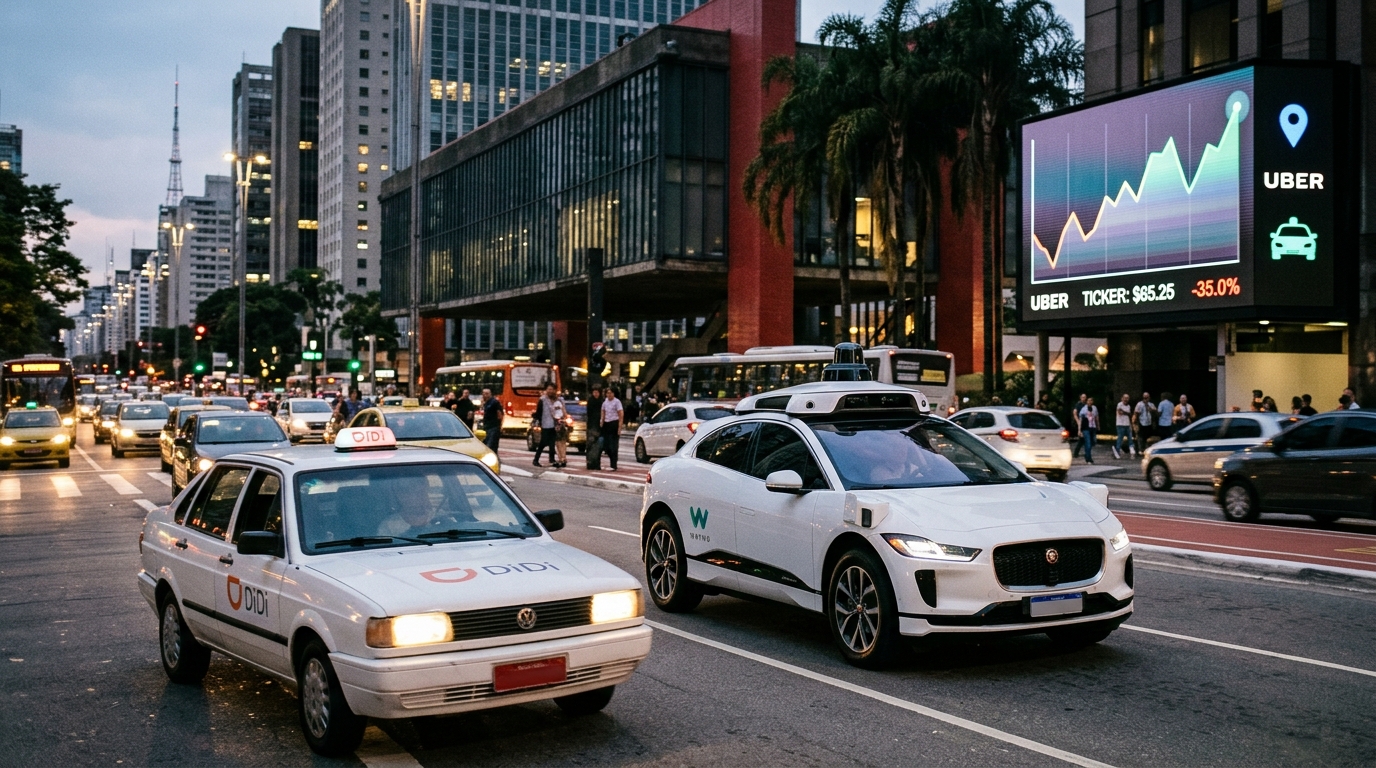
Trips grew 18% to 3.87 billion in Q2, slightly below consensus, and management said the moderation was “entirely attributable to Brazil,” its highest-volume market globally. Competition there has increased as Chinese rivals Didi and Meituan have boosted investments in the country and ratcheted up competition for local delivery bikers.
On the Q2 call, management said Didi Food, Meituan, and iFood were competing for two-wheeler delivery supply in Brazil, increasing Uber’s cost. Brazil is Uber’s largest market outside the United States, which makes the supply-cost pressure there a structural issue rather than a quarterly footnote. Wednesday’s call needs to show either stabilization or a credible response.
Brazil’s delivery market is not the only arena where competitive intensity is reshaping unit economics. MercadoLibre’s back-to-back revenue acceleration in Brazil shows how dominant local platforms can absorb competitive pressure while still compressing margins for rivals.
The Robotaxi Question That Keeps Getting Deferred
On the Q2 earnings call, Uber discussed plans to invest more than $10 billion over a multi-year period into its autonomous vehicle strategy, and took pains to insist Waymo remains a “very, very important partner” even as the two companies have moved toward a looser relationship.
The Waymo relationship tells the harder story. Waymo wound down its Phoenix robotaxi arrangements with Uber in May 2026. Waymo also notified Uber of plans to launch service through its own app in Austin and Atlanta starting in January 2028, alongside the existing deployment with Uber, with Uber saying the current contract covering those cities runs until May 2028. Robotaxis still make up less than 0.5% of Uber’s trip volume, so the near-term financial impact is minimal. The long-term question is whether Uber is assembling a durable aggregation platform or simply onboarding partners who will eventually route around it.
On the August call, management said Uber was live with autonomous vehicles in seven cities and expected to reach 15 by year-end. Since then, Uber has cut roughly 10% of its workforce, and its robotaxi leader is due to depart in mid-November. Investors will want clarity on both the city expansion timeline and the leadership succession. Neither has been addressed publicly.
Forward Scenarios
Bull
Gross bookings land at or above $59.5 billion. Management signals Brazil competition has stabilized and that two-wheeler supply costs are no longer accelerating. Q4 guidance comes in above $62 billion. Guggenheim’s argument, that few companies of Uber’s scale are growing revenue roughly 20% and profit roughly 40% while trading at a discount to the market, gets new traction. The stock recovers toward the $75 to $80 range.
Base
Bookings land near the midpoint, $59.0 to $59.5 billion. Brazil commentary is cautious but not deteriorating. Robotaxi expansion proceeds on schedule with no new Waymo headline. The stock trades flat to up modestly. Rerating requires the Q4 guide, not this quarter alone.
Bear
Bookings miss the midpoint. Brazil trip drag persists into Q4. Management signals the AV spending commitment is compressing near-term margins further than expected. The Waymo shift accelerates in market perception even if not in timeline. The stock tests the 52-week low at $64.
The delivery sector’s valuation gap between Uber and its peers has a direct reference point. DoorDash’s 31% earnings beat and the Instacart acquisition show what the market rewards when a delivery platform demonstrates both growth and expanding platform scope.
Technical Overlay
UBER is trading near the bottom of its 52-week range and below its 200-day moving average. The $64 level is the last structural support; a clean break there opens a gap to the low $60s where no recent volume base exists. On the upside, $72 to $75 is where the stock consolidated in September before the latest leg lower. Any positive surprise in the bookings number or Q4 guide could reclaim that zone quickly given how lightly the stock is owned relative to its analyst consensus.
Bottom Line
The bookings range is not really the variable. Uber has run a consistent 20%-range gross bookings growth story for five quarters. What has changed is the cost of defending that growth in Brazil and the credibility of the robotaxi aggregation bet as Waymo charts its own course. Wednesday’s call is less about whether Uber hits $59 billion and more about whether management can show that two-wheeler supply pressure in São Paulo is a finite problem and that the $10 billion AV commitment will attract partners who stay. Without answers to both, the gap between the $65 stock and the $103 analyst consensus stays exactly where it is.