Analyst Targets
- Morgan Stanley (Erik Woodring): Overweight, $355
- Evercore ISI (Amit Daryanani): Buy, $380
- J.P. Morgan (Samik Chatterjee): Buy, $360
- Bank of America (Wamsi Mohan): Buy, $370
- Bernstein (Mark Newman): Buy, $370
- MoffettNathanson (Craig Moffett): Neutral, $283
- UBS (David Vogt): Hold, $296
The Setup
Apple reports fiscal Q4 2026 after Monday’s close into the worst week for tech stocks since June. The Nasdaq 100 entered a technical correction Friday, dropping more than 10% from its recent highs for the third time this year. A 3% weekly decline followed weak earnings reports from Alphabet, Amazon, Intel, and ServiceNow. Apple is the last mega-cap left to report, and it is doing so into a market that has already decided AI capital spending needs a harder justification.
The other change since the last preview: the CEO. John Ternus became chief executive on September 1, with Tim Cook moving to executive chairman. November 2 is the first time Ternus leads an earnings call as CEO. That single sentence of December-quarter guidance is what Monday’s event is actually about.
Company Profile
Apple generates revenue across iPhone (its largest segment), Services, Mac, iPad, and Wearables. Services delivered a gross margin of 75.6% last quarter, well above that of Apple’s hardware products. That Services cushion is what protects the consolidated margin story, until memory costs in hardware erode it faster than Services can compensate.
The Numbers
- EPS consensus: $1.99 (range: $1.93–$2.06 across 27 analysts)
- Revenue consensus: ~$113.3–$113.4 billion
- YoY revenue growth implied: ~10.6%
- YoY EPS growth implied: ~7.0% from Q4 2025’s $1.85
- Gross margin guidance (Apple’s own): 47%–48%, including ~1 point from tariff refunds
- Prior quarter gross margin: 50.1% (included ~2 points of tariff refunds)
The EPS consensus has drifted down 1.5% over the past 90 days from $2.01, though estimates have held flat over the past month. Apple has beaten the consensus EPS estimate in eight of its last eight quarters. The beat itself is largely priced in. What is not priced in is what management says about the quarter it cannot yet report.
Why Gross Margin Is the Number
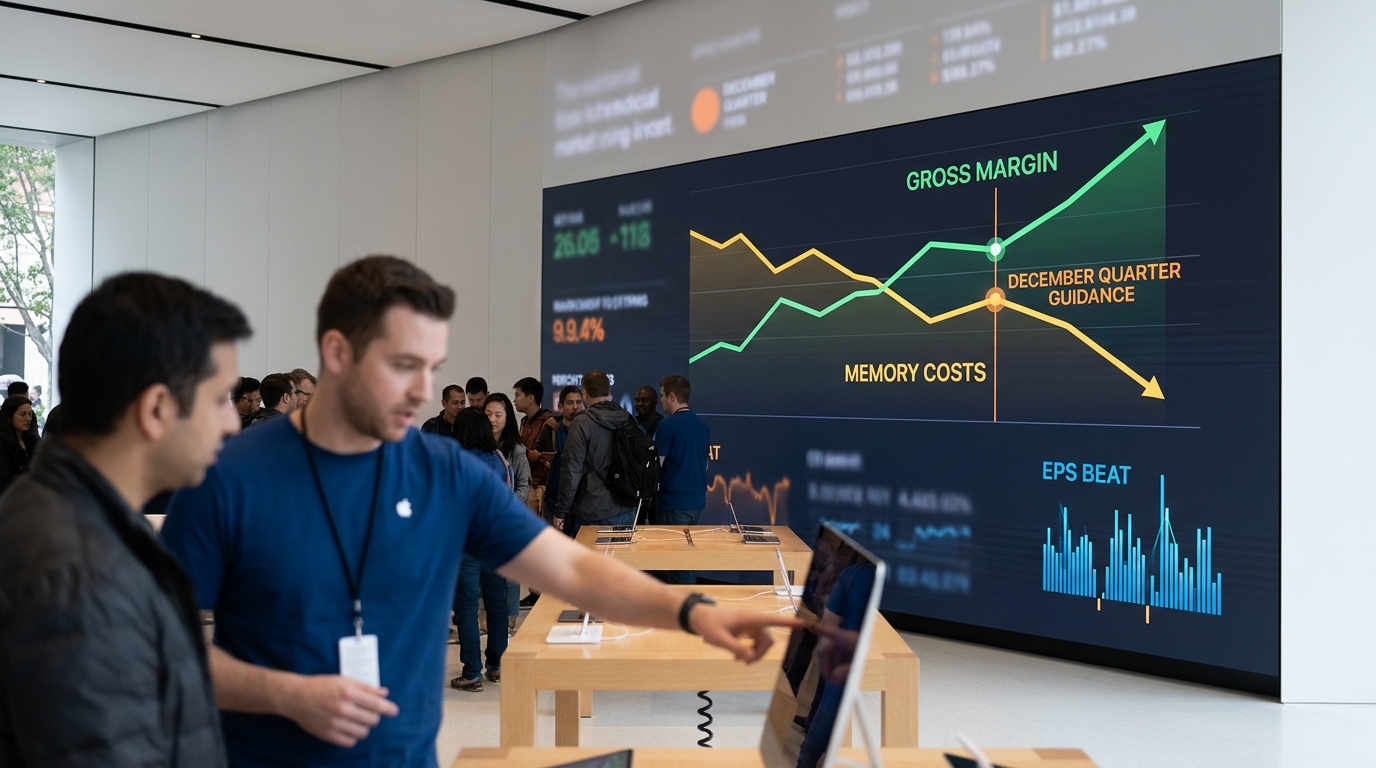
Memory costs are the driver, and management expects them to keep rising. On the last call, CFO Kevan Parekh said memory costs explained more than 100% of the sequential change in gross margin, and Tim Cook described the situation as a “hundred-year flood” in memory pricing.
Apple’s overall gross margin reached 50.1% last quarter, but approximately two percentage points came from a one-off benefit from tariff refunds. That cushion shrinks to roughly one point this quarter. Management has said memory costs continued to rise quarter-over-quarter and are expected to rise further, partially offset by prior inventory gains and declines in non-memory material costs, but those inventory gains should fade after the September quarter.
The December-quarter gross margin guidance is where the whole debate concentrates. Goldman’s analysis puts December-quarter gross margin at 46.8%, below consensus. Guidance above 47% would indicate pricing pass-through running ahead of memory costs, while 46% or lower would indicate that cost pressure remains unoffset even in the quarter where pricing is fully reflected.
The suppliers setting Apple’s cost floor are under their own pressure. SK Hynix and Samsung saw record profits fail to support their share prices as Chinese memory competition spooked markets.
The iPhone Duo Factor
The quarter contains nine days of iPhone 18 Pro sales and zero iPhone Duo. The new Pro models went on sale September 18 against a September 26 quarter end, while the Duo went on sale October 23, landing in FY2027 Q1. Wall Street is looking for roughly $153.5 billion in holiday-quarter revenue.
Early demand for the $1,999 Duo has reportedly been strong enough to push some delivery dates into late January, which could support pricing but also shift some potential December-quarter revenue into 2027. Morgan Stanley expects only low to mid-single-digit growth for the December quarter and anticipates that Apple’s outlook for iPhone sales and margins will fall slightly short of expectations.
Forward Scenarios
Bull
September gross margin lands at 48% or above, and December guidance points to revenue at or above $153 billion with commentary suggesting memory costs are peaking. Ternus conveys a credible AI monetization path for Siri. AAPL re-tests its 52-week high of $351.73 and moves toward the $370–$380 targets held by Bernstein and Bank of America.
Base
EPS meets the $1.99 consensus, September gross margin settles near 47.5% at the midpoint of guidance, and December guidance comes in near Street consensus at roughly $153 billion. Ternus reads as competent but cautious. AAPL trades flat to down modestly, consistent with its average decline of 1.16% on the day after its prior nine consecutive EPS beats.
Bear
A sell case builds if December-quarter guidance falls short of the $2.90 EPS estimate, or if memory costs push margins below the current range. A hostile macro backdrop, with the Nasdaq already in correction, amplifies any guidance miss. The main risk is a reset: shares fell nearly 10% on July 31 after the last soft outlook.
Technical Overlay
AAPL trades 1.8% below its 52-week high of $351.73. With the Nasdaq in correction, the stock enters Monday without index tailwind for the first time this earnings cycle. The first meaningful support zone sits near $339–$340, where several scenario analyses have clustered downside targets. A gap below that level on a guidance miss would leave the stock testing the $320s before the next identifiable floor.
What Investors Should Watch
- December-quarter gross margin guidance: above 47% is constructive; below 46.5% is a problem
- Ternus’s tone on memory costs and whether any relief is visible beyond Q1 2027
- December-quarter revenue guidance vs. the ~$153.5 billion consensus
- iPhone Duo supply commentary and whether delivery delays shift revenue recognition into spring
- How the guidance language is worded: this is Ternus’s first earnings call as CEO, and whether the guidance framework retains the prior approach for describing supply and product timing is itself information.
Bottom Line
The September quarter will almost certainly show an EPS beat. That is not the question. The question is what Ternus tells the market about gross margins in a December quarter where tariff refund tailwinds fade, memory costs keep climbing, and the Duo’s supply caps how much of its $1,999 price tag shows up before January. A cautious holiday outlook, as Morgan Stanley and JP Morgan consider possible, would have a greater impact than a strong September quarter. A new CEO’s first guidance number carries more weight than usual, and this one lands into a market that just told every other mega-cap it is done paying for uncertainty.