September 21, 2026
A Friday cut to a 1% margin and Monday protests across the auto sector show how deep Germany’s crisis has become.
Volkswagen’s Frankfurt-listed shares closed Friday down about 5.6%, leaving the stock more than 25% below its 52-week high. The selloff followed a late-Friday profit warning that undercut confidence in full-year guidance and dragged other European autos lower with it. This morning, tens of thousands of workers across Germany responded not with silence but with marching orders.
THE STARLINK OF ENERGY
This little-known stock could benefit from a major government catalyst this August
A single “Energy Cube” can be delivered by truck… dropped next to a data center, military base, or industrial site… and provide reliable electricity for decades.
Think of it as the “Starlink of Energy.” A government milestone expected this August could shine a spotlight on one little-known company at the center of the Energy Cube story.
Volkswagen revised its profit outlook for the year, projecting an operating return on sales of no more than 1%, down from an earlier estimate of 4% to 5.5%. Analysts had been modelling a margin closer to the prior range. The gap between what the market assumed and what management disclosed is not a rounding error. It is a structural confession.
The Numbers
- Operating margin guidance: Up to 1% for 2026, versus prior guidance of 4.0% to 5.5%
- Revenue: Full-year revenue expected to fall to approximately €315 billion, from €321.9 billion in 2025
- Total charges: VW expects around €10 billion ($11.5 billion) in charges this year, including restructuring costs associated with workforce reductions and writedowns on Chinese assets
- Porsche impairment: The total includes a €6 billion writedown related to Porsche, reflecting revised long-term expectations for the sports-car maker
- H1 operating profit: First-half revenue stood at €158.1 billion, while operating profit fell 11.6% to €5.9 billion, an operating margin of 3.8%, already below the low end of the company’s prior full-year guidance range
Why VWAGY Is Moving
Friday’s announcement marks the second time this year Volkswagen has lowered its 2026 outlook. In July, the company trimmed its sales revenue outlook while still maintaining its operating margin guidance of 4% to 5.5%. That guidance has now been abandoned entirely.
The Porsche writedown is the single largest line item, but it is not a standalone event. Porsche has been hit by U.S. tariffs and weakening demand for foreign luxury brands in China, a brutal combination for a division that posted a group operating return on sales of 1.1% in 2025. Volkswagen indirectly holds 75.4% of Porsche AG’s share capital, so the impairment flows directly into group results. Porsche historically helped support group profitability through high prices and strong margins. Its weakening performance makes Volkswagen more dependent on mass-market brands that already face intense price competition.
America’s Energy Armageddon
The expert Barron’s describes as visionary premieres a global “shockumentary”
Discover how woke progressives played politics with the energy grid as part of a potential plot to “blackout” the U.S. economy in 2026…
See firsthand who’s being set up to prosper and who could be wiped out (FREE to stream!)
VW warned of a further deterioration in the market environment, especially in China, as well as an accelerated shift in demand in favour of battery-electric vehicles, noting this would lead to lower expectations specifically for the Audi and Volkswagen passenger car brands. Profit margins on electric models are generally lower than those of comparable gasoline-powered vehicles, and the rapid shift in the sales mix toward EVs is eroding overall profitability while cost-reduction measures implemented in Germany have yet to be fully realized.
The Walkout
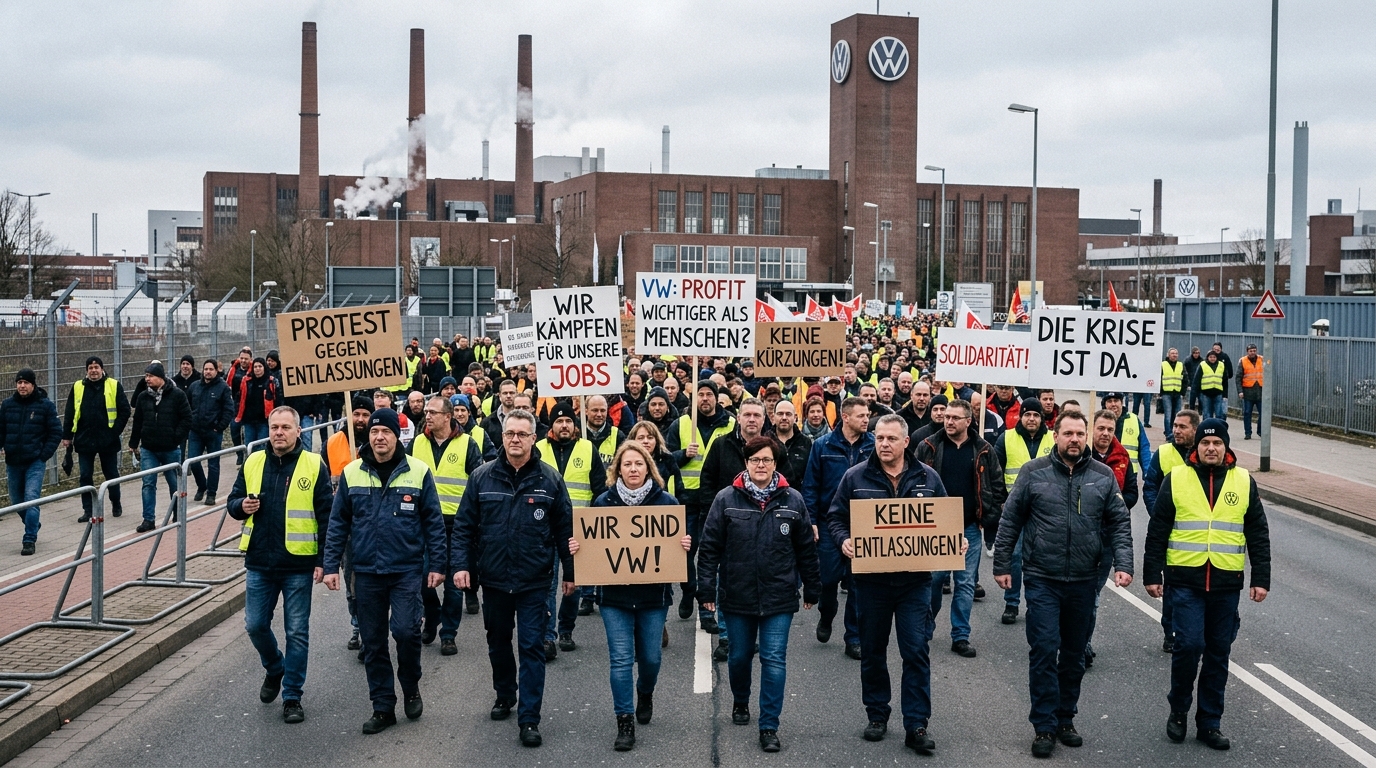
Employees at VW, as well as Mercedes-Benz Group, BMW, Audi, Porsche and major suppliers, are taking part in demonstrations at more than 280 events nationwide. IG Metall has said tens of thousands of workers are expected. The powerful IG Metall union is pressing companies to protect plants and jobs while urging Chancellor Friedrich Merz’s government to lower energy costs and shield domestic production from low-cost imports.
The protests arrive after VW’s management and IG Metall struck a major restructuring deal in late 2024, the so-called “Zukunft Volkswagen” agreement. VW’s management made a significant compromise ensuring no plants would close, while VW agreed to reduce capacity at its German plants by about 734,000 units and cut more than 35,000 jobs at German locations by 2030 in a “socially responsible” manner. That deal is now being stress-tested. The impairments, flanked by Friday’s profit warning, came two weeks after Reuters reported that Volkswagen’s supervisory board approved a transformation plan that includes cutting another 50,000 jobs, simplifying the group’s structure and leaving open the possibility of ending auto production at some German plants.
Forward Scenarios
Bull: The €10 billion charge proves to be a kitchen-sink moment. Management clears every impairment in 2026, enters 2027 with a cleaner balance sheet, and the 2024 labour deal’s over €4 billion in annual cost savings begin to show in margins. VWAGY’s price-to-sales ratio of 0.12x offers meaningful recovery potential if operating income stabilises above 3%.
Nuclear Energy’s Comeback Could Spark Before 2026
Global energy demand is surging and one overlooked power source is quietly returning to the spotlight. New policy support and supply constraints are setting the stage for a surprising shift in the energy markets.
Base: Labour and management reach a framework this quarter that holds existing plant commitments but accepts slower-than-planned headcount reduction. Margins recover to 2.5% to 3.0% in 2027 as China stabilises, but Porsche’s luxury volume remains impaired by U.S. tariffs, capping premium brand earnings for at least two years.
Bear: IG Metall escalates industrial action as the current peace obligation approaches expiry, and a protracted dispute delays German restructuring into 2027. Finance chief Arno Antlitz has pointed to a sharply weaker China market, Asian manufacturers gaining ground in Europe, and growing EV sales carrying thinner margins. If all three trends accelerate simultaneously, a second consecutive year at or near 1% margins forces asset sales.
What Investors Should Watch
- Whether today’s protests produce a formal renegotiation demand or remain symbolic pressure ahead of Q4 labour talks
- Porsche AG’s next quarterly margin disclosure, which will confirm whether the €6 billion writedown fully captured the mid-term damage
- China sales volume through October: Volkswagen has flagged severe pressure in China, and further deterioration would invalidate the base scenario
- Analyst target revisions at European banks, most of which still carry models built on the now-discarded 4% to 5.5% guidance
Bottom Line
The 1% margin is not the story. The story is that Volkswagen’s two most important earnings pillars, Porsche’s luxury premium and China volume, have cracked at the same time. What determines the next move in VWAGY is not today’s protests. It is whether management can demonstrate, before labour tensions intensify, that the cost cuts are real and the China floor is in. Until that evidence arrives, the discount in the shares is not an opportunity. It is a question mark.