
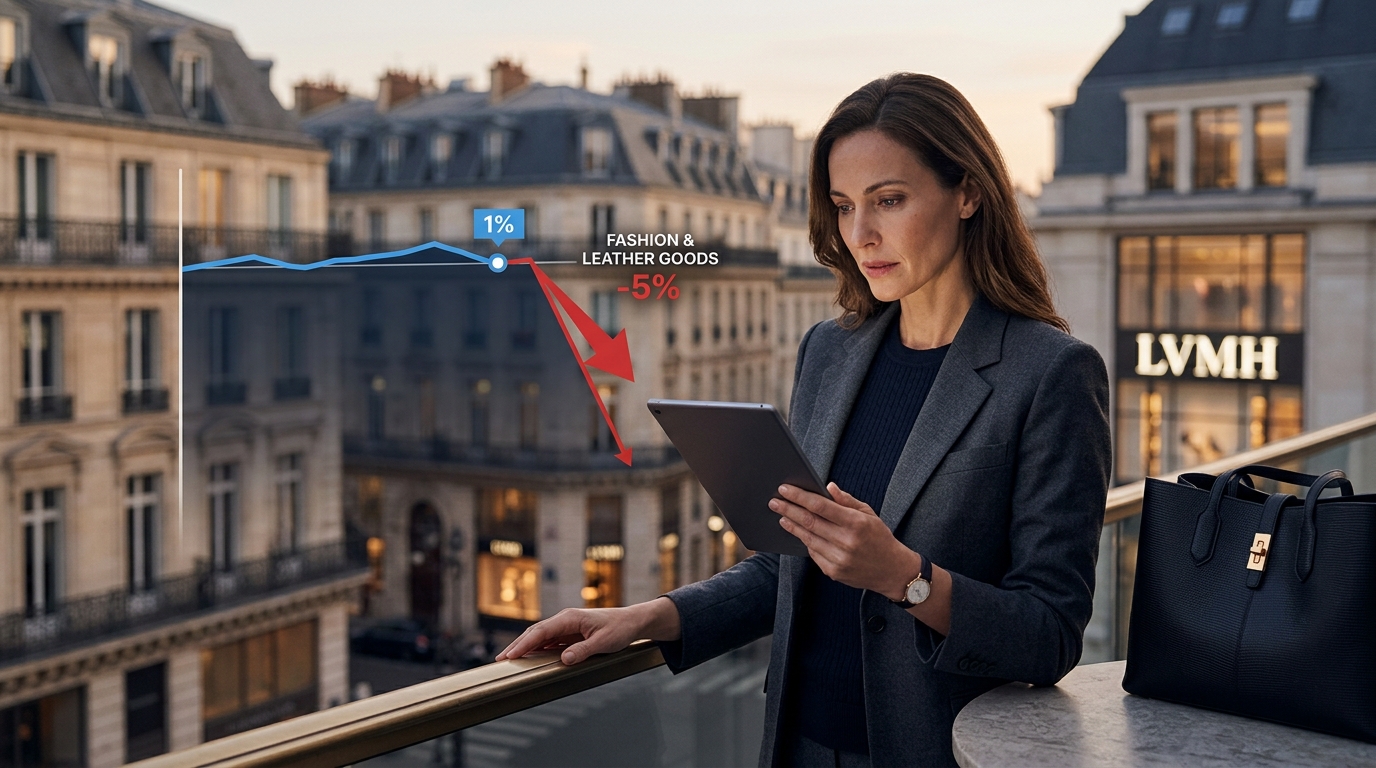
The group number is the least important figure in LVMH’s Q3 release. Total organic revenue rose 1% to €18.5 billion, broadly in line with what the market expected. Stop there and the quarter looks manageable. Go one level deeper and the picture changes sharply.
Fashion and leather goods, the division that generates the vast majority of LVMH’s operating profit, posted a 5% organic decline in the three months to September 30. Consensus had pencilled in a drop of roughly 1.8%. The miss was not close.
The Divisional Split
The portfolio’s breadth kept the group in the black, but the offsets carry far less margin weight than the division they were covering for:
- Fashion & Leather Goods: -5% organic in Q3; -2% for nine months. Revenue of €26.4 billion year-to-date, down from €27.6 billion a year earlier.
- Watches & Jewelry: +6% organic in Q3; +8% for nine months. Revenue reached €7.7 billion, driven by strong jewellery performance at Bvlgari, Chaumet, and Tiffany.
- Selective Retailing: +8% organic in Q3; +6% for nine months. Sephora continued to gain share, entering Belgium and Croatia.
- Perfumes & Cosmetics: flat organically for nine months.
Nine-month group revenue reached €57.1 billion, up 2% on an organic basis but down 2% on a reported basis, with currency headwinds of 3% and a perimeter drag from asset sales including DFS and the Marc Jacobs brand.
Watches and jewellery at 8% organic growth over nine months sounds encouraging. But that division’s operating margin sits far below fashion and leather goods, which anchors the group’s profit generation. A percentage point of growth at Louis Vuitton is simply not interchangeable with a percentage point at Sephora.
Why the Fashion Division Fell This Hard
Two forces compounded each other in China during the quarter. Analysts had revised down their expectations in recent weeks in light of a Chinese tax crackdown on wealthy individuals and the fallout of Louis Vuitton’s trademark dispute with Chinese tea chain Molly, which sparked a nationalistic backlash.
Louis Vuitton won its trademark case against Molly Tea in late June 2026, and the win may be costing more than a loss ever would have. The Suzhou Intermediate People’s Court ruled in LV’s favour and ordered Molly Tea to pay about 10.3 million yuan (roughly $1.5 million) in damages. The verdict went viral. Chinese consumers, angry that the world’s biggest luxury company would take a much smaller merchant to court, pushed back hard. The reputational damage landed at the worst possible moment for a brand already navigating softening Chinese luxury demand.
Management also cited a one-off logistic and transportation disruption at Louis Vuitton that cost more than one percentage point of growth in the quarter, adding an operational hit on top of the demand-side pressure.
The group said Asia (excluding Japan) declined 5% in Q3, with Chinese demand down in the mid-teens. The US maintained its momentum with organic revenues rising 5%, while Europe saw an acceleration, with revenues increasing 4% in the third quarter. Those are real positives. They are not large enough to compensate for a mid-teen slide in China across the group’s most profitable product category.
China’s demand problem is not unique to luxury goods. BMW’s China deliveries fell more than 20% in the first half of 2026, a collapse no restructuring plan can fix on its own.
The Broader Context
China’s tax crackdown on wealthy individuals has become the latest headache for luxury brands, already grappling with the fallout from the Iran war and signs of slowing consumer spending in the United States.
The stock extended its losses on Tuesday. In Paris, LVMH was up about 0.5% in early trading on October 13, 2026, at roughly €386. The consensus analyst target sits near €519, implying the market believes the discount has gone too far. That call depends entirely on when China stabilises.
Bull / Base / Bear
Bull: China demand recovers in Q4 as the Molly backlash fades, the logistics disruption at Vuitton proves truly one-off, and US momentum holds. Fashion and leather goods returns to low single-digit organic growth in H1 2027, margin recovers, and the stock re-rates off a 17x multiple toward historical norms.
Base: China remains subdued through early 2027. The group posts roughly flat organic growth in fashion and leather goods for the full year. Watches, jewellery, and Sephora provide cover but cannot restore group margins to 2023 levels. The stock grinds sideways near current levels.
Bear: The Molly backlash proves structural, Chinese consumers accelerate a rotation toward domestic luxury brands, and the US softens. Fashion and leather goods declines 6-8% organically through the first half of 2027, margin compression accelerates, and the stock tests multi-year lows.
What to Watch
- Louis Vuitton China sales trends in October and November, the first months after the initial Molly Tea verdict.
- Hermès Q3 results for a read on whether China softness is brand-specific or sector-wide.
- Any analyst revisions to 2026 full-year profit from recurring operations, which is where the fashion division’s decline will show most clearly.
- The Molly Tea appeal outcome: a reversal could further inflame sentiment in China.
Bottom Line
RBC said Monday that the results point to a stalling in fragile recovery momentum from earlier in the year. That framing is accurate, and the division-level data supports it completely.
The US consumer has held up so far, but there are reasons to watch that closely. Elevated fuel costs have quietly compressed household budgets, leaving less for discretionary spending including apparel and luxury.
The group’s 1% organic growth rate is a portfolio average that obscures the real problem: the engine of LVMH’s profitability contracted 5% in the quarter. Watches and Sephora are performing, but they cannot replicate the economics of Louis Vuitton at full speed. Until China stabilises and the Vuitton brand rebuilds goodwill there, the earnings recovery investors were pricing in earlier this year remains on hold.