September 20, 2026
Tuesday’s fiscal Q4 report tests whether $6.49 diesel and 5% yields are eating into the repair trade.
Analyst Targets
- Citi (Steven Zaccone): Buy, price target $3,450 (lowered from $3,700 ahead of Q4)
- Consensus (27 analysts): Strong Buy, average price target ~$3,914
- Range: $3,200 low / $4,800 high
What Is at Stake Tuesday Morning
AutoZone reports fiscal Q4 results before the open on September 22, covering the 16-week quarter ended August 29. Consensus sits at roughly $54 per share on $6.71 billion in revenue. That EPS figure implies an 11% gain over the $48.71 AutoZone posted in the year-ago quarter. Revenue would represent a 7.5% year-over-year increase.
No. 1 Stock to Buy for THIS MONDAY
Heads up: Tim Bohen’s new algorithm just uncovered a dirt-cheap stock that could DOUBLE or MORE this coming Monday. This powerful algo has already identified Monday moves of 149%, 190%, and even a whopping 536%…
Click here to see how to get positioned ahead of this Monday’s setup!
The report lands in a week where the two biggest macro variables, diesel near record highs and the 10-year Treasury at 5%, are not neutral backdrop. They are active headwinds that press directly on AutoZone’s cost structure and its capital return math.
This is the first significant consumer read of the post-rate-hike week. GM just had its worst session since July 2025, falling 5.2% Friday as diesel hit record highs and yields pushed to multi-year highs. AutoZone is the other side of that trade, but the same environment that kills new-vehicle demand also raises every distribution cost in the commercial channel.
Company Profile
AutoZone operates 7,856 stores across the Americas, including 6,766 in the U.S., 933 in Mexico, and 157 in Brazil. The business splits between a DIY retail customer who walks in to buy a battery or brake pads, and a commercial Do-It-For-Me (DIFM) channel that delivers parts to independent repair shops. AutoZone does not perform repairs itself. The commercial segment has become the faster-growing and strategically more important half, driven by Mega-Hub infrastructure that places deeper inventory closer to professional customers.
The secular engine: an aging vehicle fleet. S&P Global Mobility estimates more than 110 million vehicles on U.S. roads are currently in the 6-to-14-year range, the prime window for replacement parts demand. With a 5% ten-year rate suppressing new-vehicle affordability, that cohort is not shrinking.
The Numbers
- EPS consensus: ~$54 per share (range: $51.46 to $56.97)
- Revenue consensus: $6.71 billion (range: $6.64B to $6.84B)
- Year-over-year EPS growth implied: ~11% from $48.71
- Year-over-year revenue growth implied: ~7.5% from $6.24B
- Q3 FY26 domestic same-store sales: +4.1% (commercial +10.4%, DIY +2.2%)
- Q3 FY26 DIY traffic count: down 3.6%
- Q4 headwind flagged by management: ~$30 million non-cash LIFO impact to EBIT, with management indicating an approximate ~$1.40 headwind to EPS
- Buyback authorization (cumulative): $42.2 billion since 1998; $1.5 billion added June 2026
In Q3, AutoZone earned $38.07 per share. Revenue came in at $4.84 billion, and the stock fell about 9% that day after investors focused on the revenue miss and margin pressure. The bar on revenue precision is set high going into Tuesday.
These 7 Stocks Will Be Magnificent in the rest of 2026
Every market cycle creates a small group of stocks that end up doing most of the work.
The surprise is never that they succeeded – it’s how early their trajectory was visible.
Our analysts believe the next group of leaders is already taking shape, just outside the spotlight.
In These 7 Stocks Will Be Magnificent in the rest of 2026, we highlight companies with expanding cash flows, growing market share, and the characteristics that often precede long-term leadership.
Why Tuesday’s Report Is More Complicated Than the Headline
The bull case on AZO is simple and structural: households keep older cars on the road longer when rates make financing a new one painful. The 10-year at 5%, the highest level since 2007, is the most direct driver of that dynamic. Every month that auto loan rates stay elevated is another month a marginal buyer repairs instead of replaces.
But the same environment creates two specific pressures on AutoZone’s own operations that Tuesday’s call must address directly.
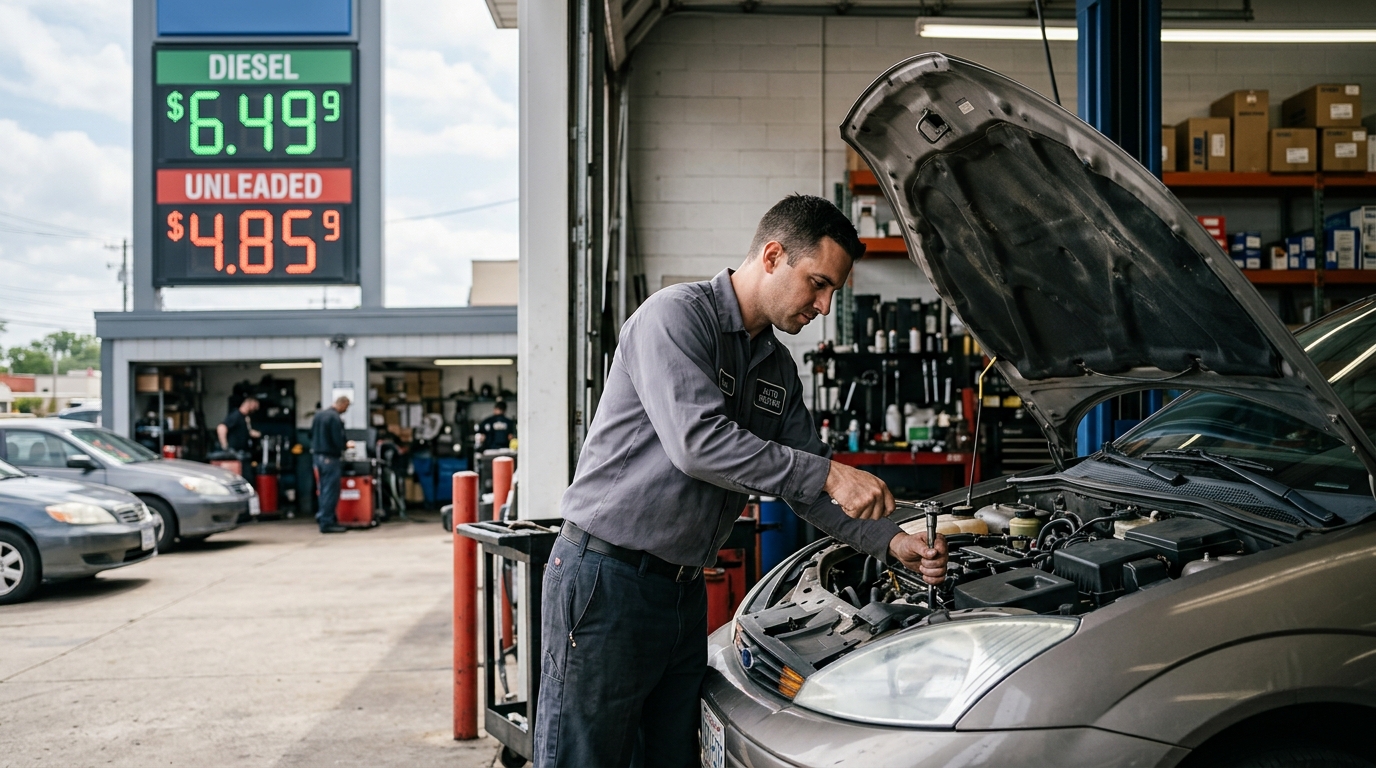
First, diesel. AAA shows the national average diesel price hit $6.4866 a gallon on September 19, 2026. AutoZone’s commercial segment depends on a fleet of delivery vehicles running parts to repair shops. Distribution cost inflation at that magnitude erodes the margin on every DIFM order, precisely the segment that has been carrying the company’s growth. In Q3, commercial sales rose 10.4%, but gross margin already came under pressure from LIFO dynamics. Diesel compounds that on the operating line.
Second, the buyback cost. AutoZone’s EPS growth story leans heavily on share count reduction. The company repurchased $586.3 million of stock in Q3 alone. With the 10-year at 5%, the opportunity cost of debt-funded buybacks has risen materially. Management will need to show that free cash flow generation still supports the capital return pace without straining the investment-grade credit ratings the company has emphasized as a constraint.
Macro and Industry Context
The Federal Reserve resumed hiking September 16, lifting its benchmark rate by 25 basis points to 3.75%-4% for the first time since July 2023. In its quarterly projections, the Fed also signaled another hike later this year. That policy shift, combined with a 10-year yield that briefly touched 5.04% this week, raises borrowing costs for every participant in the automotive supply chain.
AutoZone’s peer O’Reilly Automotive (ORLY) faces the same operating environment. Advance Auto Parts (AAP) has struggled more severely with margin compression. Genuine Parts (GPC) has a broader industrial mix that buffers some of the exposure. The September 22 report from AutoZone sets the sector tone before those companies report their own quarters.
7 AI Stocks to Invest in Today
AI is fueling the Fourth Industrial Revolution – and these 7 stocks are front and center. One of them makes $40K accelerator chips with a full-stack platform that all but guarantees wide adoption. Another powers the . From core infrastructure to automation leaders, these companies and other leaders are all in 7 AI Stocks to Invest in Today.
Forward Scenarios
Bull
Commercial same-store sales sustain above 8%, management shows diesel-related distribution costs are manageable or largely offset by pricing, and the LIFO drag comes in at or below the ~$30 million flagged figure. EPS clears $55, the stock recovers toward analyst average targets near $3,900.
Base
Revenue meets the $6.71 billion consensus, EPS comes in near $54, and commercial growth continues to outrun DIY softness. Management acknowledges diesel pressure but provides enough confidence on Q1 FY27 trends to hold the stock near current levels. AZO remains range-bound while the macro resolves.
Bear
Revenue misses consensus again, while gross margin contracts more than expected from the combined effect of the LIFO impact and diesel-driven distribution cost inflation. DIY traffic continues to erode, the commercial growth rate decelerates, and management offers no guidance clarity on the cost trajectory. The Q3 selloff of about 9% becomes the template.
Technical Overlay
AZO has declined roughly 23% over the past 52 weeks, underperforming the S&P 500 by nearly 40 percentage points on a relative basis. The stock is well below its prior highs, with gap support from the May selloff near the $2,984 level. Resistance sits between $3,100 and $3,200, the zone that marked the post-Q3 recovery ceiling. A clean beat would need to clear that shelf to attract momentum buying. The 50-day and 200-day moving averages both slope downward, meaning the chart does not offer cover for a modest beat.
What Investors Should Watch
- Commercial (DIFM) same-store sales growth: anything below 7% would represent a meaningful deceleration
- Gross margin: how much of the LIFO impact was offset by other improvements
- Distribution cost commentary: explicit language on diesel’s impact to the DIFM delivery margin
- Buyback pace in Q4: share count reduction relative to prior quarters
- Management’s Q1 FY27 outlook: whether ticket growth and commercial momentum survive a 5% rate environment
Bottom Line
The AutoZone structural thesis, older cars, stretched consumers, repair-not-replace behavior, is stronger today than it has been in a decade. A 5% ten-year and record-high diesel prices are doing more to extend vehicle lives than any analyst model could have assumed at the start of fiscal 2026. The question Tuesday is not whether the demand is there. It is whether AutoZone can deliver the earnings that demand should produce without surrendering too much margin to the same energy and rate shock that is driving customers through its doors.