
Below is an important message from one of our highly valued sponsors. Please read it carefully as they have some special information to share with you.
Dear Reader,
When this man warned of the 2008 crisis two years before it ever happened…
The CIA began circulating his warning among its senior staff.
And his full thesis was so in depth that it appeared in the CIA journal “Studies in Intelligence”.
That information remains classified to this day.
Even still, in 2016 when he went on national television to predict the election of Donald Trump…
Most people tried to dismiss him saying that “Hillary is ahead in every poll”…
But events shaped up just the way he said.
Then in 2019, a full 4 months before the coronavirus hit..
He said that a global pandemic could be the cause of the next financial crisis…and that a crisis of this proportion would happen with “near 100% certainty” within the next few years…
Most people thought he finally lost it.
But we all know what happened next…the world was nearly brought to its knees by this “unforeseen” event.
Now this former advisor to the CIA and the Pentagon is issuing a shocking new warning.
One that has to do with the brewing bubble in AI – and an event set to take place just DAYS from now.
If you have money in the markets, or wealth to protect, then you need to heed his warning.
Because once this crisis hits…it will already be too late.
>>> Click Here to See His New Warning <<<
Regards,
Matt Insley
Publisher, Paradigm Press
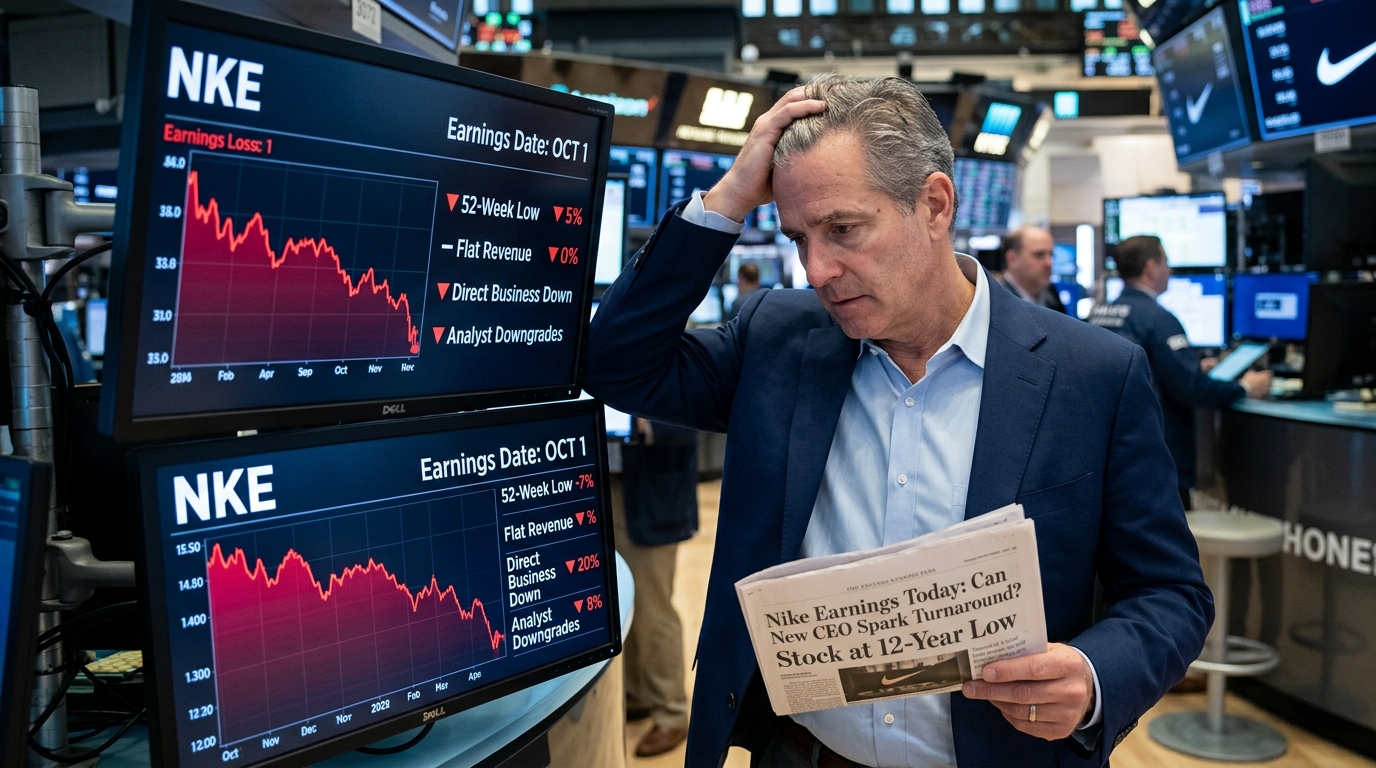
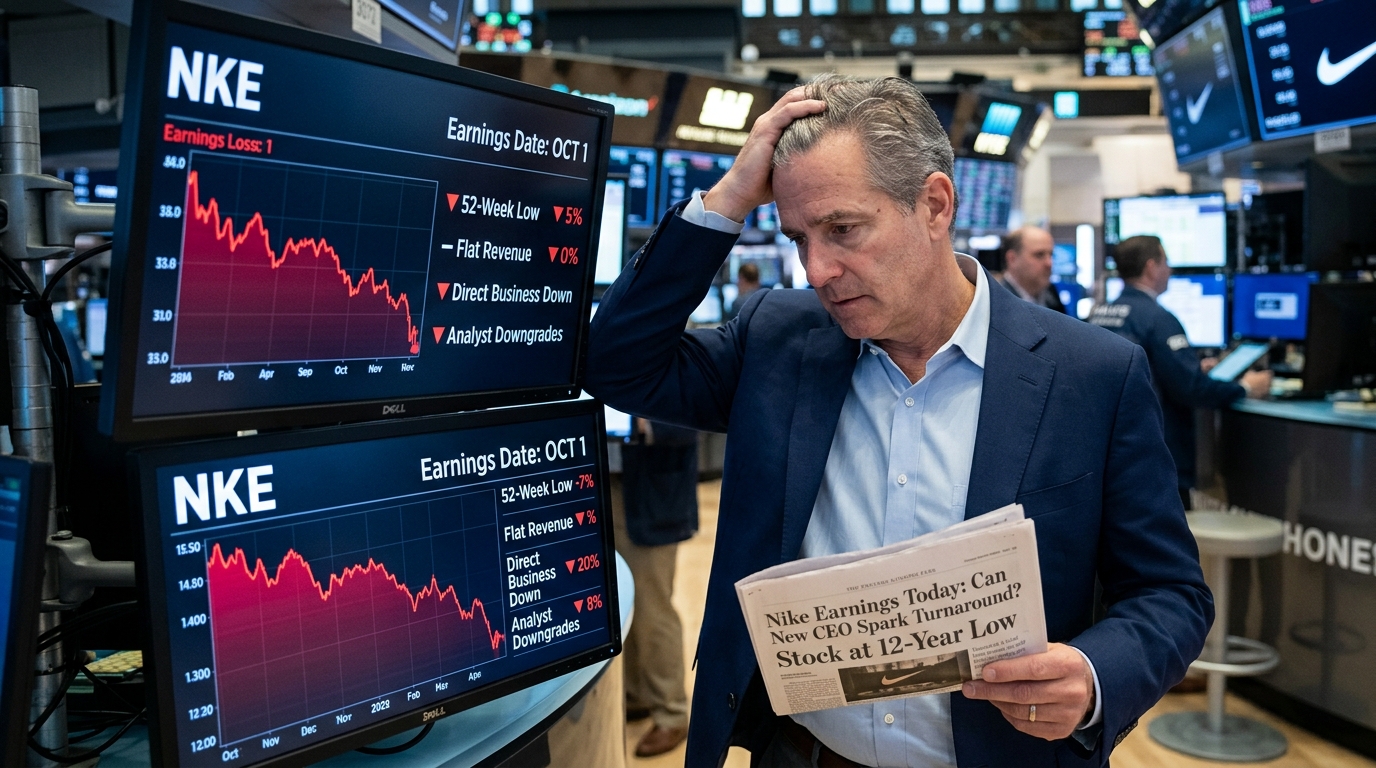
Nike Heads Into Oct. 1 Earnings at a 12-Year Low. What Has to Change.
Analyst Targets
- Morgan Stanley , Underweight, $31 target (reinstated Sept. 11)
- BMO Capital , Underperform, $30 target (initiated Sept. 8)
- Robert W. Baird , Neutral (downgraded from Outperform), $44 target (Sept. 14)
- Citigroup , Neutral, $39 target, cut from $45 (Sept. 15)
- UBS , cut to $42 from $48 (Sept. 16), expects Q1 FY2027 EPS to miss consensus by $0.05
- Telsey Advisory , Market Perform, $44 target, cut from $47 (Sept. 15)
- Needham , Buy, $75 target (the outlier on the street)
Where Things Stand
Nike closed Friday at $35.51, down 2.34% on the session, sitting at a 12-year low. The stock has now shed roughly 80% from its November 2021 all-time high of $179.10. On Monday, September 21, it drops out of the S&P 100 after an 18-year run, replaced by Palo Alto Networks in a quarterly rebalance that, symbolically or not, captures what has happened to this company’s standing in American markets.
The yield tells the same story from a different angle. At current prices, Nike pays about a 4.62% forward yield on its $1.64 annual dividend. That is not a signal of income strength. It is a function of price compression, and the payout ratio is now approaching 78%.
The Fiscal 2026 Numbers
Full-year revenue came in at $46.4 billion, flat on a reported basis and down 2% in currency-neutral terms. Net income fell 3% to $3.1 billion, with diluted EPS of $2.10. Strip out the one-time $986 million benefit tied to the recovery of IEEPA tariffs following a Supreme Court ruling, and underlying full-year EPS lands closer to $1.58.
The internal split is where the damage is concentrated:
- Nike Direct revenues fell 6% to $17.7 billion; Nike Digital down 12%
- Wholesale revenues rose 6% to $27.5 billion
- Greater China full-year revenue fell 11% year over year, with Q4 down 17% on a constant-currency basis
- Inventories flat at $7.5 billion, with units up but mix shifting
The direct-to-consumer retrenchment is intentional. CEO Elliott Hill has been rebuilding wholesale relationships and redirecting resources toward performance sports and product innovation. The wholesale recovery is real. What is not yet credible to the market is whether the DTC pullback can be offset quickly enough, or whether China stabilizes before it becomes a structural problem.
Why the Stock Keeps Falling
The broker cuts this month tell a consistent story. UBS flagged that it expects Q1 FY2027 EPS to come in $0.05 below consensus, and implied Q2 guidance of $0.31 to $0.43 against a Street expectation of $0.53. Morgan Stanley’s $31 target reflects the view that consensus still embeds too much growth too soon, particularly in China. The sector backdrop has made things worse: the S&P 500 Consumer Discretionary sector is down about 4% month-to-date in September, and Lululemon’s third guidance cut of the year and an 8-year share-price low arrived in the same window, reinforcing the read-through on discretionary apparel demand broadly.
The October 1 Report: What Street Expects
Consensus for Q1 FY2027 sits at roughly $11.37 billion in revenue and $0.45 in EPS. That compares to Q1 FY2026, when Nike posted $11.7 billion in revenue and $0.49 EPS, a quarter that beat expectations and briefly lifted the stock before guidance reset expectations lower. Management guided that revenue would be down low-to-mid single digits in the first half of fiscal 2027, with Q1 expected to be down low-to-mid single digits, and said gross margin in Q1 should be slightly positive.
Bull, Base, and Bear
Bull: Q1 revenue lands above $11.5 billion, gross margin expands as the tariff lap comes through, and Hill signals that China destocking is nearer its end. North America wholesale keeps growing. The stock is cheap enough on normalized earnings that any forward credibility could produce a sharp re-rating.
Base: Nike meets a soft consensus but offers no material positive revision to H2 FY2027 guidance. China stays negative, Direct continues to shrink, and the stock grinds sideways in a $34 to $40 band ahead of an investor day later this year.
Bear: UBS is right. Q1 misses, Q2 guidance comes in at the low end of the implied range, and Morgan Stanley’s $31 target looks conservative rather than extreme. The dividend yield climbs past 5%, but with a roughly 78% payout ratio, the sustainability question replaces the value question.
Technical Overlay
NKE trades below both its 50-day and 200-day simple moving averages with no nearby support level of consequence. The 52-week low of $37.95 set on September 3 was broken again on September 15 and has not been reclaimed. The October 1 report is the next identifiable catalyst for any gap fill toward the $40 to $42 range, where Telsey and UBS sit with their reduced targets. To the downside, $31 is not just a Morgan Stanley call: it is the only structural reference point in a zone of air.
What Investors Should Watch on October 1
- China revenue trajectory and any language on when destocking ends
- Gross margin: does it expand sequentially now that the tariff comparison softens?
- Nike Direct versus wholesale split , is the shift stabilizing or still deteriorating?
- FY2027 H2 guidance tone: any hint of a return to growth or continued negative commentary
- Sportswear category: still roughly half of Nike’s revenue base and still declining double digits
Bottom Line
The yield, the index removal, the broker cuts, these are consequences, not causes. The cause is a business that has not yet demonstrated it can grow again after a multi-year strategic reset. Elliott Hill’s plan has a defensible logic: rebuild wholesale, cut excess inventory, refocus on performance sports. Wholesale revenue is up 6%. North America is growing. The mechanics are moving in the right direction. What is missing is the timeline.
October 1 will not resolve that debate in a single quarter. But it will tell investors whether the gross margin inflection that management has been guiding toward is real, and whether Hill’s language on China has shifted from managing decline to anticipating stabilization. That is the only question that matters at $35.